Bitcoin May Be Closing In on a $44,000 to $47,000 Bottom Zone
Two models, including a Fibonacci analysis, put the possible bottom around $44,000 to $47,000. Spot Bitcoin ETF flows and institutional demand could help soften the drop.
Key Takeaways
- Bitcoin is back in the final 91 days of previous bear markets, a stretch that has often marked the end of the downtrend.
- A linear regression model and a logarithmic Fibonacci analysis both point to a possible bottom between $44,000 and $47,000.
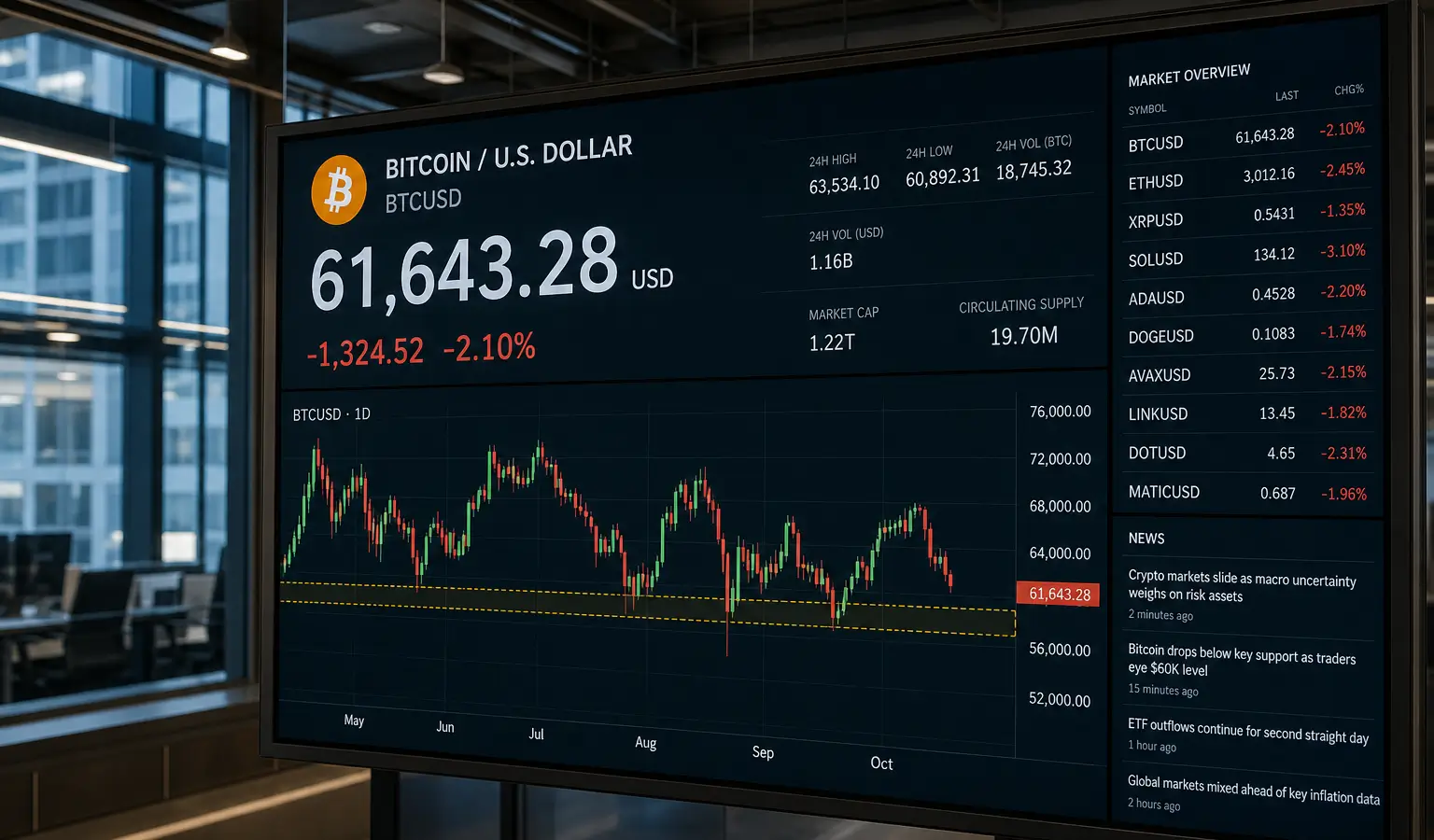
- The analysis suggests early October as a possible window, while Bitcoin trades around $62,865 and remains nearly 50 percent below its peak.
Bitcoin is once again in the 91-day stretch that has historically lined up with the end of bear markets. This time, two different models, a linear regression and a logarithmic Fibonacci analysis, both point to a potential bottom in the $44,000 (€38,500) to $47,000 (€41,100) range, with the first week of October emerging as a possible timing window.
Historically Brutal Final Stretch
Bitcoin trades around $62,865 and is still almost 50 percent below the October 2025 peak of about $126,000 (€110,200). That kind of decline fits the pattern seen in earlier bear markets, even if the size of the drawdown has generally gotten smaller over time. In the current cycle, Bitcoin has already spent 233 days in a bear market, making this one of the longest stretches since 2014 based on historical comparisons.
The study focuses on the final 91 days of three earlier bear markets. In 2014 and 2015, Bitcoin lost 63.54 percent over that period. In 2018, it fell 56.69 percent, and in 2022, the drop was 37.60 percent. By that measure, the last bear market was the mildest on record from the all-time high of $124,773 (€109,100), even though the correction was still severe.
That smaller damage is not random. Bitcoin is far larger and more liquid now than it was in its early years, and spot Bitcoin ETFs, deeper derivatives markets, and a wider institutional investor base can absorb selling more easily. The four-year halving cycle also still matters in these comparisons, although some market watchers are starting to question how reliable that rhythm remains.
Models Point to the Same Zone
The first model is a linear regression built from the three earlier drawdowns. It points to an expected final decline of about 26.6 percent, which would put the bottom near $47,431 (€41,500) based on the recent peak of $64,657 (€56,500). That is not a certainty, but it does suggest there may still be room for more downside.
The second model uses a logarithmic Fibonacci retracement. On that scale, the 0.5 level of the current cycle sits at $44,428 (€38,900), while the 0.382 level comes in at around $56,849 (€49,700). The regression result and the log-Fibonacci midpoint land unusually close together, which makes the $44,000 (€38,500) to $47,000 (€41,100) area look especially important.
The broader market backdrop also supports that view. During the June sell-off, whales kept buying according to the analysis, while ETF flows first showed billions in outflows before turning positive again in early July. Depending on how long that trend lasts, moves like that can either cushion downside pressure or add to it.
Why This Matters for Europe
For European crypto investors, the main point is that Bitcoin is being shaped more and more by institutional flows rather than just trading on crypto exchanges. If this cycle really does end with a milder bottom, it could be another sign that the market is maturing. Even so, the analysis also shows that sharp corrections are still very much on the table, especially if macro pressure or ETF outflows return.
Over the next few weeks, the key question is whether Bitcoin can hold above the $56,849 (€49,700) area or keep drifting toward the lower Fibonacci levels. A clean break below $44,000 (€38,500) would weaken the historical comparison, while a bounce from that zone would make the case for a repeat of earlier bear-market patterns stronger.
The latest weakness also lines up with Glassnode's on-chain analysis, which says Bitcoin is in a late bear-market phase but has not yet confirmed a lasting recovery.