Bitcoin Shows Timing Is Almost Impossible
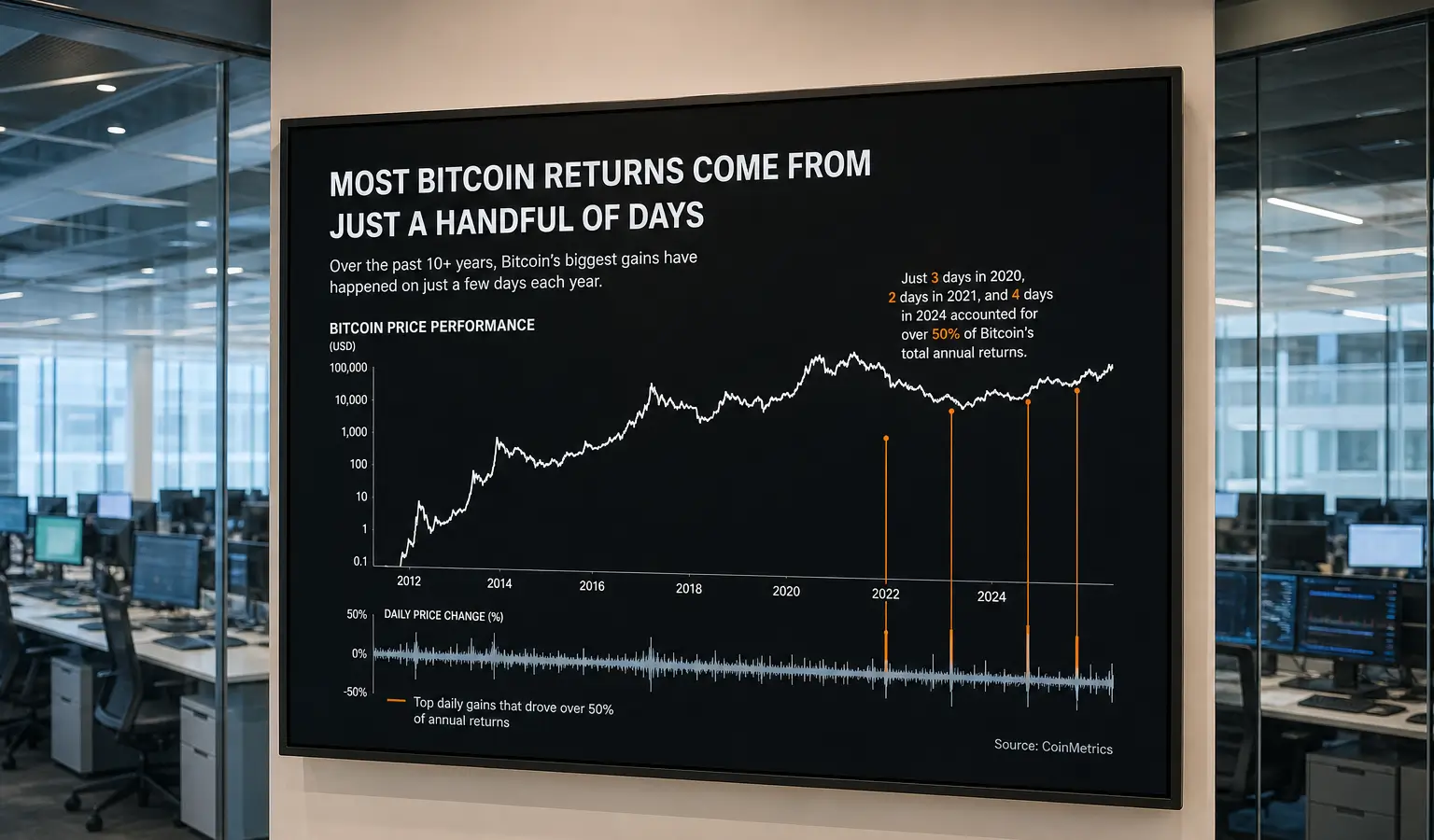
Historical data from Bitwise Europe shows that just a few trading days often decide the yearly result. Timing remains tough in a 24/7 market, especially for ETFs and professional traders.
Key Takeaways
- Historical data shows that Bitcoin often earns a big chunk of its yearly return in just a few days.
- Missing the best trading days can quickly turn a winning year into a losing one.
- For European firms, liquidity and execution remain important because the market is open 24/7, but institutional trading mostly happens during U.S. sessions.
Bitcoin trades 24 hours a day, seven days a week, but according to a new historical analysis, most of its yearly performance often comes from a handful of days. That makes active timing difficult for traders and fund managers, while buy-and-hold is often easier than trying to catch every price move, according to several market participants.
Just a Few Days Matter
In 2026, Bitcoin was trading about 9% lower, a setback but not a disaster. Without the five best days of that year, however, the coin would be down 36%. Andre Dragosch, head of research at Bitwise Europe, says that is typical for Bitcoin. In his view, Bitcoin is often a relatively boring asset, where most of the performance comes in a few days and the price mostly moves sideways the rest of the time.
That concentration is not new. Since the early years, when Bitcoin was still trading for just a few cents in 2010, historical data shows that a small number of trading days often makes the difference between profit and loss. In 11 of the last 18 years, simply removing the 10 best days was enough to turn a positive year into a losing one.
In 2019, Bitcoin still ended the year up 94%. Take out the 10 best days, and that turns into a 40% drop. In 2011, the effect was even more extreme: a yearly gain of 1,474% fell back to 2.2% once the 10 best days were removed.
Timing Remains Tough
For investors, that mainly means a few missed days can make a huge difference. Anyone trying to catch a rally a little too early or too late often misses a big part of the move. Dragosch therefore says that time in the market matters more than trying to perfectly time the market.
The risks on the other side also matter. According to the historical data, the chance of still being underwater after a longer holding period drops sharply the longer someone stays in. After three years, that chance would fall below 1%.
Adam Haeems, head of asset management at Tesseract Group, pointed to February 2026 as a clear example. Bitcoin dropped about 14% on February 5, then rose about 12% the next day. In his view, that shows how close a big drop and a rebound can sometimes be. He also noted that it is not a given that a specific trading rule would have caught that turn.
Why This Matters for Europe
For European crypto investors, the key point is that Bitcoin can be choppy not just in price, but also in liquidity. The market is open 24/7, but institutional trading still mostly runs through U.S. weekday sessions, where liquidity is often deeper. On weekends, liquidity is thinner, which makes bigger swings and price gaps more likely.
That helps explain why large orders often go through an OTC desk and why execution matters so much for whales and professional players. Paul Howard of Wincent said crypto does trade 24/7, but the way institutions access liquidity does not. In his view, especially during fast moves, execution can decide the price at which a large order ultimately gets filled.
The analysis also fits with Bitcoin's broader maturation. The launch of futures and later spot ETFs has changed volatility over time, while the biggest daily moves have become smaller than they were in the early years. That does not make Bitcoin less volatile, but it does make it different from the early, much wilder phase of the market.
Macro factors can also speed up a move like this. When the Fed recently signaled that rates may stay unchanged for longer, Bitcoin shot sharply higher on a broad short squeeze.