Bitget Resumes Bitcoin Withdrawals After $388 Million Hack
Bitcoin withdrawals are open again as Bitget continues investigating the damage from the attack on its wallet system. Ether and USDT will follow in stages.
Key Takeaways
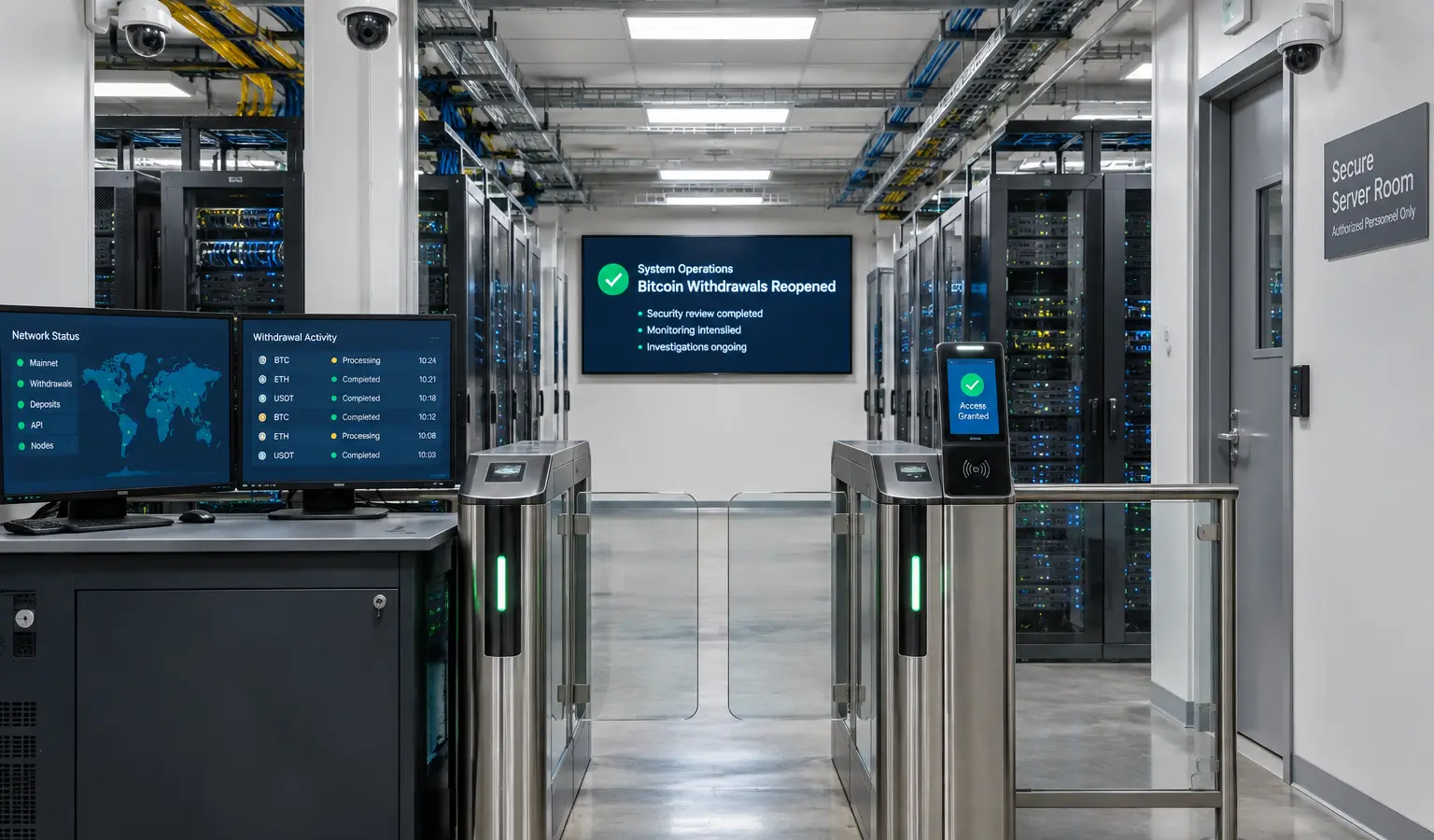
- Bitget resumed Bitcoin withdrawals on September 28 at 08:00 UTC, four days after a security breach of about $388 million.
- Ether withdrawals will follow on September 29 and USDT a day later, while the restart of other services is still underway.
- Bitget says 4,098 BTC have been withdrawn and that private keys and cold wallets were not compromised.
Bitget resumed Bitcoin withdrawals on Monday, September 28 at 08:00 UTC, four days after the crypto exchange had paused the service following a security breach of about $388 million (€341 million). The reopening is happening in stages: Ether follows on September 29 and USDT a day later. The investigation is still ongoing, along with the restart of the other services.
Phased Restart
The suspension followed unauthorized transfers from Bitget's wallet system infrastructure. After the exchange said it had the situation under control, the company chose a step-by-step restart by blockchain and by asset class. Bitcoin reopened first because the related withdrawal pipeline was not affected by the attack.
Bitget said users have withdrawn 4,098 BTC since the reopening. The exchange also reported 9,585 processed withdrawal transactions. That figure refers to the number of transactions and not to a separate bitcoin volume.
What Bitget Says
According to Bitget, no private keys were compromised in the attack. The cold wallets are said to have stayed untouched. The exchange says each blockchain and each asset is checked separately before withdrawals are reopened.
The roughly $388 million (€341 million) figure is the updated estimate of the damage. A lower preliminary number had circulated earlier. Bitget presents that revision as the result of further investigation into the attack, not as proof of new thefts. No full technical report has been published yet on the attackers' exact method.
The attack fits into a broader concern around the security of centralized crypto exchanges. In the industry, the focus is increasingly on third-party risks and on how wallet system infrastructure can be better protected. The aftermath of the hack is still visible too: THORChain refused to block the hack wallets, allowing stolen funds to keep moving through a permissionless route.
Why This Matters
For European crypto users, this shows how quickly withdrawal services can be restarted after an incident, but also how dependent customers are on an exchange's internal controls. Bitget previously said its User Protection Fund was used to absorb the damage, which has further increased attention on risk management in the sector. As long as the technical report is still missing, the main question remains how broad the impact of this breach actually was.