Bitwise Says Circle Is Undervalued as Stablecoins Grow
Rasmussen says USDC and the Circle Payments Network show stablecoins are becoming more than just a token. He argues that market growth and tighter U.S. rules could strengthen Circle’s role in infrastructure.
Key Takeaways
- Ryan Rasmussen says investors are still pricing Circle too cheaply, even as stablecoins could expand from $300 billion to $3 trillion or $5 trillion.
- He argues that Circle earns value not only from reserve income, but also from payment infrastructure, while USDC posted strong growth in circulation and volume.
- Rasmussen sees Circle’s compliance setup and Arc blockchain as key tests for whether the company can keep growing in stablecoin payments and infrastructure.
Bitwise Head of Research Ryan Rasmussen says investors are still underestimating Circle, even as stablecoins move closer to becoming a multi-trillion-dollar market. In an interview on CoinDesk’s Public Keys, he said Circle is not just benefiting from higher reserve income, but also from a second growth engine: payment infrastructure.
Stablecoins Head Toward Trillions
Rasmussen outlined a market he believes could expand from roughly $300 billion (€260 billion) to $3 trillion (€2.6 trillion) and eventually $5 trillion (€4.3 trillion). In that scenario, he sees Circle as an early leader, especially as U.S. regulation around stablecoins continues to take shape. He said the market is still not fully appreciating how well positioned Circle already is in a sector that is only beginning to scale.
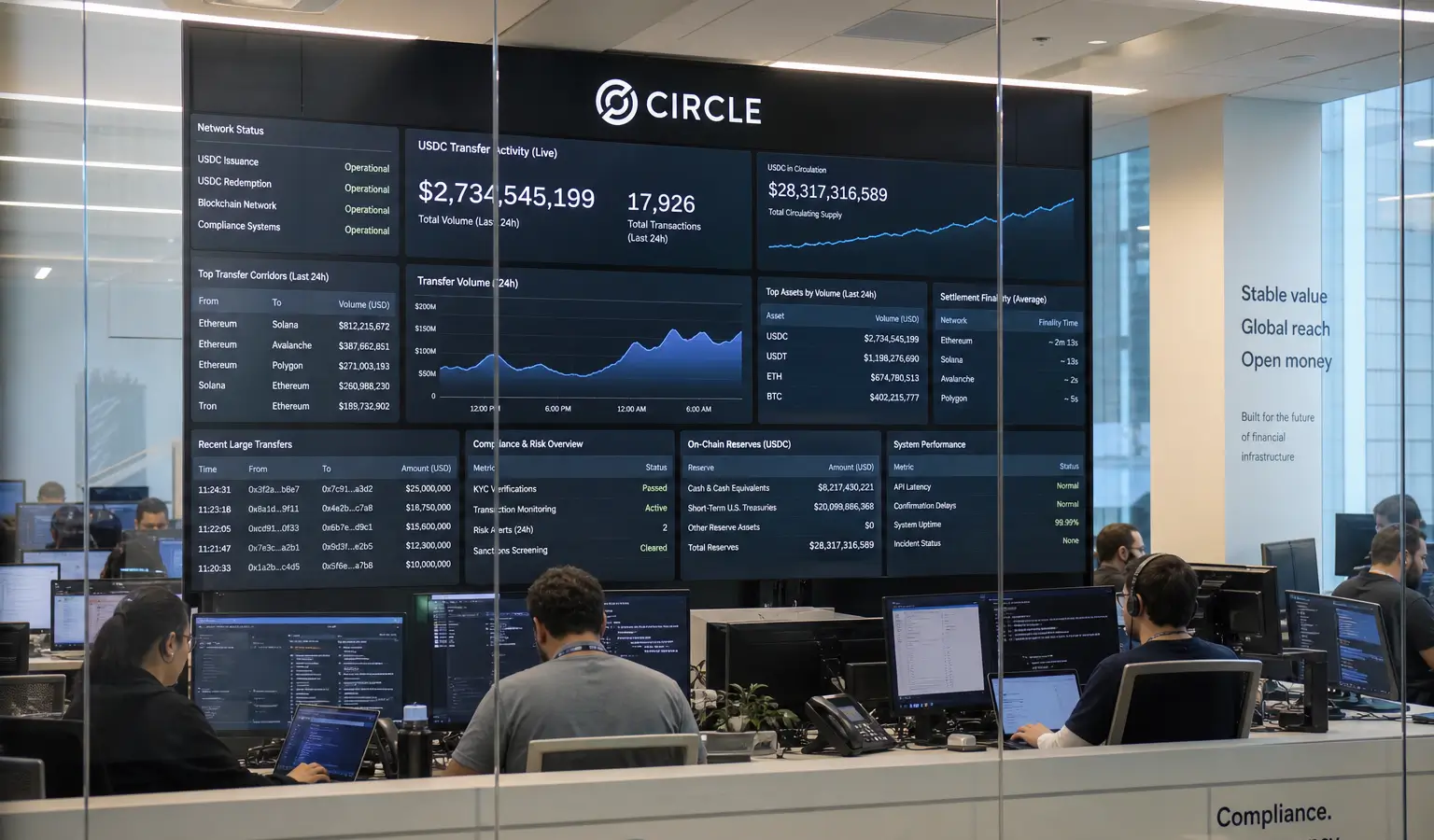
Recent growth in Circle’s USDC supports that view. The stablecoin averaged $61 billion (€52.8 billion) in circulation in Q2 2025, up 90 percent from a year earlier. In Q3 2025, onchain volume climbed to $9.6 trillion (€8.3 trillion), while Circle’s Circle Payments Network handled $31 billion (€26.8 billion) in USDC transfers. USDC is now natively available on 30 blockchain networks.
More Than Just Reserve Income
Rasmussen’s main point is that Circle is more than a stablecoin issuer. He sees it as a company building the payment rails that move those tokens, and he said the market is “very mispriced” on that part of the story. He compared Circle’s long-term potential with payment giants like Visa and Mastercard, which goes well beyond the usual focus on interest and reserve income.
He also does not think wider competition is an immediate problem for Circle. Banks, consumer brands, and other established companies are building their own stablecoins, but Rasmussen says the market may grow fast enough to support several winners. He pointed to efforts like OpenUSD as evidence that interest from incumbents is building. In the same broader space, stablecoin infrastructure is also gaining traction, including Mastercard’s acquisition of BVNK.
Why This Matters for Europe
For European crypto readers, the bigger takeaway is that the stablecoin conversation is increasingly about infrastructure, compliance, and distribution, not just the token itself. Circle’s compliance framework, including FinCEN registration and money transmission licenses in all 50 states, shows how important regulated access is becoming in institutional channels. If stablecoins keep moving deeper into payments, that could also reshape how European firms approach settlement and cross-border transfers.
Rasmussen said Circle’s Arc blockchain is the next major test. The layer-1 will need to prove it can create value at the infrastructure level, not just through stablecoin issuance. Arc’s testnet went live in October 2025 with more than 100 participating companies, which he says shows there is already serious interest. The open question is how quickly that interest turns into real economics for Circle.