Brazil Overtakes the US in Crypto Adoption During Bear Market
Chainalysis sees Brazil as the leader in grassroots adoption, with strong stablecoin and cross-border flows. The US slipped back in a year when global market value was cut in half.
Key Takeaways
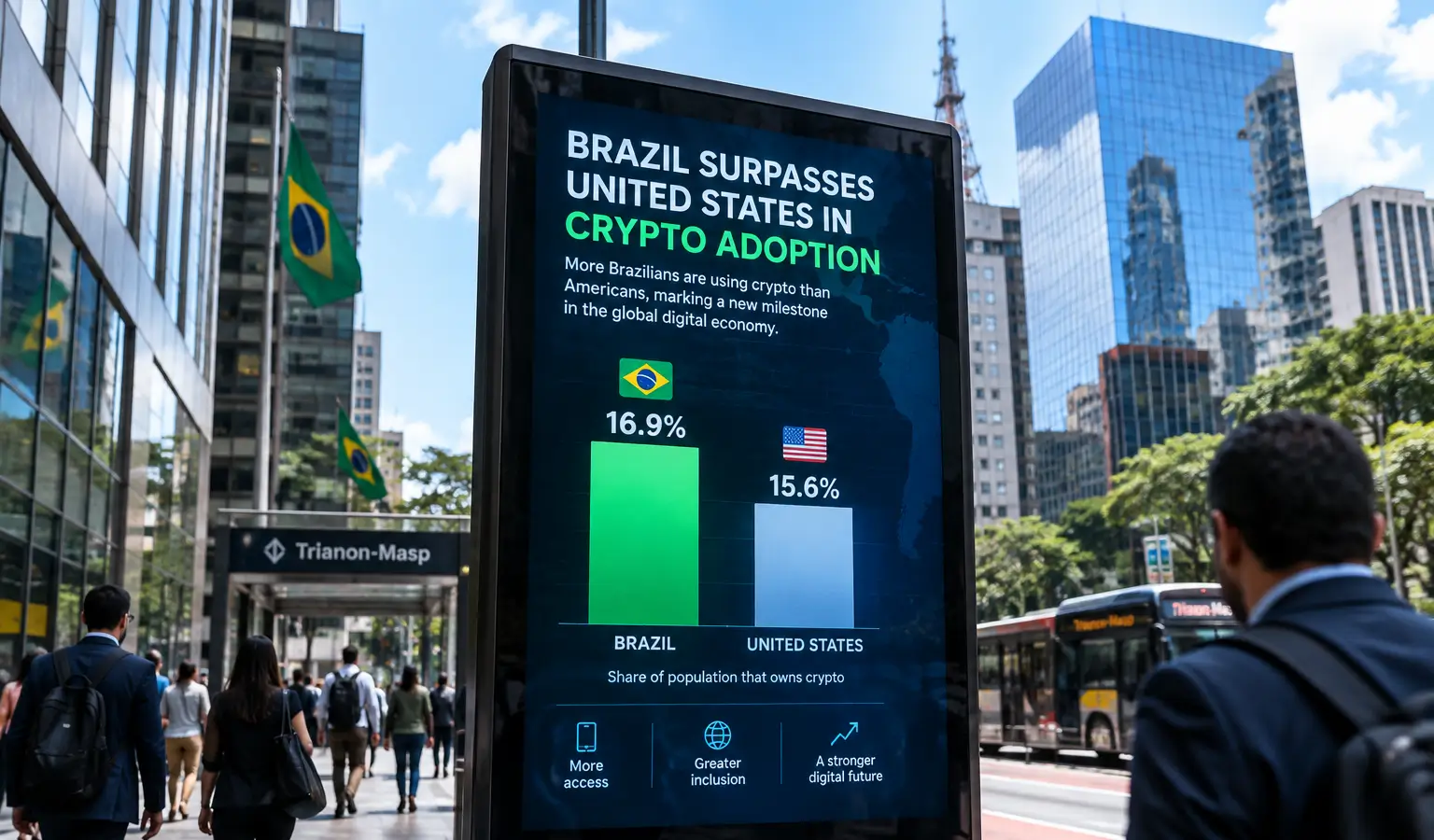
- In 2026, Brazil became the country with the highest grassroots crypto adoption according to Chainalysis, overtaking the United States.
- In the 12 months through June 30, the country processed a $252.5 billion crypto economy, despite a sharply weaker global market.
- Stablecoins played a big role: they accounted for 96% of domestic wallet flows and also grew in cross-border transfers.
According to Chainalysis, Brazil became the country with the highest grassroots crypto adoption in 2026, overtaking the United States in a year when the crypto market fell hard. The country processed a $252.5 billion (€221 billion) crypto economy in the 12 months through June 30, while global market value roughly halved.
Strong Across the Board
The result did not come from Brazil leading in just one area, but from scoring highly in almost every category. The country ranked second in cross-border flows, third in service flows and domestic peer-to-peer activity, and fourth in balances. Chainalysis said Brazil performed notably well relative to its size in a year of weak global growth, leaving larger markets like the United States behind.
The index uses scores from 0 to 1 for each category and then takes the geometric mean. That means broad consistency matters more than one standout result. Brazil was still in fifth place in the previous ranking, but that comparison is limited because Chainalysis changed the methodology this year.
Stablecoins Kept the Market Moving
The broader market showed a mixed picture in the meantime. Global on-chain activity fell just 1.6% to about $9.4 trillion (€8.2 trillion), while total market value dropped by $2.1 trillion (€1.8 trillion). Chainalysis links that resilience to the growing use of stablecoins and other practical use cases.
Transfers between personal wallets within countries rose 302.9% to $228.7 billion (€200 billion). Stablecoins accounted for 96% of that flow. At the same time, inflows to crypto exchanges, DeFi protocols, and other services fell 4.3%.
Cross-border stablecoin transfers also increased, rising 77.5% to $220.3 billion (€193 billion). The average payment was around $3,000 (€2,630). According to Philip Gradwell, vice president of economics at Tether, that pattern points to business use rather than speculation, because the activity moves more evenly through wallets.
Why This Matters for Europe
For European readers, this shows that crypto adoption is not just about price moves, but also about everyday use. The strong role of stablecoins in Brazil lines up with a broader trend where tokens are increasingly used for payments and transfers. That matters for Europe, where regulators and companies are still trying to balance ease of use, control, and crypto rules.