Bybit Gets European Banking App With MiCA and MiFID
Bybit’s Austrian EMI and MiCA licenses give it room for banking services, while an upcoming MiFID license is also expected to make derivatives and tokenized stocks possible.
Key Takeaways
- Bybit is launching a super app in Europe with banking features, spot crypto, regulated derivatives, and tokenized stocks.
- The company has an EMI license and a MiCA license in Austria, and expects to get a MiFID license soon as well.
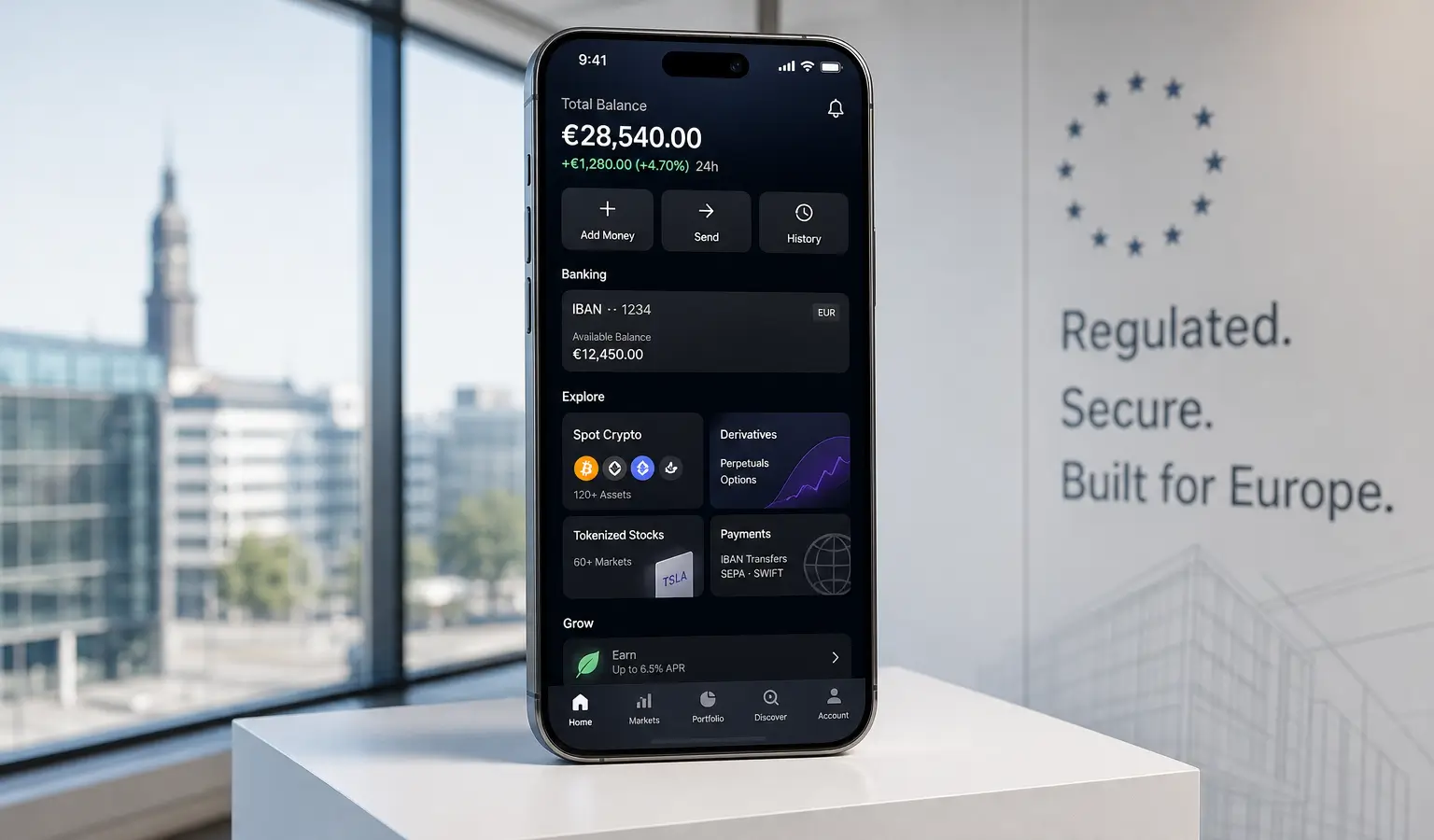
- The app is meant to give users an IBAN, payments, transfers, and access to multiple investment products.
Bybit is taking another step in Europe with a so-called super app that is meant to combine banking features with spot crypto, regulated derivatives, and tokenized stocks. The crypto exchange says it wants to go beyond just trading tokens and is aiming for a broader financial package for European users.
Licenses in Austria
The company has received an electronic money institution license from Austria’s financial regulator, the FMA, founder and CEO Ben Zhou said in a conversation with Coindesk. Bybit already has a MiCA license in Austria, which gives it access to the entire European Union. According to Zhou, a MiFID license will also be added soon, which is needed for financial products such as derivatives, among other things.
That combination should give Bybit more room to operate in Europe as a fully regulated provider. Zhou said the company wants to build something with those three licenses that looks like Revolut, but with Bybit’s existing crypto services added in. He stressed that this is a fully regulated and compliant setup.
More Than Just Crypto
The planned app should give users their own account and IBAN, so they can receive salaries, make local payments, and transfer money, for example. On top of that, Bybit wants to offer stablecoins, crypto, and other investment products in the same environment. Zhou also said the EMI license is enough for most of this setup.
With a MiFID license, Bybit could also offer regulated derivatives. Zhou also mentioned access to U.S. stocks through integrations with firms like Alpaca or Saxo Bank, and named Apple and Tesla as examples of stocks customers could hold in their account. Contracts for difference and commodities such as gold, silver, and oil were also mentioned.
European Competition
The move fits into a European market where fintech apps are increasingly bundling multiple services into one product. According to a recent estimate, the European super app market is growing fast, and embedded finance is becoming more important in apps people use every day. That matters for Bybit because in Europe the company is competing not only with crypto exchanges, but also with broader financial apps like Revolut.
Zhou said that in his view a MiCA license alone is not enough to become profitable in Europe, partly because of compliance costs and competition from companies with a broader offering. Bybit is also already working with Kraken on xStocks for tokenized equities, and that partnership will continue, according to Zhou. That means the company is choosing not to build everything itself, but instead to use a mix of its own services and partners.
Other companies are also moving in Europe toward a broader offering. Kraken is adding U.S. stocks in Europe, which is further blurring the line between a crypto exchange and an investment platform.