Cardano Rises, But DeFi Revenue Keeps Falling
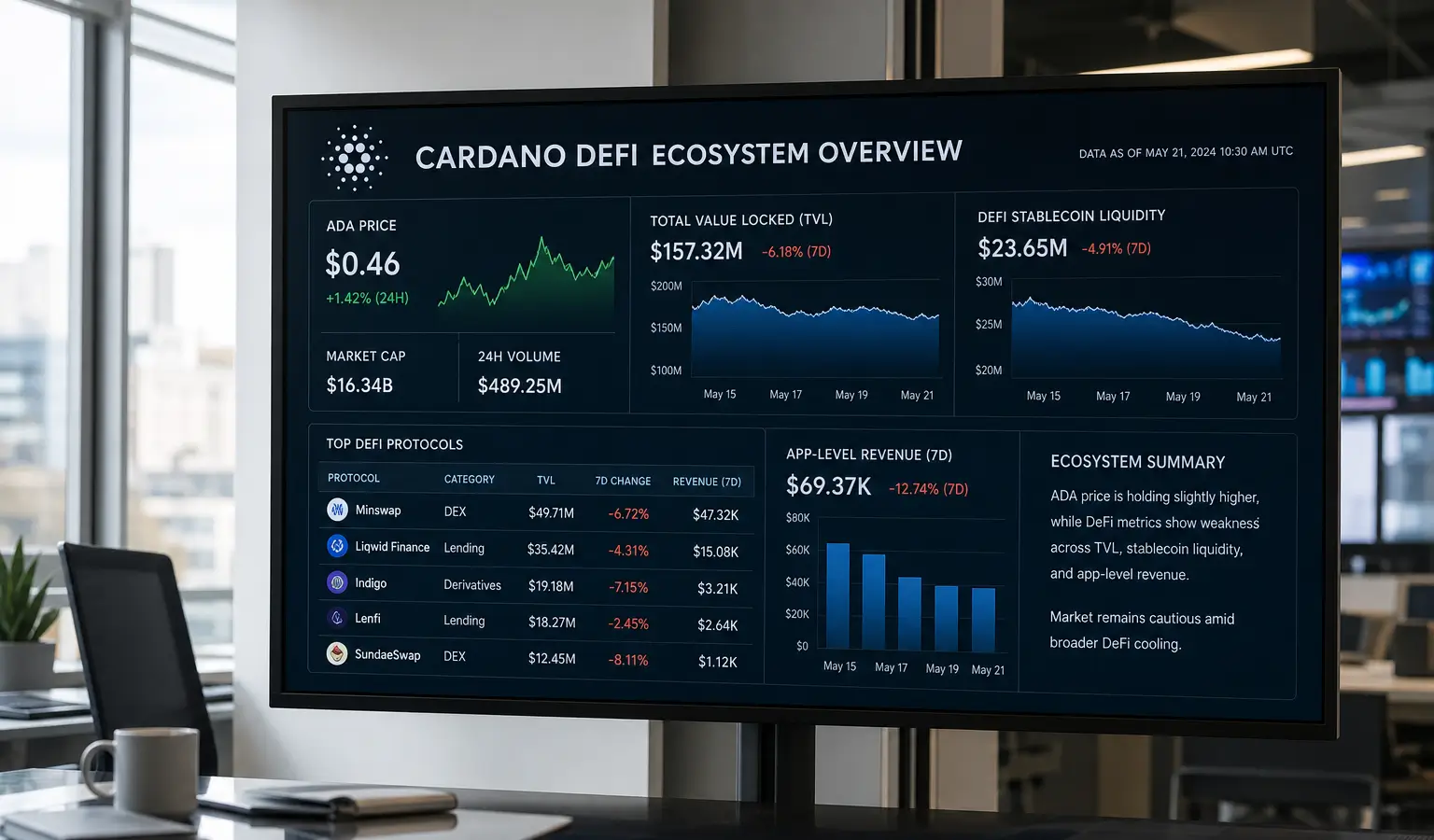
ADA is trading higher, but app fees and DeFi activity on Cardano are falling sharply. Low stablecoin liquidity is slowing lending and trading on the network.
Key Takeaways
- ADA is about 3.6% higher than a month ago, while app-level fees fell 67.1% over the same period.
- Cardano still processes 150,000 to 180,000 transactions per week, but a lot of that activity comes from transfers, staking, and bundled swaps.
- Cardano’s stablecoin supply is around $59 million, leaving very little liquidity for lending, trading, and other DeFi use cases.
Cardano is sending mixed signals right now. ADA is up from a month ago, but the DeFi layer built on top of the network is clearly losing momentum. Over the past 30 days, app-level fees, which reflect what DeFi protocols actually earn, dropped 67.1%, even as Cardano’s price climbed about 3.6%.
Price and Usage Are Moving in Different Directions
ADA is changing hands at around $0,167 (€0.15) and remains the 18th-largest crypto by market value, with a market cap of roughly $6.2 billion (€5.4 billion). The monthly chart looks relatively calm, but the underlying data points to a weaker network picture.
Base-layer gas fees also fell 35.7% over the same period. App revenue dropping nearly twice as fast suggests that users are not just paying less on-chain, but are also interacting with DeFi apps less often. That lines up with a broader slowdown across the Cardano ecosystem, where deposits and trading activity have been falling in 2026.
Activity Is Not Holding Value
On-chain data shows Cardano still handles about 150,000 to 180,000 transactions each week. In early June, that figure briefly surged by around 50% to 271,000, largely driven by a burst of DEX swaps on Minswap, WingRiders, and SundaeSwap.
Even so, transaction counts only tell part of the story when it comes to DeFi health. Much of that activity comes from basic transfers, staking, and bundled swap orders. And even during that June spike, Minswap’s total value locked dropped about 22% in a month, according to DefiLlama. In other words, the chain was active, but the capital did not stay put.
Liquidity Is Still the Main Bottleneck
The bigger problem is still liquidity. Cardano’s stablecoin supply is about $59 million (€51.6 million), while the network’s total DeFi pool sits near $73 million (€63.9 million). That leaves very little dollar liquidity available for lending, trading, and other DeFi activity.
For context, Solana has about $15.4 billion in circulating stablecoins compared with roughly $5.0 billion (€4.4 billion) locked in DeFi. Tron has more than $89 billion (€77.9 billion) in stablecoins. Cardano’s much smaller base makes it tough to build a deep market, even with projects like Djed trying to help.
For European crypto readers, the takeaway is simple: a higher token price does not automatically mean a stronger economy behind the network. On Cardano, thin stablecoin liquidity and falling app revenue suggest DeFi could remain fragile, even if ADA gets a short-term bounce. The network has tried to strengthen that foundation before with new scaling and infrastructure upgrades, including the Leios testnet.