Circle Brings BlackRock and Visa Into Arc as Ethereum Faces Pressure
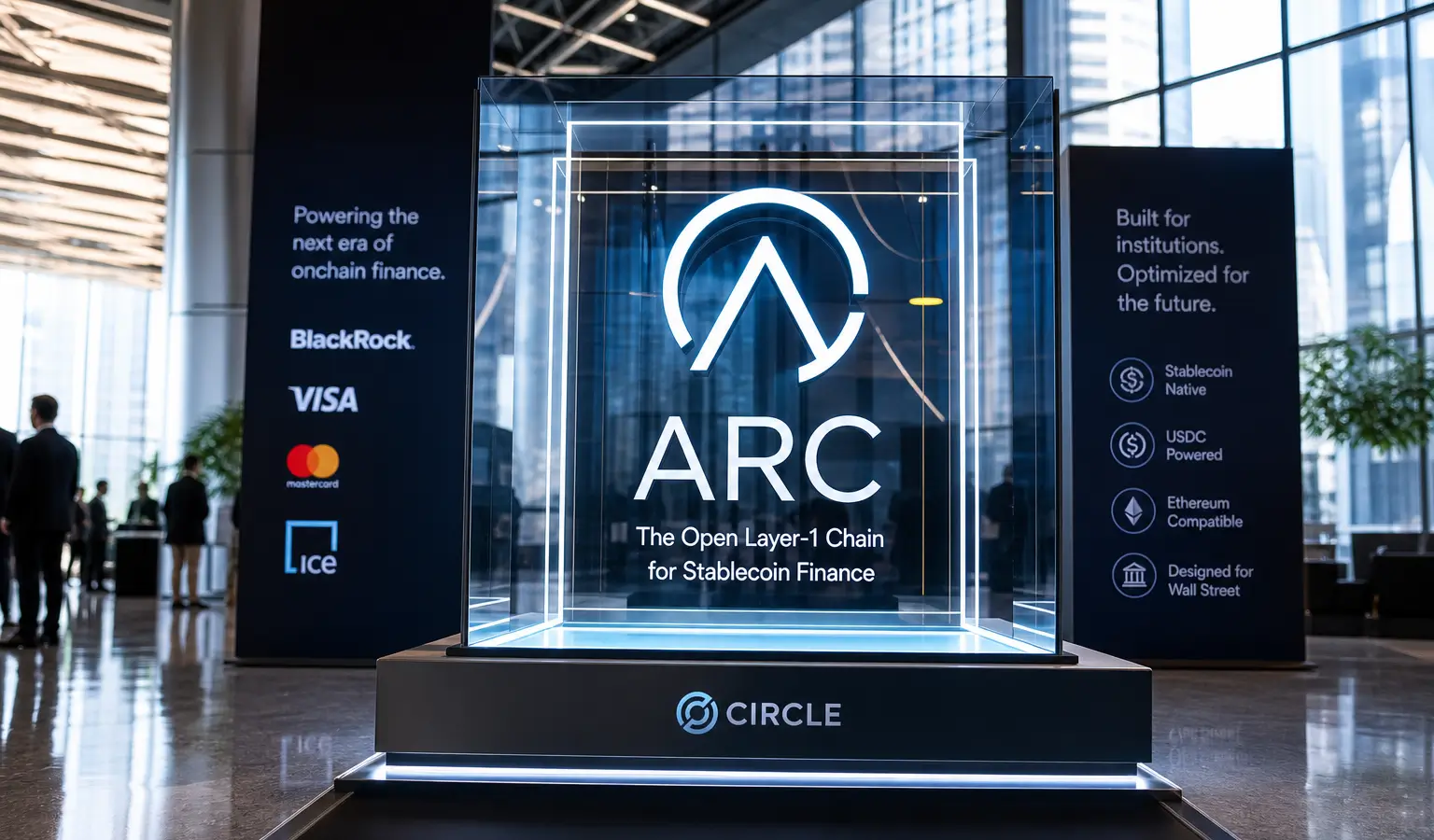
BlackRock, Visa, and Mastercard are joining as validators on Circle’s Arc, which uses USDC and Ethereum compatibility for institutional payments. For Ethereum, it is a new competitor in stablecoin and DeFi infrastructure.
Key Takeaways
- Circle has lined up eleven major names, including BlackRock, Visa, and Mastercard, as validators for Arc.
- Arc goes live on September 16, is Ethereum-compatible, and uses USDC as its native gas token.
- Ethereum is trading around $1,870, with support between $1,750 and $1,800 and resistance at $2,000.
Circle has brought together eleven major companies to serve as validators for Arc, its new stablecoin-focused blockchain. BlackRock, Visa, Mastercard, and ICE are all set to run nodes on the network, which is scheduled to launch on September 16. For Ethereum, that is worth watching because USDC still mostly lives on that chain, and Arc is aiming at a similar slice of the market.
Wall Street Is Helping Build It
Circle said on August 5 that these companies are part of Arc from day one. In addition to BlackRock and Visa, the founding group includes Standard Chartered, DTCC, Galaxy, Global Payments, MoneyGram, SBI Group, and Sumitomo. Circle also said more than 100 companies are already building on the network’s private test version.
The project is clearly built with traditional finance in mind. The blockchain is fully compatible with Ethereum, which should make it easier for developers to move applications over. Arc also uses USDC as its native gas token, so fees are priced in dollars and may feel more predictable for institutions that want stable costs.
Visa has also extended its stablecoin settlement pilot to Arc, a sign that payment firms are still testing several blockchains at once. Circle is also leaning heavily on speed, with sub-second finality as one of the network’s main selling points.
Why This Matters for Ethereum
In the near term, one analyst says this is unlikely to move Ethereum’s price much. USDC is not leaving Ethereum, and Arc does not launch until mid-September. Over time, though, it shows that large institutions increasingly want to build on their own rails, while Ethereum still has to protect its role in DeFi.
That makes Arc more of a competitor for specific use cases than a straight replacement for Ethereum. DeFi platforms like Aave and Uniswap are already preparing to build on Arc, and BlackRock is bringing its tokenized fund BUIDL to the chain. If more institutional activity shifts into an environment like that, it could continue to change the balance of power in crypto.
ETH Is Still Waiting on a Breakout
Ethereum is trading around $1,870 (€1,620). The key support zone is between $1,750 (€1,510) and $1,800 (€1,560), while $2,000 (€1,730) is the level the analyst says really matters. Only a move above that would bring the $2,200 (€1,900) to $2,450 (€2,120) range into view.
Until ETH clears that level, the outlook remains cautious. Traders are mostly focused on trading volume, which has been fairly weak over the past few days.