Crypto Exchanges Are Using Perps to Tap Wall Street Markets
CoinGecko sees as much as $1.32 trillion in trading for stock perps and index derivatives by 2026. Coinbase, Binance, and Hyperliquid are also moving to meet demand for 24/7 exposure.
Key Takeaways
- Crypto exchanges traded $1.32 trillion in perpetual futures tied to traditional assets in the first five months of 2026.
- Perps offer 24/7 trading in stocks, indexes, and commodities, without ownership, voting rights, dividends, or stock market hours.
- In Europe, the line between crypto and traditional markets is getting blurrier as platforms like Coinbase and Binance expand their offerings.
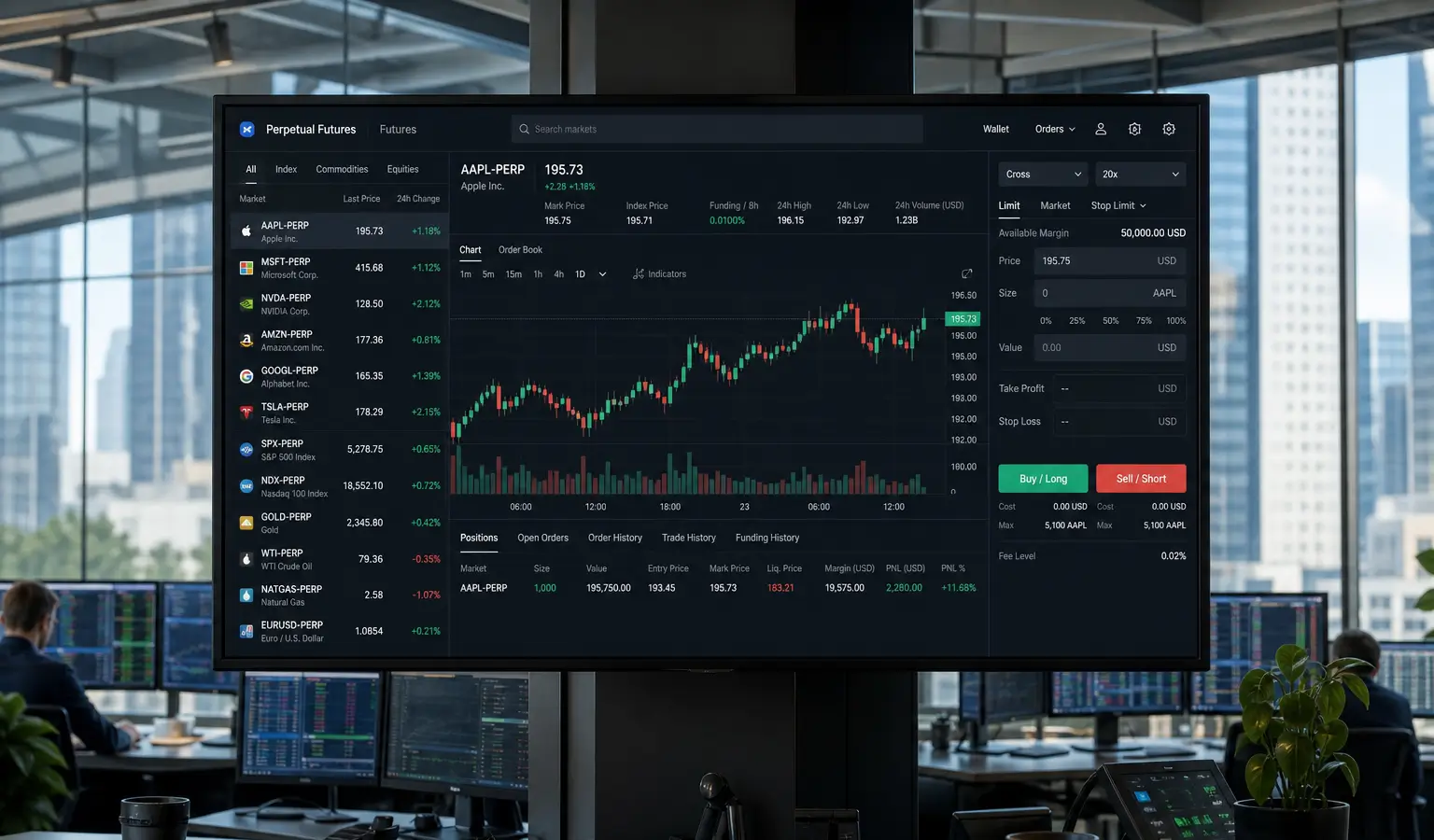
Crypto exchanges are leaning harder into perpetual futures as a way to give traders exposure to stocks, indexes, and commodities. The flow has now flipped from two years ago, when the bigger trend was traditional markets moving into crypto. According to CoinGecko, the sector handled $1.32 trillion (€1.1 trillion) in perps linked to traditional assets in the first five months of 2026, up from $104.21 billion (€90.7 billion) for all of 2025.
From Crypto to Wall Street
Perpetual futures, better known as perps, are derivatives that never expire. They first caught on in crypto because they let traders stay in positions around the clock without rolling contracts, and that same structure is now appealing to traditional markets as well. In crypto, perps have been a core trading product since 2016, when BitMEX helped bring them into the mainstream.
The volume growth makes the trend hard to miss. CoinGecko said monthly trading climbed from $230 million (€200 million) in January 2025 to $347.17 billion (€302 billion) in May 2026. Between January 2025 and May 2026, crypto exchanges listed about 360 traditional assets through spot markets and perps, with perps taking the lead.
Bitget says the shift is already changing its revenue mix. CEO Gracy Chen said the company had no perpetual stock product a year ago and that 100 percent of volume came from crypto. Now, she said, about 28 percent of total trading volume comes from the stock business, mostly from stock perps.
Why Perps Are Catching On
The draw is not ownership of the shares themselves, but exposure to the price move. Stock perps generally do not come with voting rights, dividends, or the protections you would get from buying through a regulated broker. What they do offer is nonstop trading and the ability to react to market moves without waiting for the opening bell.
For trading desks outside the U.S., the appeal is mostly about cutting friction. Institutional firms often already have access to brokers and OTC desks, but perps make it easier to hedge or rebalance positions outside U.S. trading hours. For retail investors abroad, the attraction can be direct access to names like Tesla or the S&P 500, especially in markets where local stock choices are limited.
The launch of the first official onchain S&P 500 perpetual futures contracts shows how far the idea has already spread. S&P Dow Jones Indices licensed its S&P 500 benchmark to Trade XYZ, a platform on the Hyperliquid blockchain, giving non-U.S. users a way to trade the U.S. index 24/7.
What This Means for Europe
For European crypto readers, the bigger takeaway is that the line between crypto and traditional finance is getting harder to see. Coinbase is already lining up a product set in the United Kingdom that includes stocks and derivatives alongside crypto, after approval from the Financial Conduct Authority under MiFID-based rules. It is part of a broader push by regulated platforms to bring more markets into one account.
Binance is moving in a similar direction, including plans to let some wealthy clients use tokenized stock positions as collateral for other trades. Even so, institutional use of decentralized venues is still limited, in part because of concerns around custody, clearing, and smart contract security. That means the next stage of this market is not just about new products, but also about licenses, infrastructure, and trust.
The trend also fits a wider shift across exchanges, where crypto exchanges are expanding into stocks and commodities to keep capital in-house as a way to hold onto users and liquidity.