Dallas Fed Warns Tokenized Deposits Could Cut Bank Lending Room by $700 Billion
According to the Dallas Fed, tokenized deposits could reduce the stability of U.S. bank deposits and shrink banks' room for long-term interest rate risk.
Key Takeaways
- The Dallas Fed estimates that tokenized deposits could reduce U.S. banks' room for long-term interest rate risk by about $700 billion.
- In an alternative scenario with 10% faster deposit outflows, the possible decline comes to about $580 billion.
- The economists warn that tokenized deposits could make deposits less stable and may force banks to hold more expensive funding or more reserves.
Tokenized deposits could reduce the room U.S. banks have to hold long-term interest rate risk by about $700 billion (€600 billion) if savers become 10% more sensitive to interest rate differences. That is according to estimates from two Dallas Fed economists. In a second scenario, where deposits flow out 10% faster, the possible decline came to about $580 billion (€497 billion).
What Tokenized Deposits Do
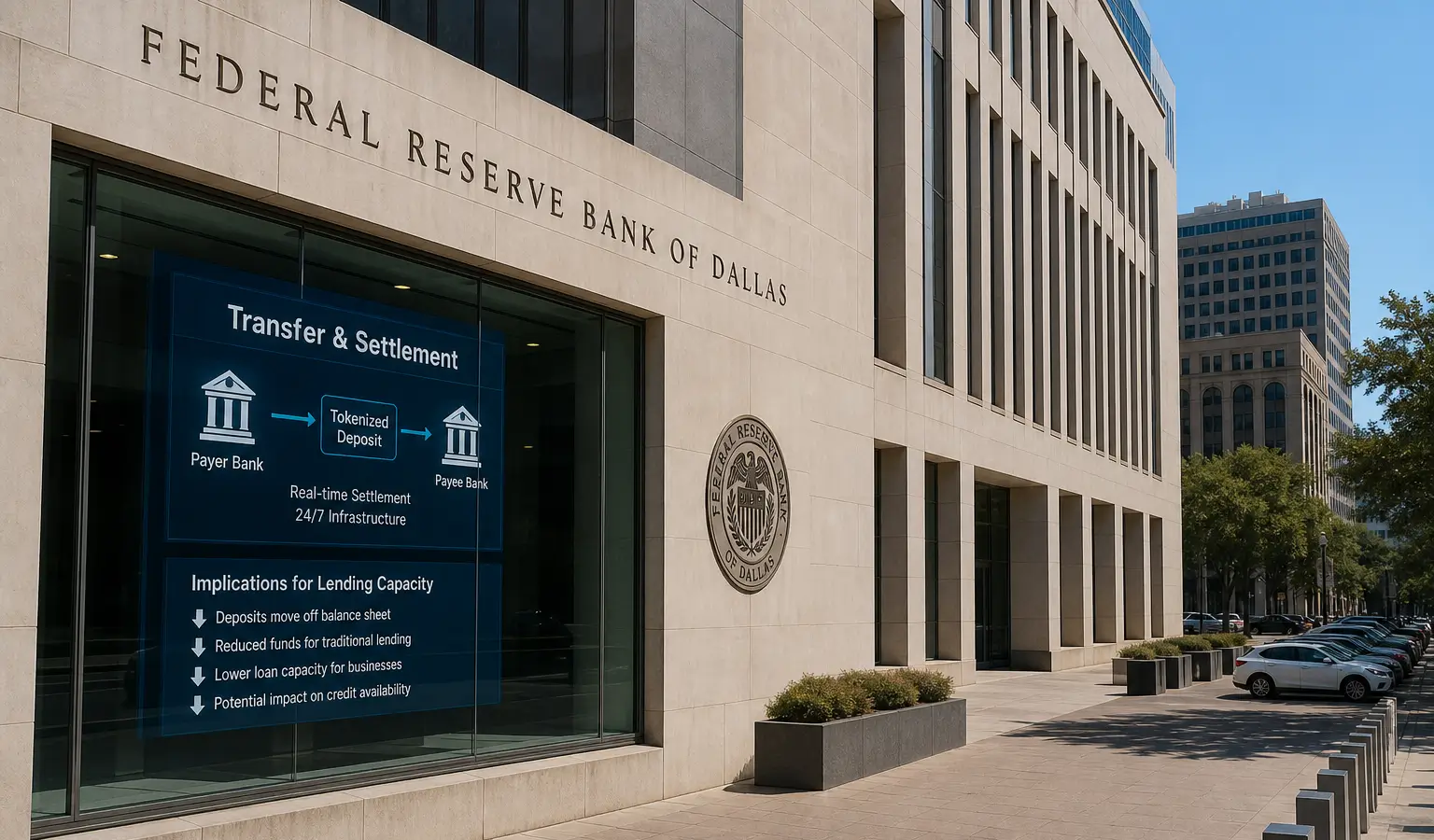
Tokenized deposits are digital versions of bank balances on a blockchain. They make programmable payments and real-time settlement possible, while the money stays inside the regulated banking system. That combination is exactly what makes them interesting as an alternative to stablecoins, but according to the economists, it could also mean deposits become less “sticky.”
The calculations assume that deposits stay at a bank for an average of four years. If customers can move their money faster to a bank offering a higher yield, banks may have to pay more to keep that money. The economists wrote that instant settlement could let yield-focused savers switch banks almost immediately.
Effects on Credit
According to Rosie Levy and Srini Ramaswamy, “other deposits,” excluding large time deposits, support about $5.8 trillion (€5 trillion), or 80%, of total long-term interest rate risk in the U.S. banking system. If tokenization makes that funding less stable, banks may hold more reserves and Treasuries or rely more often on more expensive term debt.
That could matter for European crypto readers, because tokenized deposits show how blockchain applications are not just about crypto itself, but also about the broader financial system. That debate also touches on the line between regulated bank money and blockchain-based payment forms, a topic that is getting more attention outside the United States too. In that debate, it also matters how banks want to keep tokenized deposit rails inside their own infrastructure, as explained in an earlier analysis of bank-linked tokenized deposits.
The economists warned that banks that want to keep funding their current lending with more expensive money may pass higher costs on to consumers and businesses. An earlier study on Brazil's Pix payment system had already shown that heavier use was linked to more liquid assets at banks and less credit intermediation.
Interoperable Networks Are Coming
Tokenized deposits are still early in their development and are often hard to move between different issuers right now. Still, The Clearing House and banks like Bank of America, Citi and Wells Fargo are working on an interoperable network for cross-bank clearing, automated workflows and 24/7 settlement. Smart contracts and agentic AI could also, in theory, help automate those transfers without the holder having to do anything directly.