Goldman Sachs Limits Employees to Sports and Entertainment on Kalshi and Polymarket
The bank wants to reduce compliance risks around bets on elections, interest rates, and other market-sensitive events. Kalshi and Polymarket are also facing tighter scrutiny over insider information and manipulation.
Key Takeaways
- Goldman Sachs is limiting employees on prediction markets to sports and entertainment to reduce compliance risks around sensitive bets.
- Repeated violations of the internal rules could lead to termination, according to a memo.
- Kalshi and Polymarket are tightening their controls as the sector faces more oversight and growing institutional attention.
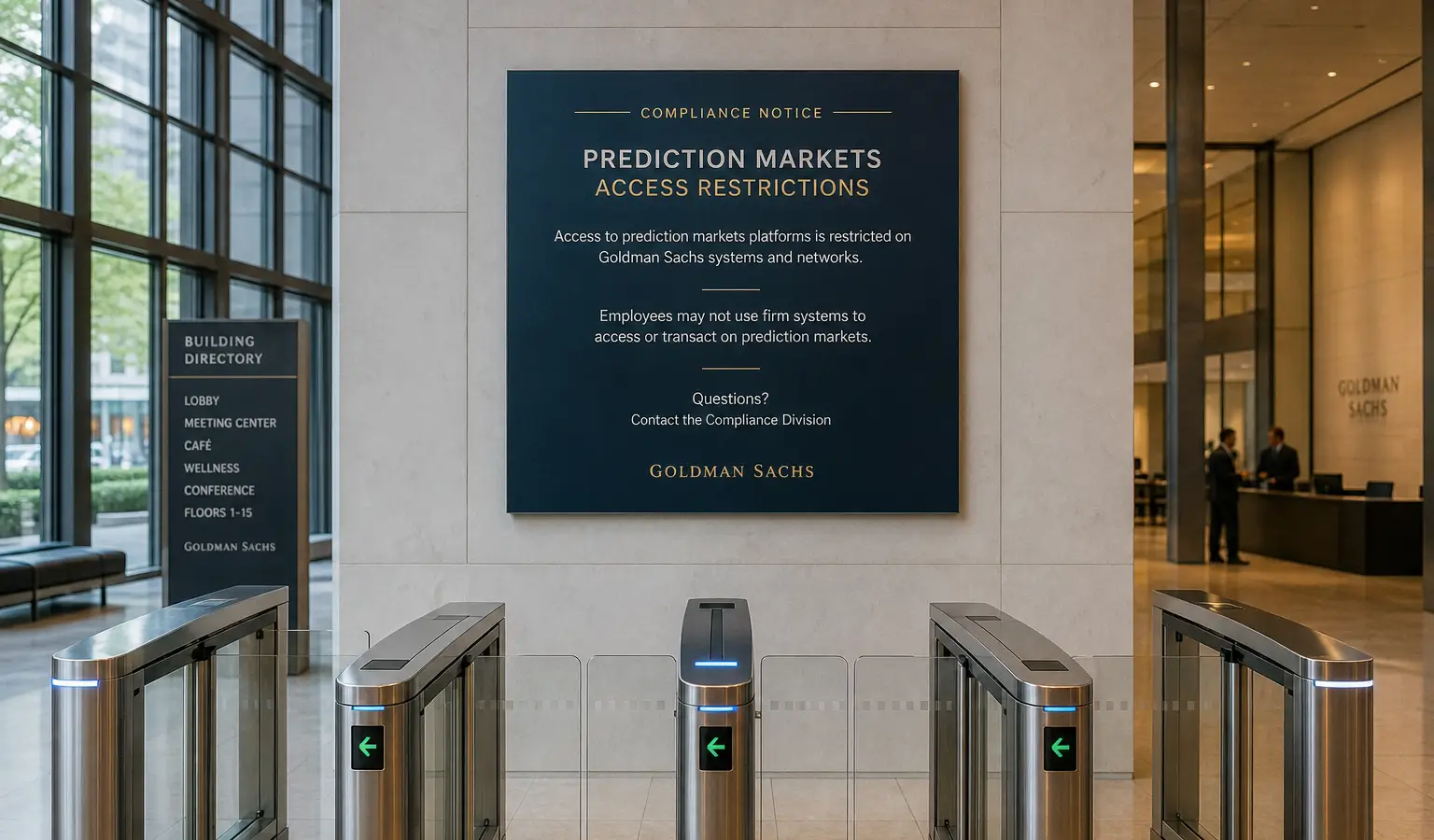
Goldman Sachs has told employees to keep their prediction market activity limited to sports and entertainment. The bank is trying to lower compliance risks tied to bets on elections, interest rates, and other market-sensitive events on Kalshi and Polymarket.
Stricter Internal Rules
The change was communicated in an internal memo, according to a person familiar with the matter who spoke to the Financial Times. That source said Goldman also warned that repeated violations could result in termination.
The move fits into a wider shift across the industry, as platforms like Kalshi and Polymarket tighten their controls. Both companies have recently introduced stricter rules aimed at preventing trading on nonpublic information and market manipulation, including advance bans for people with direct access to sensitive information, such as politicians and athletes, in markets that affect them. That also reflects the broader debate over prediction market oversight, which is playing out in U.S. politics.
Why Wall Street Is Paying Attention
Banks face a higher standard because their employees may have access to material nonpublic information that can move markets. Prediction markets make that line harder to define, since users can bet on outcomes tied directly to politics, macroeconomics, and other price-sensitive topics.
Kalshi and Polymarket have been under scrutiny for some time over concerns about insider trading. For instance, Lookonchain flagged three wallets that reportedly made more than $630,000 (€550,900) by betting on Nicolás Maduro's removal just hours before he was arrested. The organizers of the Nobel Peace Prize also previously examined a possible leak after a run of successful bets on the eventual winner.
More Pressure on Prediction Markets
The sector is also attracting more institutional money. Kalshi is working on a new funding round at a $40 billion (€35 billion) valuation, which shows how quickly capital is moving into the space. At the same time, the debate over oversight and ethics keeps getting louder, especially as prediction markets increasingly overlap with financial products instead of just sports betting.
For European crypto and market watchers, that matters because the line between gambling, financial speculation, and regulated investment products is getting harder to see. In Spain, Kalshi and Polymarket were even blocked in May 2026 after authorities said they were gambling products without the required betting licenses.