Hyundai Launches Stablecoin Payments on Avalanche
Hyundai is testing live treasury payments between the U.S. and Mexico with USDT, and later this month it also wants to bring in European subsidiaries. The pilot positions Avalanche and stablecoins as infrastructure for business settlement.
Key Takeaways
- Hyundai has launched a stablecoin-based payment system on Avalanche for internal cross-border transactions.
- The first $20,000 transfer between the U.S. and Mexico took an average of seven minutes, compared with three to four hours through traditional banking networks.
- Hyundai plans a European pilot later this month to test local currency transfers and conversion costs.
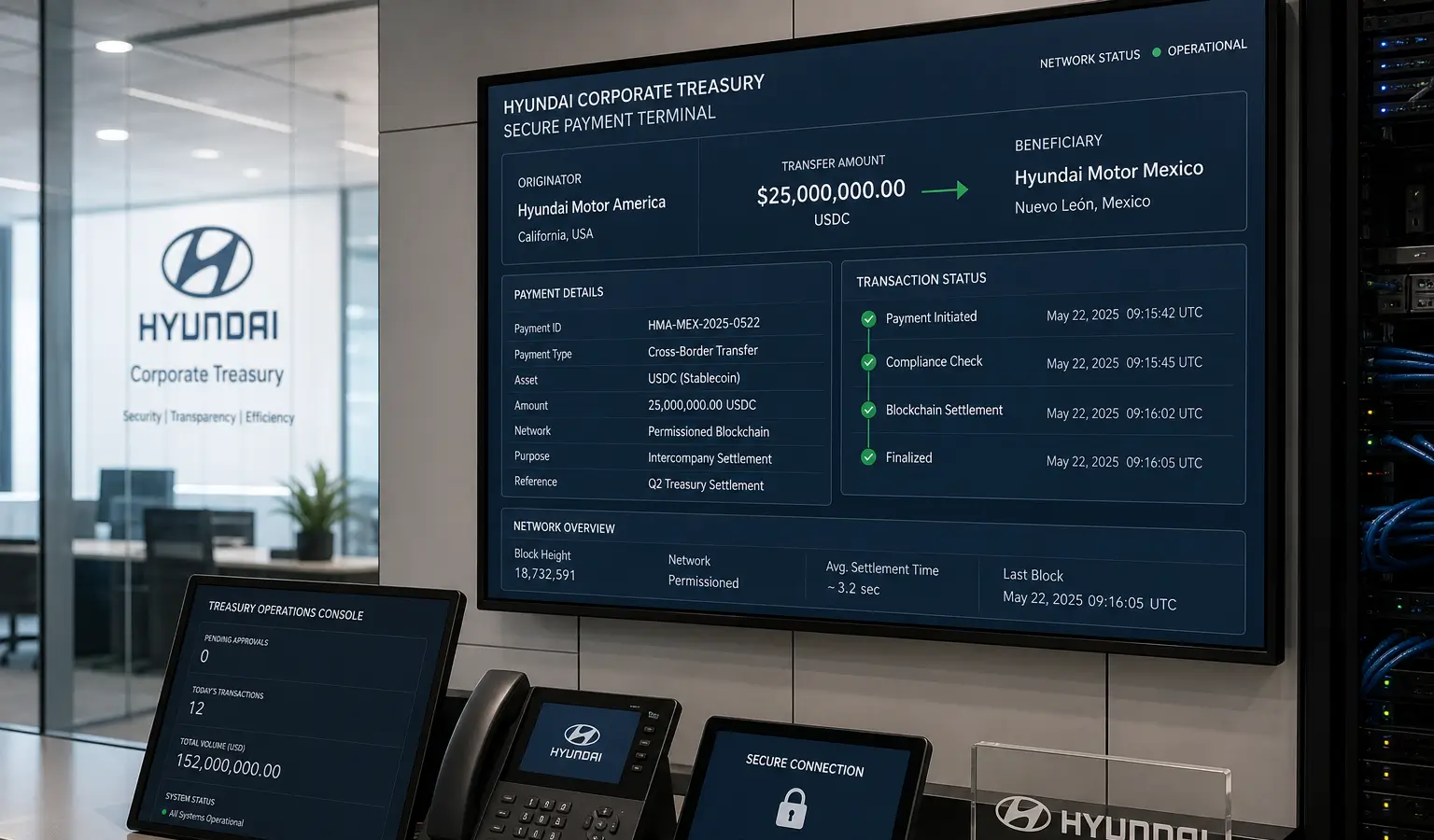
Hyundai has rolled out a stablecoin-based system for internal cross-border payments on Avalanche. According to the companies involved, the South Korean automaker is the first major business in South Korea to publicly move this type of setup into production.
The pilot also points to a bigger shift: stablecoins are being used for more than crypto trading. More companies are turning to the technology to move money between subsidiaries faster and to reduce the cost and delays that come with traditional banking rails. That trend has become more visible in recent months, including through stablecoin payments and treasury activity that banks and financial institutions are increasingly adopting.
Live Transfer Between the U.S. and Mexico
Ava Labs, the team behind Avalanche, said this was not a sandbox test but a real treasury workflow. Justin Kim, APAC head at Ava Labs, said live USD and USDT were transferred between Hyundai Motor in the U.S. and Mexico.
The first phase covered a $20,000 (€17,500) transfer from Hyundai Motor America to Hyundai Motor Mexico. During the process, dollars were converted into Tether's USDT and then converted back into dollars. Hyundai Card, the automaker's credit card unit, said the transfer took an average of seven minutes, versus the three to four hours that are typical on traditional banking networks.
Expansion to Europe
Hyundai is now looking to extend the setup to additional corridors and currencies. A second pilot with European subsidiaries is scheduled for later this month and is designed to test local currency transfers and foreign exchange conversion costs.
That next step matters for readers in Europe because it shows stablecoin infrastructure being considered for more than trading or DeFi. It is also being tested as a tool for business payments across borders. The partnership with Circle and Visa further shows how crypto firms and traditional payment companies are increasingly ending up in the same payment flow.
Broader Enterprise Signal
Hyundai's move fits into a wider pattern of large companies using blockchain for treasury and settlement. For the crypto market, the main takeaway is that these pilots are pushing the conversation away from speculation and toward real payment infrastructure, even if it is still unclear how quickly the systems will scale.
Avalanche is also getting a boost from its enterprise-focused design, which gives companies more room to customize than a standard public chain. That makes Hyundai's case a useful example of how blockchain can be built into day-to-day business operations instead of being treated as a standalone experiment.