Institutional Crypto Trading Hits Record Share at Wintermute
Wintermute says Bitcoin, derivatives, and tokenized Treasuries are the main beneficiaries of the influx of professional players. Liquidity is also concentrating in fewer tokens, while volatility is easing.
Key Takeaways
- Institutional investors accounted for about 72% of spot volume on Wintermute's OTC desk in the first half of 2026, a record share.
- Wintermute says volatility has eased, with realized swings around 45% compared with about 70% in earlier market cycles.
- Tokenized assets grew nearly 50% in six months to $31 billion, while monthly transfer volume more than doubled to $9 billion.
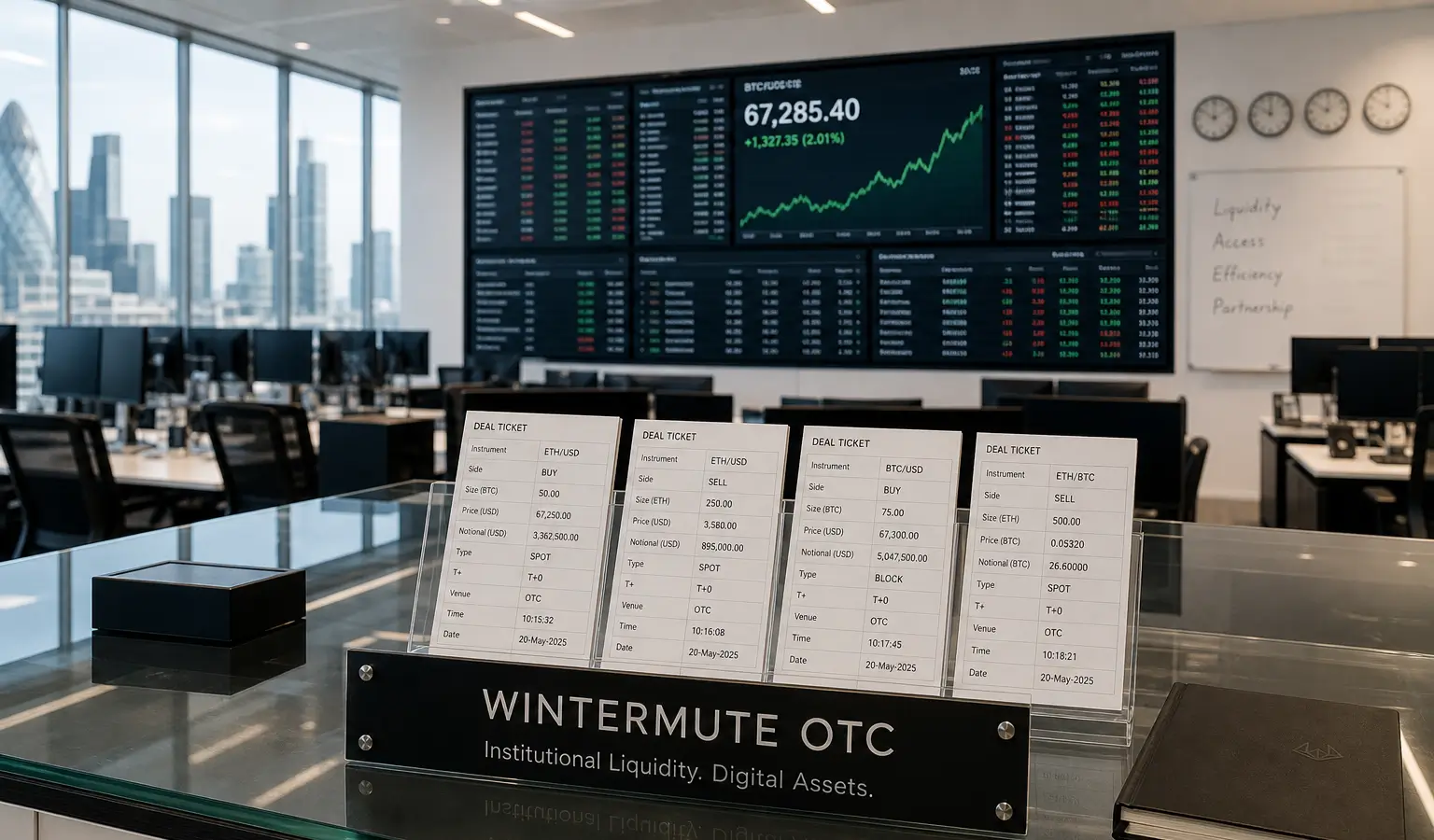
Institutional investors are taking up a much larger share of crypto trading, according to market maker Wintermute. The firm says they made up about 72% of spot volume on its OTC desk in the first half of 2026, the highest level on record and well above roughly 61% in the second half of 2025.
Wintermute says that shift points to a more mature market and a retail crowd that is playing a smaller role than before. With longer time horizons, stricter risk controls, and less reactive trading, the firm says liquidity is flowing into fewer tokens. It also sees that as part of a wider move toward closer ties between crypto and traditional markets.
Less Volatility
Wintermute also says the rise in institutional activity is showing up in calmer price action. Its analysis puts realized volatility at around 45% in the current cycle, down from about 70% in earlier market cycles. That lines up with research suggesting institutional participation can help reduce price risk, especially when markets get shaky.
For Bitcoin, the trend matters even more because the asset is increasingly trading in step with major U.S. stock indexes. In other words, institutional money is not only adding volume, but also reshaping how crypto is priced and traded.
Altcoins Are Getting More Selective
The report also shows that institutional traders are concentrating on a relatively small set of tokens, while retail traders remain spread across a much wider range of assets. Wintermute says that makes broad altcoin rallies less likely, since capital is increasingly clustering around just a few names.
That matches the recent move toward more selective altcoin trading. In a separate analysis, altcoins outside Bitcoin and Ethereum have been under pressure for months, while market breadth remains weak.
Wintermute is also seeing a strong pickup in derivatives. Notional trading volume in altcoin options on the OTC desk was about 3.4 times higher in the first half of 2026 than in the second half of 2025. The firm says that is mostly being driven by investors looking for yield rather than simple spot exposure, while CFDs are being used more often for directional trades, hedging, and basket strategies.
Tokenized Assets Are Gaining Ground
Tokenization is still gaining momentum as well. The value of tokenized assets climbed nearly 50% in the first six months of this year to $31 billion (€27.2 billion), while average monthly transfer volume more than doubled to $9 billion (€7.9 billion). Wintermute says institutions are mainly focused on tokenized Treasuries, money market funds, and private credit within that market.
That fits the broader rise of tokenized real-world assets, which had already reached more than $19.3 billion (€17 billion) by the end of the first quarter of 2026. For European crypto readers, the takeaway is clear: the line between crypto infrastructure and traditional investment products is getting thinner fast, especially as professional players gain more influence over liquidity, pricing, and the tools investors use.