June Shows Weak Crypto Breadth Despite Positive Average Returns
CryptoRank’s June data showed a narrow rebound at the surface: most top-100 tokens declined, while Velvet (VELVET) lifted the average sharply. Layer 2, DePIN, and DeFi also faced broad pressure.
Key Takeaways
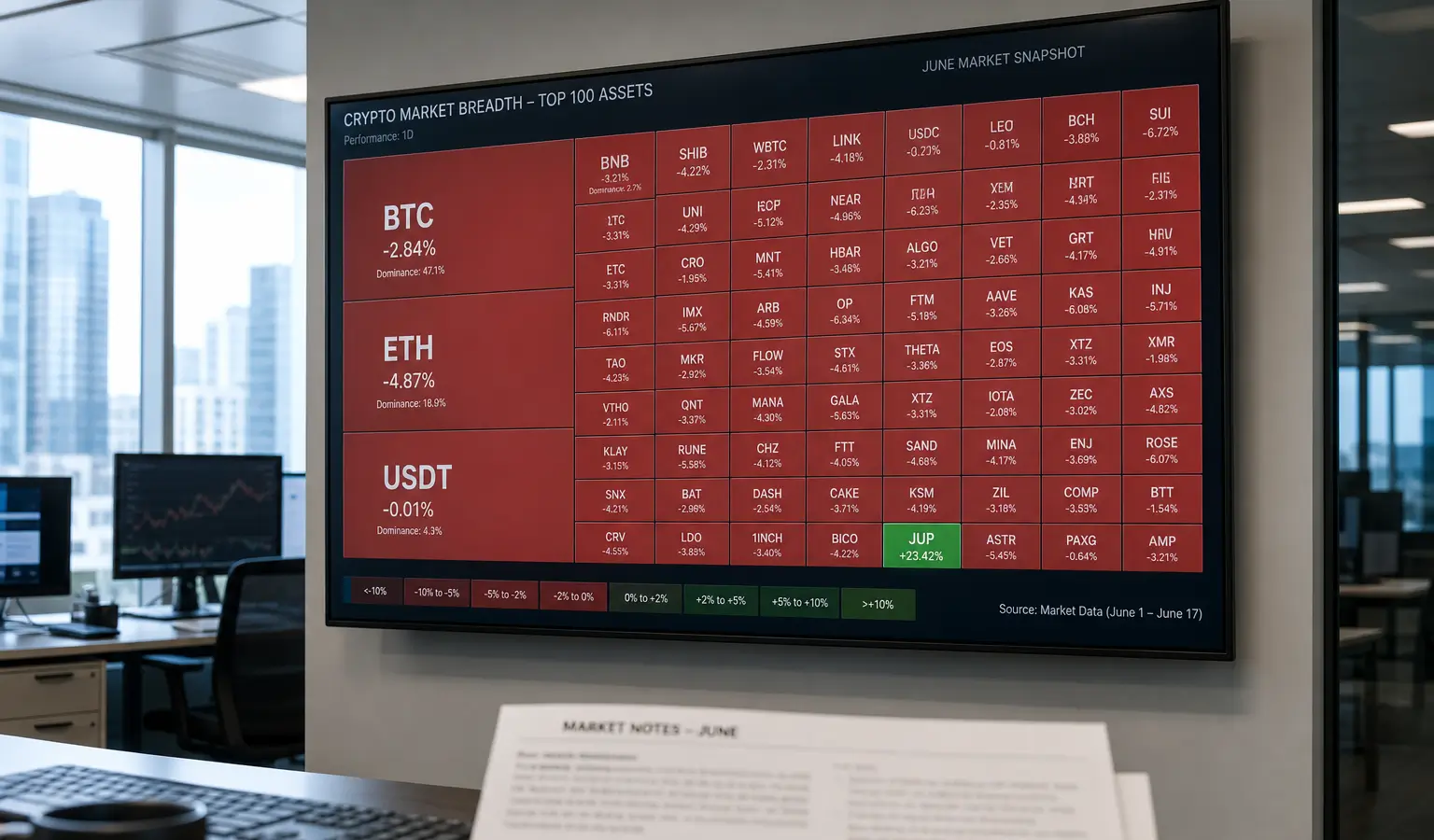
- In June, 82.1% of the top-100 crypto assets fell, even though the average return still finished in positive territory at 8.9%.
- The median return was minus 16.8%, largely because Velvet’s 1,715% surge pulled the average sharply higher.
- All eight tracked narratives posted negative median returns, with Layer 2, DePIN, and Layer 1 among the weakest.
June painted a very uneven picture for crypto. While 82.1% of the top-100 crypto assets ended the month lower, the average return still came out positive. In a quarterly report from CryptoRank, that disconnect was mostly explained by one massive outlier that masked how weak the broader market really was.
One Outlier Lifted the Average
Looking at the current top 100, excluding stablecoins, CryptoRank put June’s average return at 8.9%. But the median was minus 16.8%, which is a much clearer sign that most tokens were under pressure.
Velvet (VELVET) was the main reason the average looked so strong, after soaring 1,715% during the month. LAB (LAB), which gained 116%, and Audiera (BEAT), up 112%, were also among the top performers. The wide gap between the average and the median makes it clear that June’s upside was concentrated in just a few names.
April remained the strongest month of 2026, with 64% of top-100 assets finishing in the green. May had already shown signs of weakness, and June confirmed that market breadth deteriorated even further.
Narratives Stayed Under Pressure
The weakness went well beyond the largest coins. Among all tracked narratives with 24-hour volume above $1 million (€0.9 million), every one of the eight categories posted a negative median return.
Layer 2 networks were the weakest at minus 24.9%, followed closely by DePIN at minus 24.8% and Layer 1 at minus 22.8%. CryptoRank said losers outnumbered winners in nearly every category, which points to a market that remained defensive and struggled to build a broad recovery.
The same pattern showed up in the winner-loser split. DeFi recorded 42 gainers and 117 losers, while AI had 21 gainers and 35 losers. Bitcoin dominance held near 56% at the end of the quarter, suggesting capital continued to flow more toward Bitcoin than toward weaker altcoins.
That weakness was also visible in individual altcoins. For instance, the ongoing selling pressure on altcoins shows the sector has been under strain for some time, even as a few tokens have still managed sharp short-term rallies.
Why This Matters
For European crypto readers, the key point is that a positive average return does not necessarily mean the market is recovering in a healthy way. When a few extreme winners skew the numbers, the experience for traders and long-term holders can look very different from the headline result.
That is why market breadth is worth watching alongside price and volume, especially when several narratives are weak at once. In a market like this, a small group of tokens can lift sentiment on paper while most of the crypto market remains under pressure.