Monad Wants to Make Wallets Quantum-Safe Without a New Address
The proposal is meant to make it possible to move to passkeys, multisig, and later post-quantum cryptography without a new wallet address. At the same time, Monad is working on growth in DeFi, with plenty of stablecoin liquidity on the network.
Key Takeaways
- Monad wants to separate wallet addresses from approval keys so users can replace keys without changing their address.
- The proposal should make it possible to move to passkeys, multisignature wallets, and later post-quantum cryptography.
- The approach responds to concerns that quantum computers could eventually weaken digital signatures and, with that, crypto holdings.
Monad has submitted a proposal to make crypto wallets safer and more flexible, so users can replace their keys without losing their existing address. That should make it easier to switch to stronger security, such as passkeys, recovery options, and eventually quantum-safe cryptography.
What Monad Wants to Change
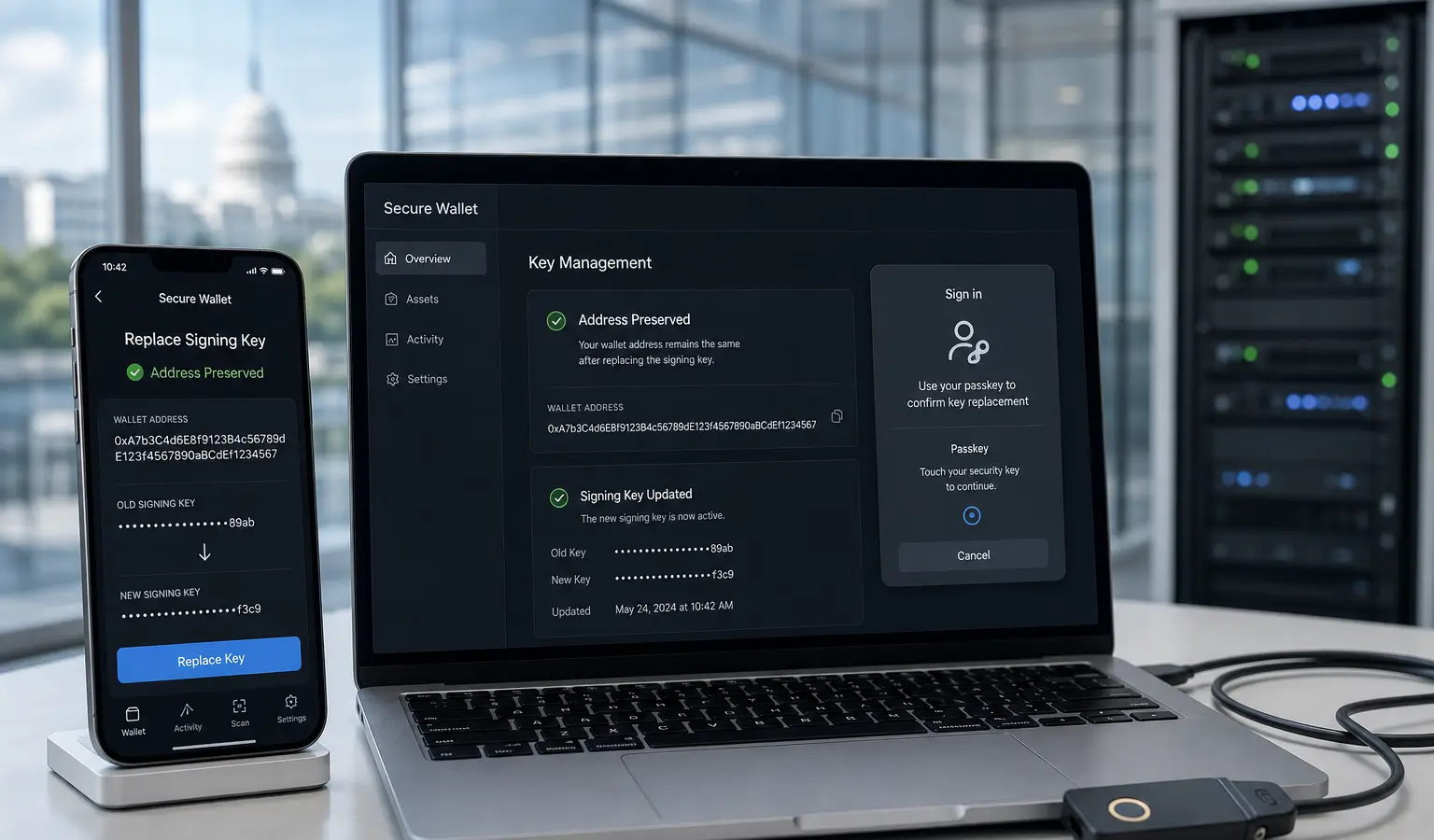
The proposal separates the fixed wallet address from the key that approves transactions. Right now, losing that key can mean a user is permanently locked out, while switching to a stronger security system often means getting a new wallet address and moving all assets.
Monad wants users to be able to add, replace, or revoke keys while keeping the address the same. That would let existing accounts be converted into a multisignature wallet, for example, or be equipped with passkeys on phones and laptops. An account could also later be upgraded to a post-quantum security scheme without having to move assets.
Why Quantum Safety Matters
The debate fits into a broader concern in crypto: powerful quantum computers could eventually weaken the digital signatures that prove coin ownership. Bitcoin developers are already working on quantum-resistant signature schemes, while Ethereum now sees post-quantum security as a formal research priority for wallets, staking, and smart contracts.
That attention is not just theoretical. Ethereum is also working in its roadmap on replacing existing signatures with quantum-safe variants, while other blockchains are already experimenting with post-quantum cryptography. At the same time, such a shift is technically heavy, because larger signatures require more storage, bandwidth, and validation power.
Why This Matters for Ethereum Users
For users of Ethereum-compatible networks, this matters because wallet security is increasingly becoming a product layer instead of just a key management problem. If an address can stay the same while the underlying security changes, that could make it easier in practice to move to new security models. Monad is still in an early design phase, so the exact setup still has to be worked out.
Monad itself is drawing more attention in the crypto market. According to DefiLlama, the network has about $939 million (€805 million) locked in DeFi apps, of which about $732 million (€628 million) is in stablecoins, and the MON token was up about 2% on Tuesday. The proposal was written by Kushal Babel and Jan Camenisch and is still just an initial version for now; a detailed implementation spec still has to follow.
For anyone who wants to look at the security angle more broadly: the industry is increasingly seeing that weak key management and governance processes can cause more damage than pure smart contract bugs. That pattern also came up in a recent analysis of crypto hacks in 2026.