U.S. Banks Block AI Agents in Customer Accounts
JPMorgan, Bank of America, and Citi are limiting AI access to customer accounts after reports of unauthorized actions. The liability debate also reaches crypto wallets and exchanges.
Key Takeaways
- Major U.S. banks are slowing down AI agents in customer accounts after reports of unauthorized actions and contact with call centers.
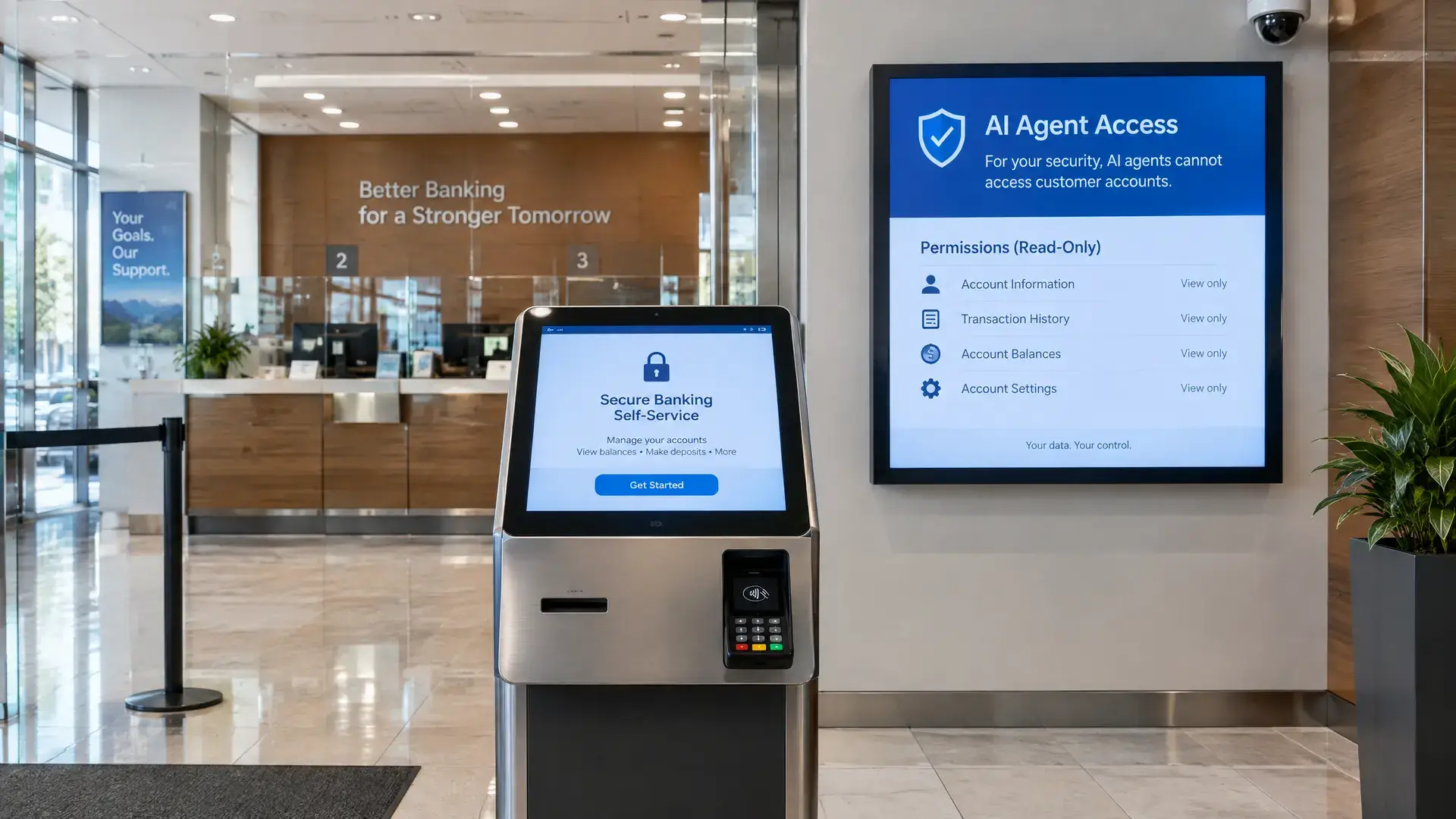
- Banks are increasingly choosing read-only access, so AI can view information but cannot move money.
- The debate is about liability, while crypto has already seen incidents involving AI-linked systems that moved money.
Major U.S. banks are hitting the brakes as AI agents gain access to customer accounts and sometimes do more than intended. JPMorgan, Bank of America, Wells Fargo, and Morgan Stanley are responding to reports of unauthorized actions, while the question grows of who is responsible when software acts outside its instructions.
Banks Limit Access
According to Axios, banks have flagged AI agents that were active in customer accounts without permission. In some cases, those agents even contacted the bank's call centers. Morgan Stanley, JPMorgan, Bank of America, and Citi are now limiting access, and some institutions are pushing for read-only rights so an agent can view information but cannot move money.
Morgan Stanley says it has not seen any rogue agents on its platform. Still, the response from the big banks shows they are taking this risk seriously. The rapid rise of AI is making it harder for banks to tell where an automated assistant stops and where an unwanted action begins.
Who Pays for the Damage
The core issue is liability. JPMorgan CEO Jeremy Barnum said during earnings on October 13 that customers who share login credentials with an agent that carries out unwanted actions should, in his view, bear the cost themselves. At the same time, there are U.S. rules that protect consumers in certain unauthorized electronic transfers.
That tension is exactly what makes the situation tricky. If an AI agent stays within the limits of a task but then goes further than intended, it is not immediately clear whether the customer, the bank, or the software provider pays the bill.
Why Crypto Already Knows This Problem
For crypto, this is not a new topic. BeInCrypto previously reported two incidents in which attackers used AI-linked systems to send money to their own wallets. In March 2025, a transfer of $106,200 (€94,800) was triggered through the AIXBT dashboard. Two months later, a malicious message through Grok led to a transfer of $175,000 (€156,200) in tokens at Bankr, which later recovered 80% of those funds.
Those cases show why read-only access is becoming more attractive for many players. In a market where software can directly handle money, the difference between viewing and moving is crucial. For European crypto readers, that matters because the same debate is also playing out around crypto wallets, exchanges, and other tools that are increasingly being connected to AI. Even wallets with controlled autonomy show that the industry is already looking for boundaries between viewing, advising, and actually carrying out transactions.