Moody's Gives Ripple's RLUSD an Investment-Grade Rating
Moody’s rates RLUSD on the XRP Ledger and Ethereum as investment grade, with reserves in U.S. Treasuries and cash. The timing lines up with Ripple’s bank license and new support from Robinhood and Coinbase.
Key Takeaways
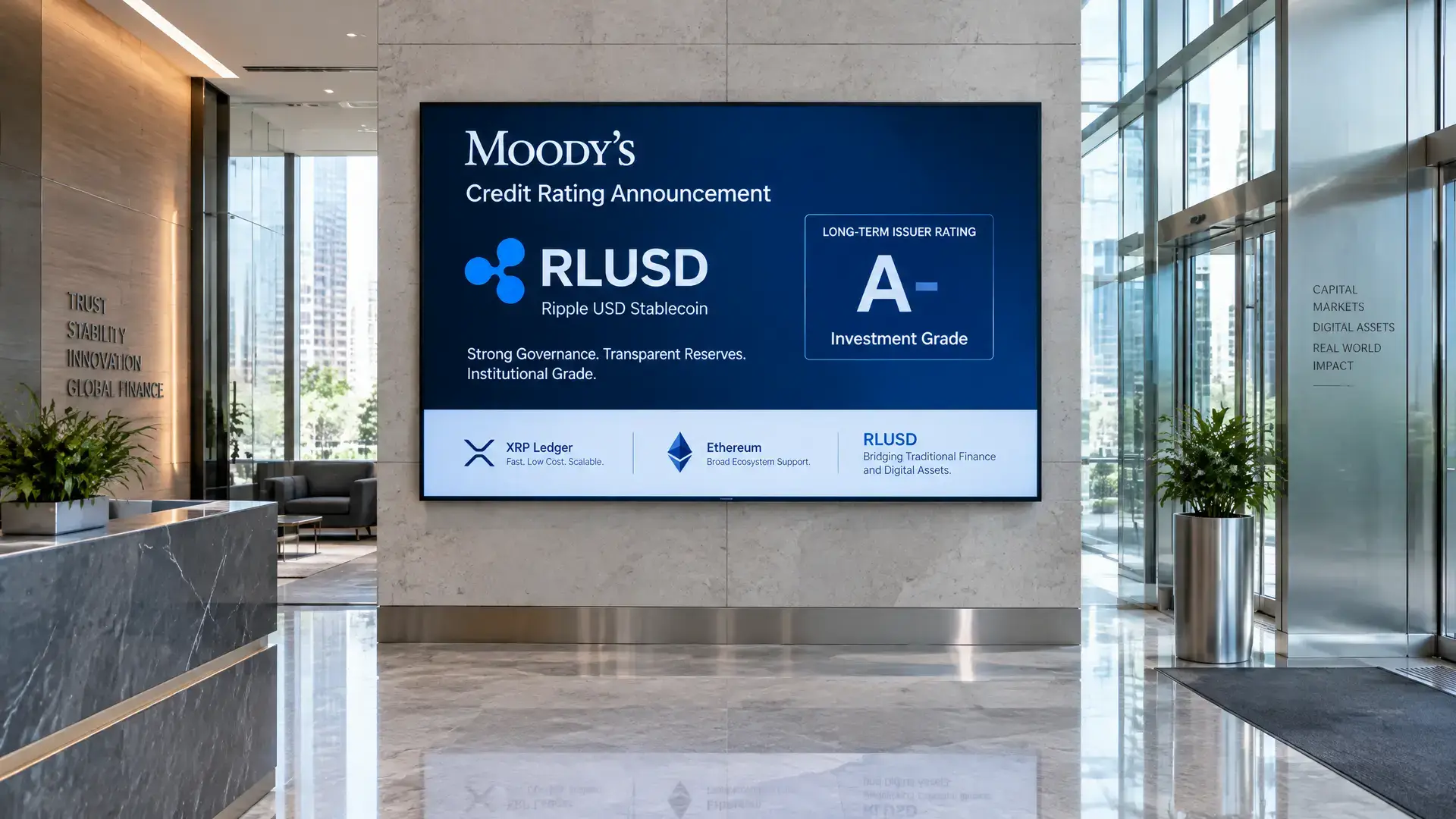
- Moody's gave Ripple's RLUSD an A2 rating for the long term and a P-1 rating for the short term, which amounts to an investment-grade assessment.
- The rating is based on reserves made up of short-term U.S. Treasuries and cash, plus a target reserve coverage of 103%.
- For XRP, the RLUSD rating does not automatically mean price gains; extra value depends on liquidity, bridge transactions, and institutional adoption.
Moody's gave Ripple's RLUSD an A2 rating for the long term and a P-1 rating for the short term. That gives the stablecoin an investment-grade rating. The bigger question is whether XRP holders also benefit from it right away.
RLUSD Gets a Formal Rating
The rating was assigned on October 28 and applies to RLUSD on both the XRP Ledger and Ethereum. Moody's looked at the quality of the reserves, liquidity, the redemption structure, and the separate custody of the funds. According to the assessment, the reserves mainly consist of short-term U.S. Treasuries and cash at BNY.
It also matters that Standard Custody & Trust Company aims for 103% reserve coverage. RLUSD has built up a market value of nearly $2.5 billion (€2.2 billion) since launching in December 2024. Ripple executive Jack McDonald called it the first stablecoin with a Moody's investment-grade rating.
New Rules for Stablecoins
Moody's also pointed out that the GENIUS Act, which takes effect in January 2027, is supposed to protect the required reserves from a possible issuer bankruptcy. The law also requires stablecoin issuers to hold reserves equal to at least 100% of the outstanding stablecoins, backed by high-quality and liquid assets. That makes RLUSD's rating relevant beyond Ripple itself, since regulators and institutional players are increasingly looking at fixed frameworks for stablecoins.
What This Means for XRP
The timing stands out because Ripple also received final approval for Ripple National Trust Bank from the OCC on October 26. That bank is allowed to manage RLUSD reserves and offer fiduciary custody, but it cannot take regular deposits or issue loans. Soon after, Robinhood announced a partnership with Ripple to offer RLUSD in its app, while Coinbase has now also added support through the XRP Ledger, Ethereum, and Base.
For XRP, that does not automatically mean a big price jump. The strongest case is still that XRP is a bridge asset for payments between different currencies. Whether RLUSD's growth eventually pulls a lot of extra value into XRP depends mostly on deeper liquidity, more bridge transactions, and institutional trading. Ripple had already leaned more heavily into that institutional role with treasury clients and RLUSD, which shows that the stablecoin is mainly being positioned as a payment and settlement tool.