Perpetual Swaps Dominate Crypto and Shape Price Discovery
Perps now account for most crypto trading, with funding rates and liquidations sitting at the center of price discovery for Bitcoin and Ethereum.
Key Takeaways
- Perpetual swaps have become the dominant trading tool in crypto and are estimated to process $40 trillion to $50 trillion a year.
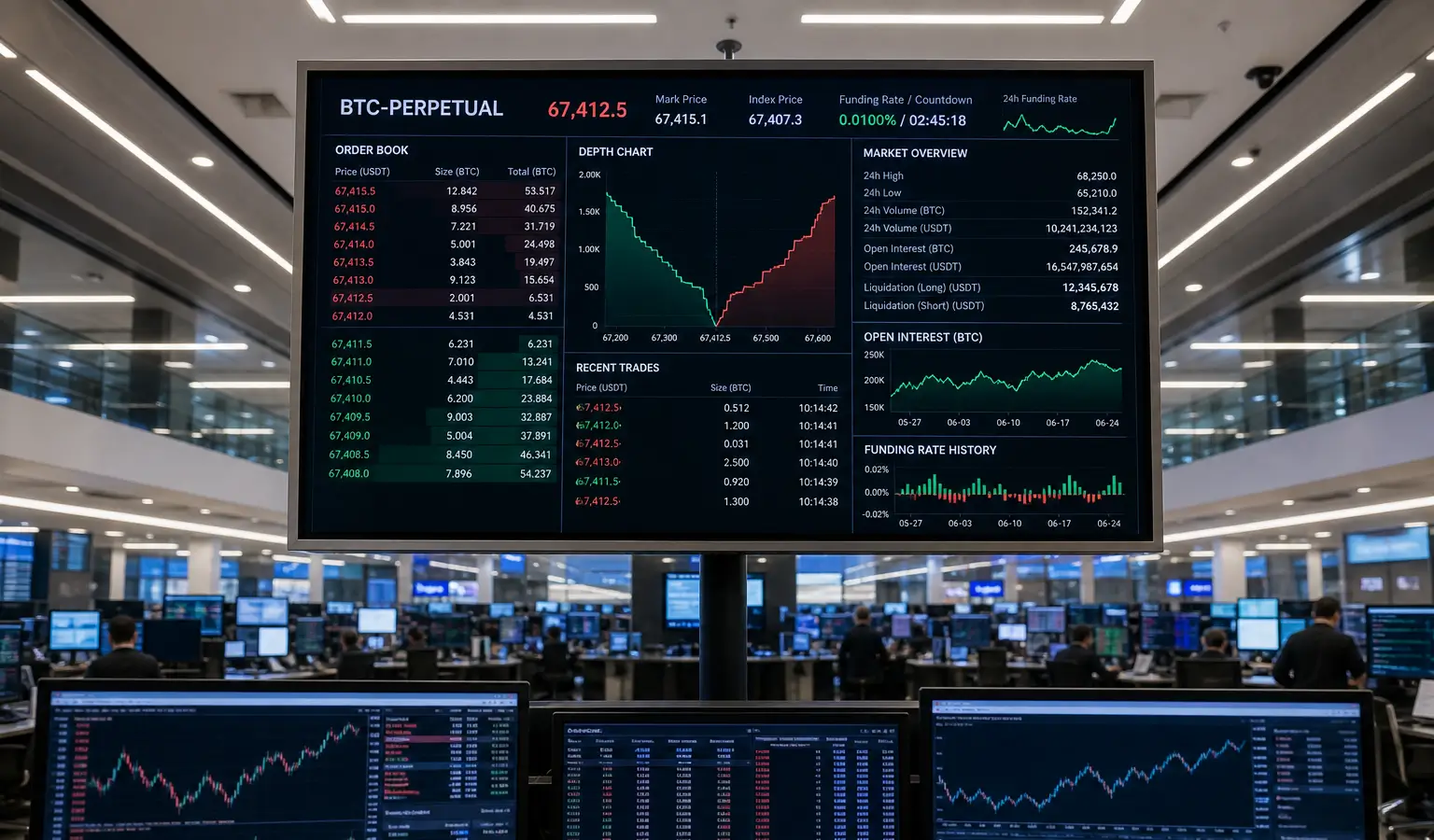
- Perps have no expiration date, and funding rates every eight hours keep the contract price close to the spot price.
- In 2025, the ten biggest perpetual swap exchanges processed $92.9 trillion in volume combined, highlighting the shift toward derivatives.
Perpetual swaps, or perps, have taken over as crypto’s main trading instrument. They are estimated to handle between $40 trillion (€35.1 trillion) and $50 trillion (€43.9 trillion) a year, far more than spot markets. For professional traders, hedge funds, and retail speculators alike, perps are often the go-to way to get leveraged exposure to Bitcoin or Ethereum without holding the underlying asset.
Why Perps Work Differently
Perps were designed to solve a problem with traditional futures. In standard markets, futures expire on a fixed date, which forces traders to roll positions if they want to stay exposed. In crypto’s early days, that setup created headaches, including futures frequently trading above Bitcoin’s spot price, which made the market harder for retail traders to read.
BitMEX, the derivatives exchange founded by Arthur Hayes and Ben Delo, first tried to address that issue by shortening contract expiries again and again, moving from quarterly contracts to monthly, weekly, and even 24-hour expiries. The real turning point came in May 2015, when BitMEX introduced the perpetual swap, a contract with no expiration date. That lets traders keep a position open for hours, days, or even years without having to settle or roll it over.
Funding Keeps the Price Aligned
Because perps never expire, their price can drift away from spot if nothing keeps it in check. That is where the funding rate comes in. Every eight hours, money changes hands between longs and shorts. If the perp trades above spot, longs pay shorts. If it trades below spot, shorts pay longs. The exchange does not take a cut.
This mechanism helps pull the contract price back toward the underlying market and makes large gaps more expensive to maintain. Market makers also use the spread when it gets wide, often shorting the perp while buying spot at the same time if a clear premium appears. In 2025, the ten biggest perpetual swap exchanges processed $92.9 trillion (€81.6 trillion) in combined volume, up 64.6 percent from 2024. That underscores how much crypto price discovery has moved into derivatives.
Why This Still Matters
For European crypto readers, the takeaway is that perps are no longer a niche product. They are now a core part of how the market works. The growth of decentralized venues like Hyperliquid also shows that capital is increasingly looking beyond centralized exchanges, helped by capital efficiency and the broad range of assets available to trade. At the same time, there is growing debate over whether this derivatives model could extend beyond crypto, including to traditional stocks or tokenized assets. That broader push is already showing up on major trading platforms: Coinbase Expands Into Derivatives to become less dependent on trading fees.
Leverage is another big part of the appeal. During the boom years, some platforms offered as much as 100x leverage, meaning even a small price move could produce a large gain or loss. To keep that risk in check, exchanges rely on automatic liquidation systems that close positions before balances go negative. Together, funding, leverage, and liquidation mechanics have made perps one of the most widely used tools in crypto trading.