Polymarket Changes Settlement Rules After Fraud Probe
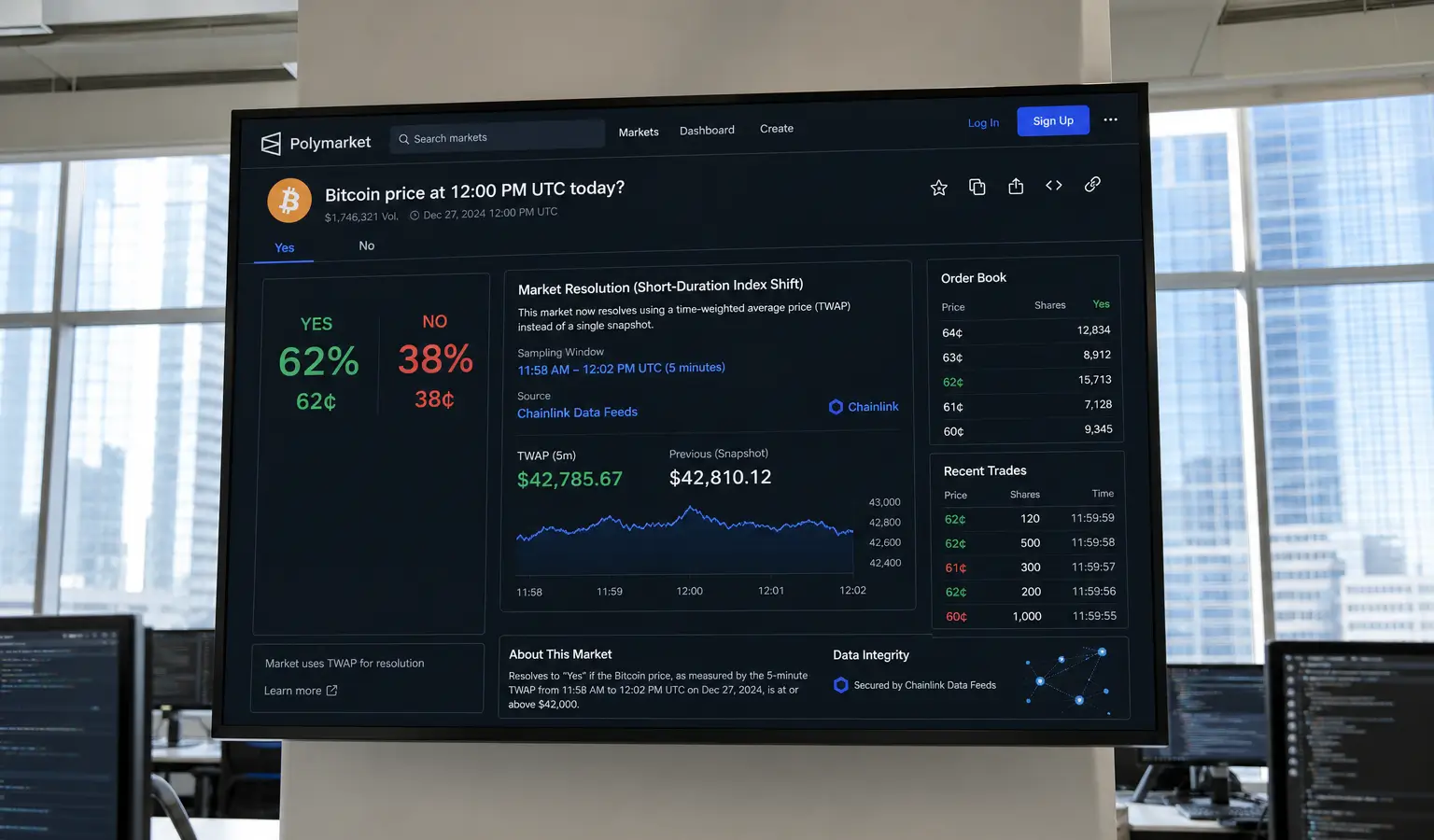
Polymarket will now use TWAP through Chainlink Data Streams to reduce the impact of last-second price moves on five-minute, 15-minute, and four-hour markets.
Key Takeaways
- Polymarket is changing how its short crypto contracts settle after complaints about possible settlement manipulation.
- The platform is replacing a single price snapshot with a time-weighted average price, using 30 seconds for five-minute markets and 60 seconds for 15-minute and four-hour markets.
- Researchers identified 821 accounts that may have benefited from manipulated settlement windows, with a total of $8.2 million.
Polymarket is overhauling the way its short crypto contracts settle after months of trader complaints and a probe into possible settlement manipulation. Instead of relying on one final price snapshot, the prediction market will now use a time-weighted average price, or TWAP, which should make last-second price swings less likely to decide the outcome.
New Settlement Method
According to Polymarket, five-minute markets will now be settled using a 30-second average. Markets that expire in 15 minutes or four hours will use a 60-second average. The price feed comes through Chainlink Data Streams, the platform said.
On X, the company said the rule change is meant to protect market integrity in its crypto up-down markets. As part of the rollout, Polymarket is also offering $1 million (€0.9 million) in liquidity rewards across all affected markets in August.
The update comes after a study by researchers at Stanford University and Singapore Management University. The researchers identified 821 accounts whose activity, they said, lined up with possible manipulation during settlement windows. Those accounts reportedly earned a combined $8.2 million (€7.1 million) during periods the researchers described as likely manipulated.
What the Research Found
The researchers examined roughly two months of five-minute contracts on Bitcoin. They found unusually large orders on Binance in the final seconds before settlement, followed by sharp reversals in Bitcoin’s price.
The paper did not prove that the traders intended to manipulate the market, and it also did not directly show that the spot orders came from the same people holding positions on Polymarket. Even so, the authors said that, once market makers were excluded, 93 percent of losses in the windows they flagged as manipulated were borne by retail traders.
In the researchers’ view, the problem is built into the structure of the product: if a contract settles based on a market price, that price can be pushed around by moving the underlying market itself. For European crypto readers, the takeaway is that short prediction markets can be highly sensitive to liquidity and order flow in the final seconds before settlement.
Broader Debate Around Prediction Markets
This debate is not happening in isolation. Kalshi has faced similar questions in the past, although the platform says it settles markets using a regulated CF Benchmarks price index and can more easily review suspicious activity because all traders are verified.
Polymarket, by contrast, operates globally with limited regulatory oversight, uses USDC on the Polygon blockchain, and does not require KYC for trading. That makes the switch to TWAP especially important as prediction markets come under more scrutiny following earlier regulatory action, including by the CFTC in the United States.