Robinhood Says Crypto Event Contracts Are Growing Faster Than Sports
Crypto event contracts are growing fast at Robinhood and pushing sports into the background. The growth comes as legal pressure builds on Kalshi and Polymarket in the U.S.
Key Takeaways
- Robinhood CEO Vlad Tenev says crypto event contracts are growing faster than sports contracts on the platform.
- According to Tenev, sports contracts will be in the minority within prediction markets within a few years.
- Robinhood is continuing to build its own prediction market infrastructure and processed about nine billion event contracts over the past year.
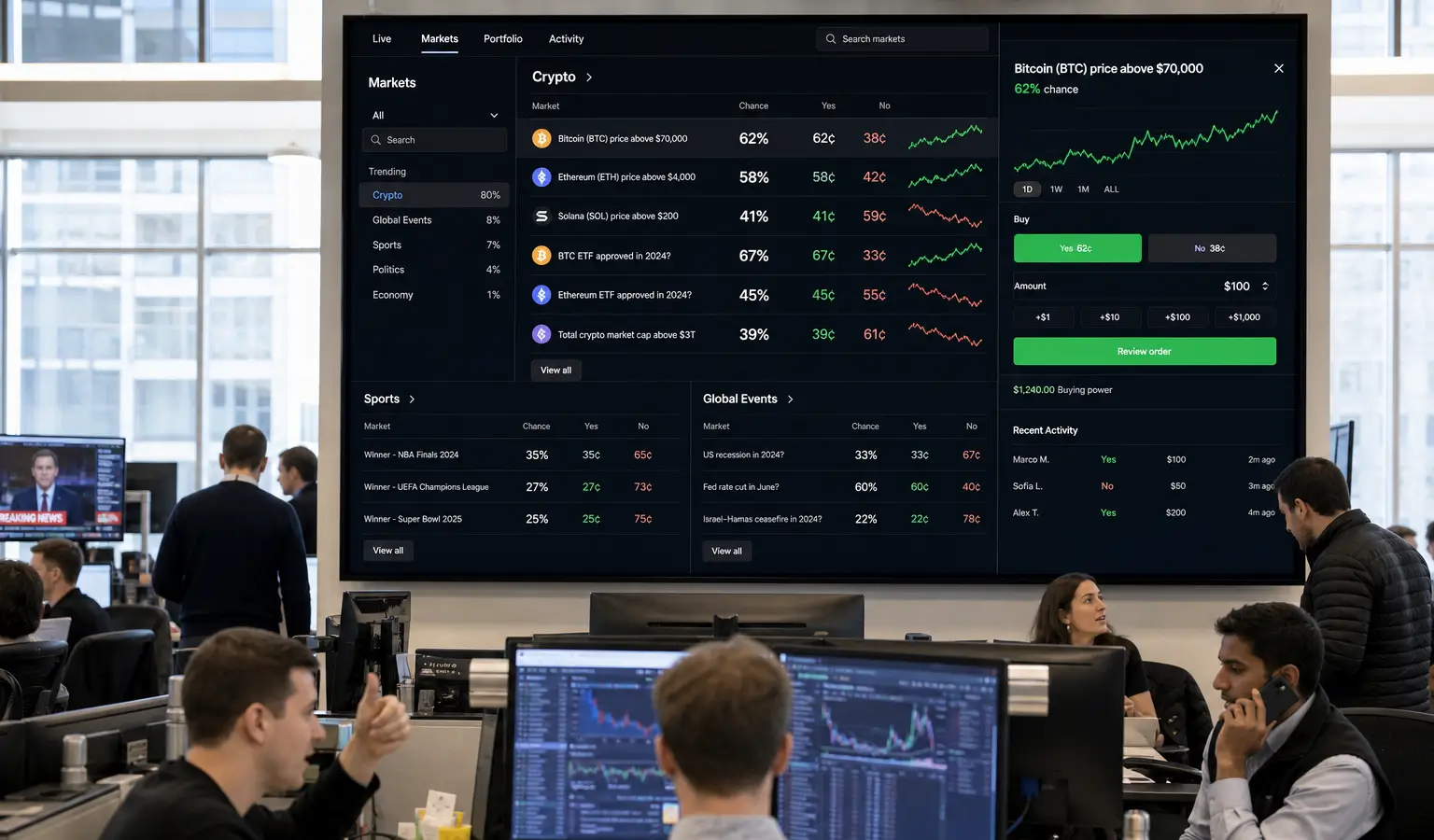
Robinhood CEO Vlad Tenev says crypto event contracts already make up a strikingly large share of prediction market activity on the platform. According to him, sports contracts will even be in the minority within a few years. The comment highlights how quickly this market is growing in the U.S., even as the fight over sports-related contracts keeps heating up.
Crypto Is Gaining Ground
Tenev told CNBC that event contracts, meaning yes-or-no trades on the outcome of a future event, are not simply a new name for sports betting. He sees crypto as the category growing faster than sports. "We’re already seeing other categories like crypto taking a disproportionate share. And I think within a few years, sports will actually be in the minority," he said.
That shift fits into broader growth in prediction markets. In March 2026, total trading volume rose to $25.7 billion (€22.4 billion), up 10.6% from February. Analysts at Bernstein also think event contract volumes could reach about $240 billion (€209 billion) by the end of 2026, with a possible $1 trillion (€0.9 trillion) market in 2030. Those are not certainties, but they do show how quickly the sector is maturing.
Legal Pressure on Sports
Sports contracts are under a microscope in the meantime. New York sued Kalshi in July and is seeking more than $36 billion (€31.4 billion) in damages plus a nationwide ban on the platform’s event contracts. Baltimore separately filed a case against Kalshi and Polymarket, saying the city sees those products as unlicensed sportsbooks. The New York City Council is also looking into how Kalshi, Polymarket, Coinbase, and Gemini Titan offer prediction contracts to residents.
Crypto-related contracts have so far mostly stayed outside that specific sports case. That gives that category more room to grow while the legal fight over sports continues. It also lines up with the broader uncertainty around new CFTC rules, which could end up shaping how far event contracts are allowed to go.
Robinhood Keeps Building
Robinhood is also making moves in this market. The company recently formed a joint venture with market maker Susquehanna to acquire crypto exchange MIAXdx, formerly LedgerX. It wants to use that to build its own prediction market infrastructure. Robinhood now calls prediction markets its fastest-growing revenue line, with about nine billion event contracts traded on the platform over the past year.
For European crypto followers, the big takeaway is that the line between traditional derivatives and crypto products is getting blurrier. The CFTC is now looking for more clarity and stressing federal control over prediction markets, while firms like Wintermute are already providing liquidity on both sides. That suggests this market is no longer being driven only by retail traders, but is also drawing more and more institutional players.