RWA Perps Are Growing Faster Than Tokenization
RWA perps are quickly gaining ground with 24/7 trading in commodities and AI stocks. Robinhood is already offering them to European customers, while oversight is still lagging.
Key Takeaways
- DWF Labs market strategist Martin Lee says RWA perps are expanding faster than tokenization and could become a key link between crypto and traditional markets.
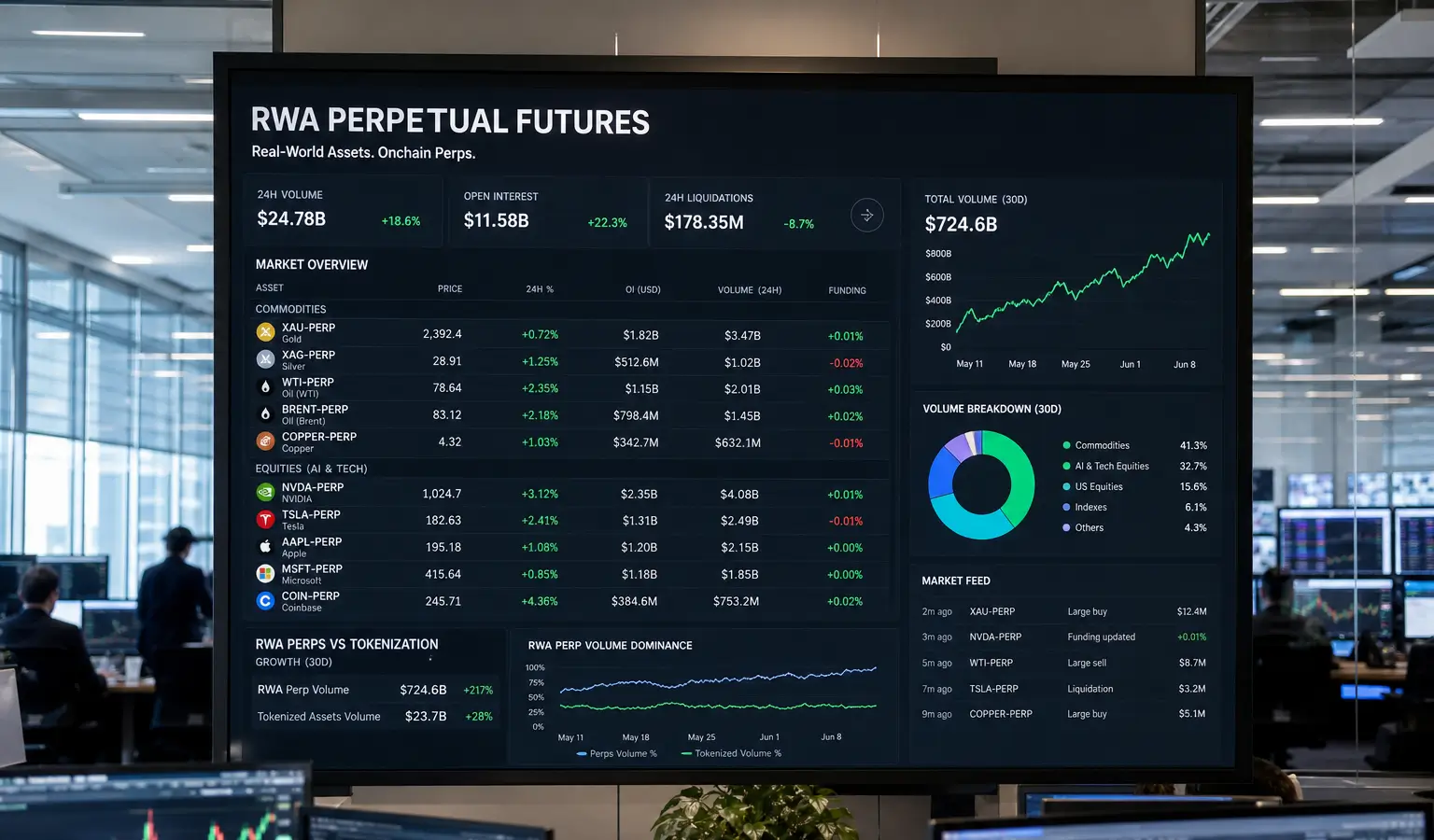
- In May, RWA perps handled $347 billion in volume, up from $230 million at the start of 2025, while daily open interest on DEXs reached $4.5 billion in July.
- Lee says RWA perps now represent 31 percent of onchain perp volume, and Robinhood is already offering them to European customers.
According to DWF Labs market strategist Martin Lee, RWA perps are moving faster than tokenization and may end up becoming the next major connection between crypto and traditional finance. Tokenization is already being adopted by major firms like BlackRock, Fidelity, and Franklin Templeton, but Lee argues that perpetual futures tied to real-world assets could have the bigger long-term impact.
Volume Is Surging
The data points to a steep rise. RWA perps processed $347 billion in volume in May, up from just $230 million (€200 million) at the start of 2025. That works out to a 1,472x jump. On DEXs, daily open interest reached a record $4.5 billion (€3.9 billion) in July, while exchanges had already handled $1.32 trillion (€1.2 trillion) in volume by the end of May, 13 times the total for all of 2025.
That growth is being driven partly by crypto traders looking for exposure to commodities and AI stocks, but the product design itself is also a big reason. Perps trade 24/7, so traders can respond immediately when news breaks outside normal market hours. Lee points to oil perps on Hyperliquid, which were already moving on the Iran conflict before CME reopened.
Why Perps Are Attractive
Lee argues that perps are often a cleaner product than futures or options. Futures expire, options require dealing with complex greeks, and the user experience is usually less straightforward. Perps preserve the speculative upside, but package it in something simpler that can be traded at any time.
How quickly new markets can be launched also matters. Tokenized assets tend to come with more legal complexity, while perp markets can go live much faster. That makes it easier to create synthetic markets, including pre-IPO contracts. When Cerebras went public on Nasdaq in May, Hyperliquid had already priced the pre-IPO perp at $354 (€308), close to the opening price of $350 (€305).
What This Means for Europe
For European crypto users, the main point is that these products are getting closer to mainstream investing. According to Lee, Robinhood is already offering RWA perps to European customers, which shows how much the line between crypto-native derivatives and traditional brokerage products is starting to blur. At the same time, oversight is still catching up, and regulators as well as established financial firms are still working out how these products fit into existing rules.
Lee says RWA perps now make up 31 percent of onchain perp volume, up from 1.3 percent at the start of the year. That suggests they are becoming more than just another trading niche and could keep reshaping how investors think about different asset classes.