Solana and Hyperliquid Compete for SpaceX Trading
SpaceX perps and tokenized stocks are turning Solana and Hyperliquid into a test case for onchain price discovery. The big question is which network will be first to pull in traditional markets.
Key Takeaways
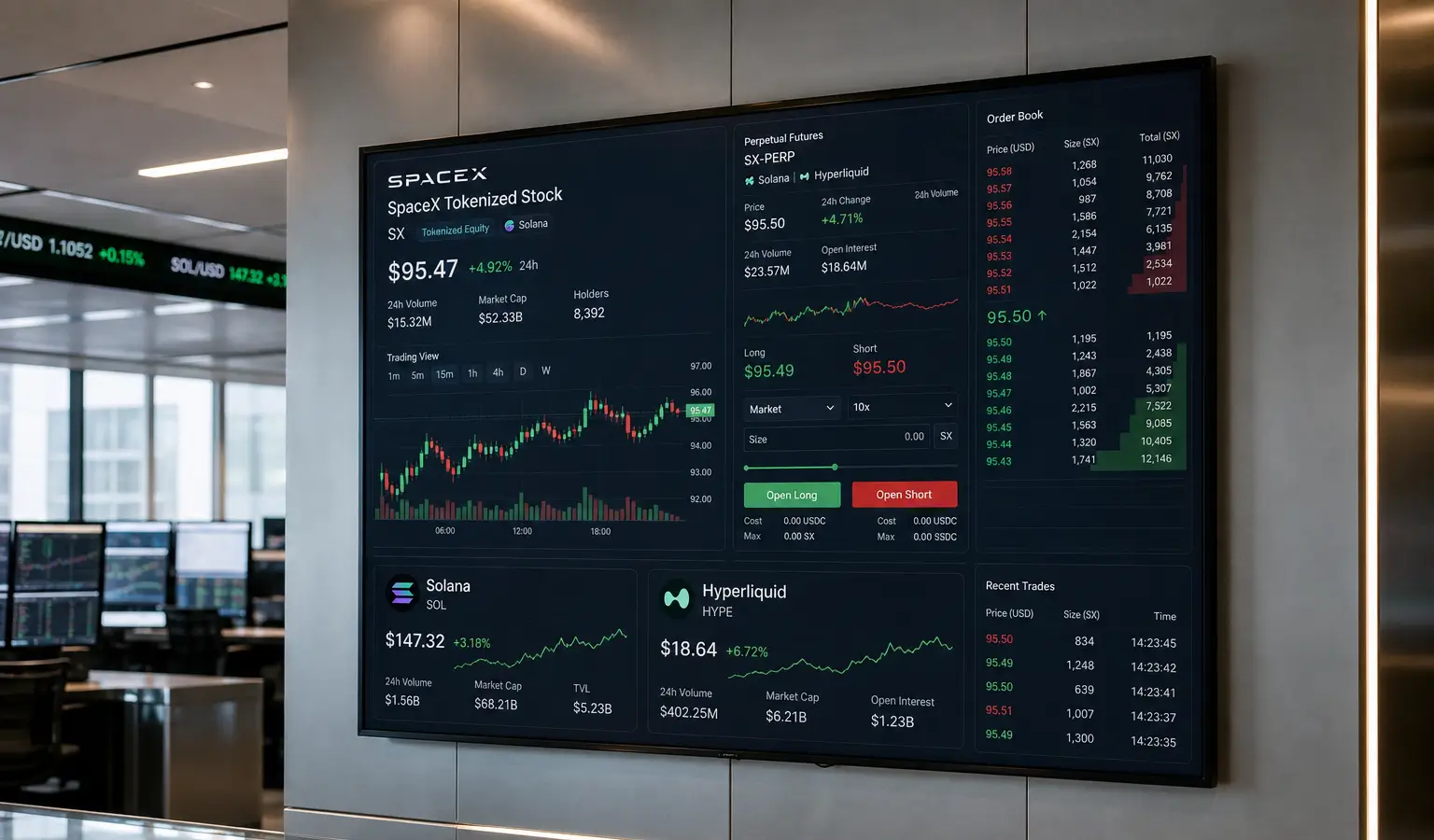
- Trading in SpaceX shares and perpetual futures on Solana and Hyperliquid has become a fight over which network will serve as the entry point for onchain traditional markets.
- Brian Smith says perpetual futures can act as a Trojan horse for bringing traditional finance onchain, and argues that price discovery is already happening.
- Solana’s decentralized derivatives market reached a record $147 billion in perpetual swap volume in Q2 2026.
Trading in SpaceX shares and perpetual futures on Solana and Hyperliquid has emerged as a fresh flashpoint in crypto. Brian Smith, president of the Jito Foundation, says the real issue is not just trading activity. In his view, the bigger question is which network will become the bridge for traditional financial markets as more of that activity moves onchain.
SpaceX as a Test Case
SpaceX’s IPO last month drew global attention, especially because the company quickly became one of the largest in the world. For crypto traders, though, the bigger story was that tokenized stocks and SpaceX-linked perps were actively changing hands on Solana and Hyperliquid, with billions in volume on the line. Smith sees that as far more than a narrow trading niche. He describes perps as a kind of Trojan horse for bringing traditional finance onchain.
That view also lines up with a broader market shift. During tensions with Iran, traders turned to onchain derivatives venues, where gold and oil were repriced in real time while CME was closed. Episodes like that suggest crypto platforms are no longer limited to native tokens. They are also becoming places where broader market prices get set.
Why Solana Needs to Win
The Jito Foundation backs Solana’s execution layer and liquid staking ecosystem, and Smith says that is exactly where the competition gets interesting. He argues that Solana already has the speed, throughput, and low-cost structure needed to support markets like this, but Hyperliquid got an early edge because it was designed from the start for derivatives traders.
That means the race is about more than raw technology. Liquidity tends to attract more liquidity, and the network that can keep trading active on Sundays and outside normal market hours may be the one that pulls a larger share of the market in its direction. Smith also notes that the implied SpaceX price on perps was around $171 (€150) and nearly matched the first listing at $171 (€150), which he says is evidence that these markets are already contributing to price discovery.
Why This Matters for European Traders
For European crypto traders, the takeaway is how quickly onchain derivatives are moving into traditional assets. In Q2 2026, Solana’s decentralized derivatives market reached a record $147 billion in perpetual swap volume, a sign that the market structure is maturing quickly. If more pre-IPO stocks, commodities, and index-like products start trading on crypto venues, that could further strengthen the role of Solana and similar networks across the wider crypto market. Solana’s rise in tokenized stock trading shows just how fast that shift can take hold.