Clarity Act Failure Wipes Out $571 Million in Longs
After the vote failed in the U.S. Senate, bitcoin and ether longs were hit the hardest. The focus now shifts to the CFTC and SEC, which could still write their own rules.
Key Takeaways
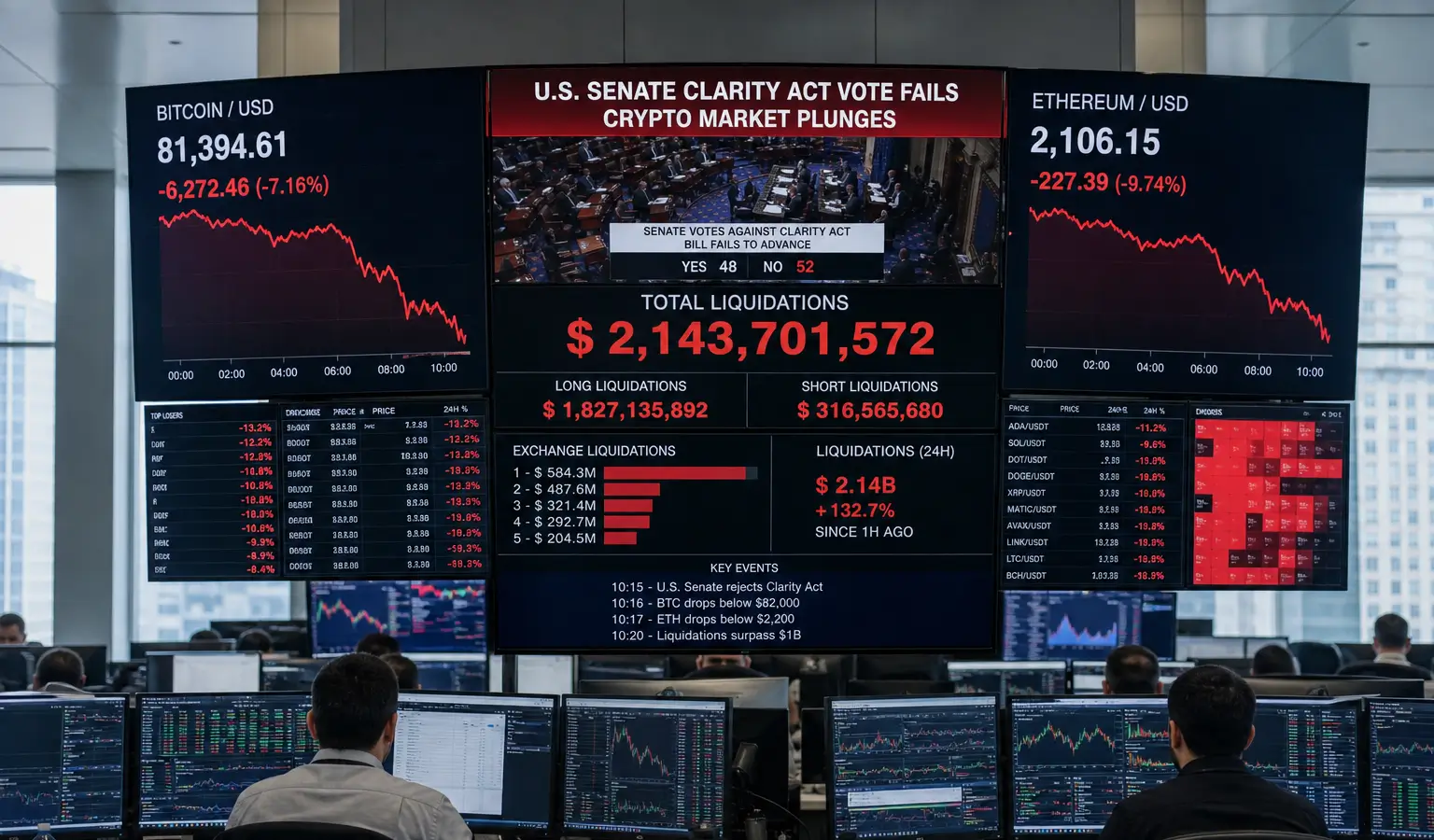
- After the Clarity Act vote failed, about $571 million in long positions were liquidated in 24 hours.
- Bitcoin and ether were hit the hardest, with about $190 million in liquidations each.
- The Senate blocked the bill by a 49 to 50 vote, after which attention shifted to the CFTC and SEC.
Crypto traders holding bullish futures positions took a hard hit over the past 24 hours after the Clarity Act failed to clear a procedural vote in the U.S. Senate. According to CoinGlass, about $571 million (€495 million) in long positions were liquidated during that period, the highest amount since August 22. Shorts accounted for only about $100 million (€86.7 million) of that wipeout.
Bitcoin and Ether Hit
Bitcoin and ether took the biggest hits, with about $190 million (€165 million) in liquidations each. That fits the picture that many traders had positioned themselves for further gains in those two assets. Analysts had earlier pointed to ether and DeFi tokens as the names most likely to benefit if the Senate approved the bill.
Other major tokens were hit too. XRP longs lost about $30 million (€26 million), and Solana longs lost about $22 million (€19.1 million). The numbers show that the market was clearly positioned for more upside momentum, especially based on the expectation that the Clarity Act would move forward.
Political Hope Turned Around
That expectation got stronger earlier this week when reports circulated that President Donald Trump was willing to make concessions on the bill's ethics provisions. Bitcoin then climbed to nearly $80,000 (€69,300), up from around $77,000 (€66,700) on Monday. Sentiment then reversed once it became clear that Democrats were sticking to their position.
The Senate ultimately blocked the bill in a 49 to 50 vote. That does not completely kill the issue, but it does make the political path more difficult. The CFTC and SEC can still work out their own rules, which means attention now shifts to the executive branch and the regulators.
What This Means for Traders
For European crypto followers, this matters mainly because liquidations can pile up fast when a lot of traders are on the same side of the market. The move also shows how strongly U.S. regulation still affects the crypto market. At the same time, Bitcoin's current price around $75,700 (€65,600) suggests the damage is still limited for now and that the market has not fully broken out of its recent range.