Solana Nears 200 Milliseconds After Latest Upgrade
The SIMD-0525 upgrade further shortens slot duration, while validators face more pressure and higher operational demands. Solana is testing the balance between speed, capacity, and network stability.
Key Takeaways
- Solana is lowering block time to 200 milliseconds on Friday, after earlier steps through 350, 300, and 250 milliseconds.
- The change under SIMD-0525 raises block frequency to five chances per second, while theoretical network capacity stays about the same.
- Validators face more pressure from voting more often and having less time per slot; the upgrade is already on testnet and devnet, but mainnet depends on network conditions.
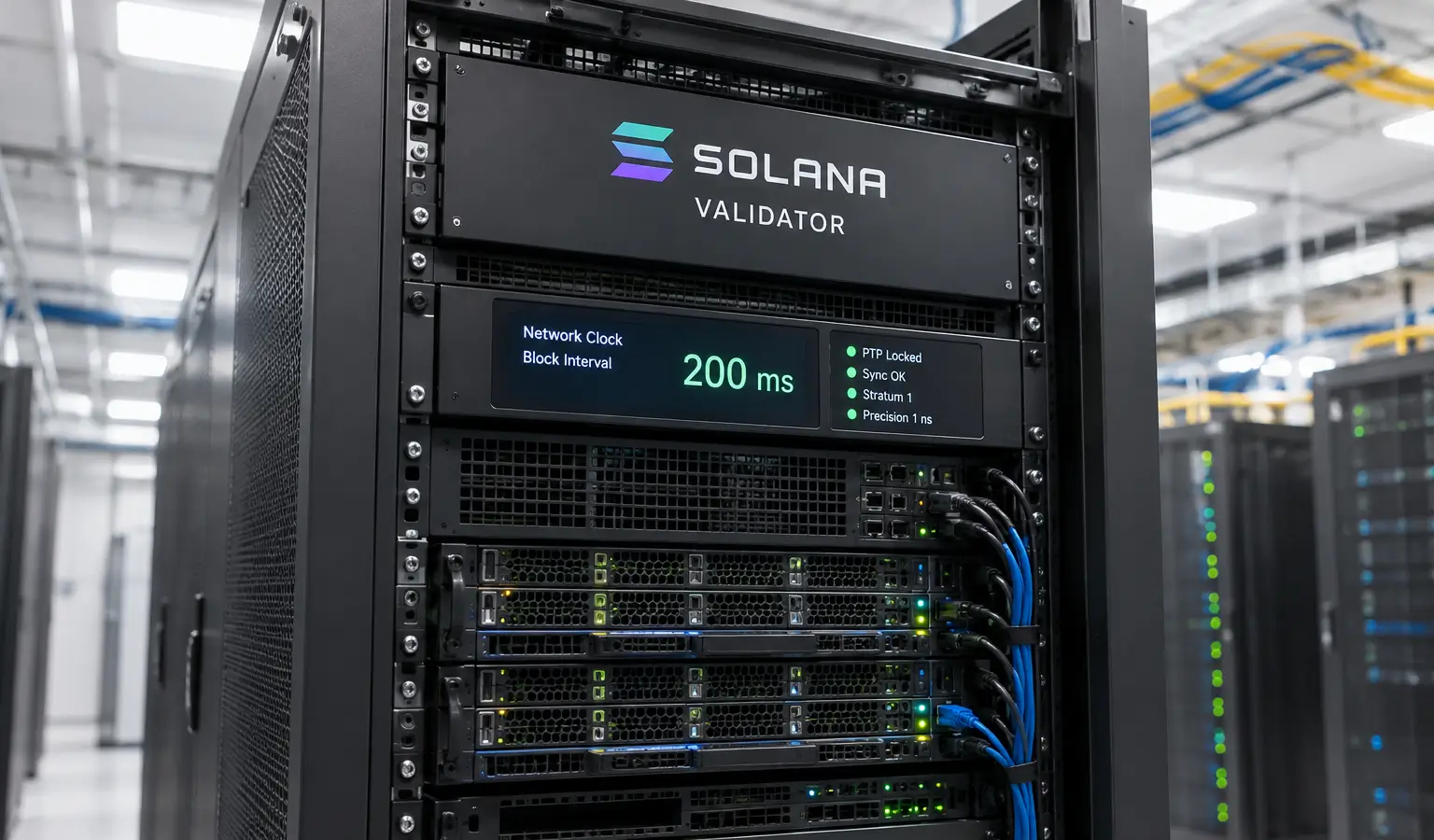
Solana is getting ready for another step in its network upgrade. On Friday, the time between blocks is set to drop to 200 milliseconds. That wraps up a series of speed increases that have already cut block time sharply since August.
The latest reduction, from 250 milliseconds, is scheduled for epoch 1053 and is expected to take effect around 15:00 UTC, according to Anza, the developer behind the widely used Agave validator software. Solana would then have five chances per second to produce blocks, compared with 2.5 under the original 400-millisecond setting.
What Changes Technically
A slot is the short time window in which a designated validator can add transactions to the blockchain. Shorter slots mean trading apps, crypto wallets, and crypto exchanges get updated information more often. For users, that basically means a submitted transaction may have to wait less time before it gets processed.
The adjustment falls under SIMD-0525. That proposal also limits how much computing work validators can pack into each block. At 200 milliseconds, a block can contain a maximum of 30 million compute units, compared with 37.5 million at 250 milliseconds. So blocks arrive more often, but each block carries less work, which keeps the network's theoretical capacity about the same.
Solana already rolled out the earlier steps on August 21, August 28, and September 18. At that point, the target first moved to 350 milliseconds, then to 300 milliseconds, and then to 250 milliseconds.
Pressure on Validators Is Rising
The faster clock also has a downside. Validators that vote on every slot have to do that about twice as often as under the original setup. That raises their costs and puts more strain on their network connections.
Wallets and other apps also get less time to use a recent blockhash. That reference is included in transactions to prevent reuse. Transactions that need manual approval or offline signatures can become harder to handle because of that.
Shorter slots also reduce the period in which one validator determines the order of transactions. That can shrink the room to delay transactions or to take advantage of price differences already visible on other exchanges.
Mainnet Is Still a Test
The upgrade has already been rolled out on testnet and devnet. According to developers, the move to mainnet still depends on network conditions, especially how often validators miss their assigned block chances. Solana Compass previously showed that the 250-millisecond setting averaged about 266 to 269 milliseconds in recent epochs, so a little slower than the target.
For European crypto readers, this matters because Solana is once again showing how quickly a major mainchain can adjust its infrastructure. At the same time, the upgrade makes it clear that higher speed is not free: the operational demands on validators get heavier, while the time for transaction processing and network coordination gets shorter. That fits the broader move toward faster finality, like Alpenglow, which is supposed to make Solana much faster over time.