Solana Vote Puts Higher Burns and Lower Inflation Proposal in Focus
The proposal pairs higher transaction fees with a faster reduction in SOL issuance. It is still far from getting enough validator support to reach a real vote.
Key Takeaways
- Solana validators are backing a proposal that combines higher transaction burns with a faster reduction in new SOL issuance.
- Daily burns could rise from about 650 SOL to 7,500 to 9,000 SOL, but they would still stay below daily inflation issuance.
- The proposal still needs a lot more support to reach a real vote, and current signaling is still well below the required threshold.
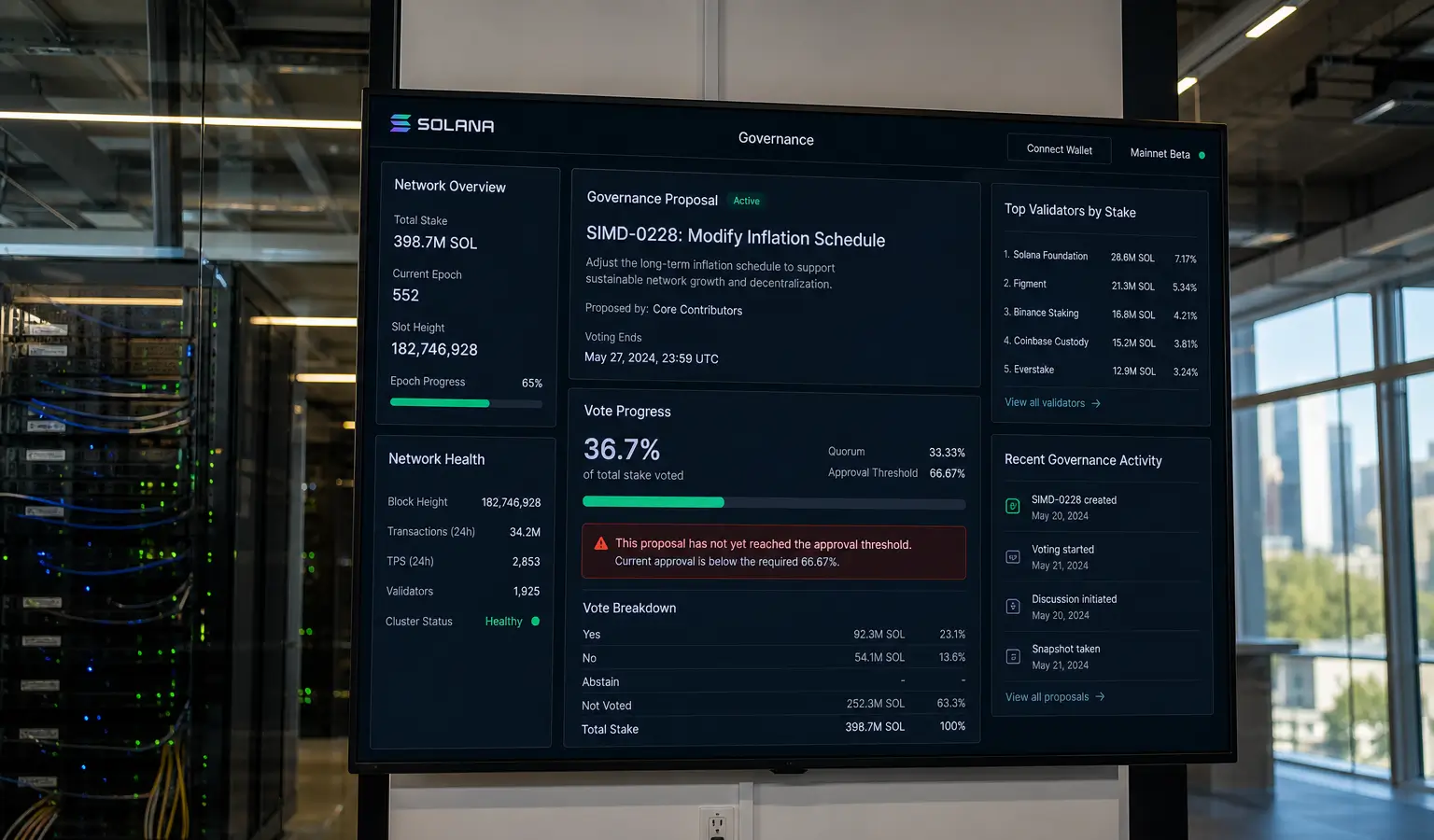
Solana validators began signaling support this week for a governance proposal that would reshape the network’s tokenomics in two ways. The plan would raise transaction burns and speed up the cut in new SOL issuance, but it still needs far more validator backing before it can even make it to a vote.
Higher Burns Through New Fees
The first part, SIMD-0553, would add resource-based fees. In practice, that means transactions would be priced according to the network resources they consume. Based on the current estimate, daily burns would climb from about 650 SOL, worth around $47,000 (€40,700), to between 7,500 and 9,000 SOL a day, or as much as roughly $650,000 (€563,500).
That is a sharp increase, but it would not automatically make Solana deflationary. Even at the high end of that range, daily burns would still come in below the roughly 60,000 SOL the network creates each day through inflation. So this fee change is not meant to work on its own. It is part of a broader push to rebalance issuance and burning.
Faster Inflation Reduction
The second proposal, SIMD-0550, would double the annual disinflation rate to 30%. That would pull forward the 1.5% terminal inflation floor to 2029 instead of 2032. Over six years, the change would reduce emissions by about 18.9 million SOL, with an estimated value of $1.36 billion (€1.2 billion).
This comes against the backdrop of Solana’s current inflation schedule. The network started at 8% annual inflation and is now declining by 15% per year, with current inflation around 3.8%. Validators receive staking rewards from that inflation, with nominal yields that, based on the network parameters, are roughly between 6% and 8%. That makes the debate especially sensitive, since validators are not only responsible for securing the network, they are also directly exposed to changes in issuance. In that sense, the proposal fits into a broader move toward a tighter economic model for Solana, alongside the growth of large SOL treasuries.
Still Far From the Vote Threshold
For now, support stands at 24.94 million SOL, or 5.8% of the 432.65 million SOL that is staked. That is only about 38% of the 15% threshold needed to bring a proposal to a real vote. Another 39.95 million SOL, or about $2.9 billion (€2.5 billion), still has to be added before the signaling period ends on August 18.
So far, 16 validators have weighed in, and together they account for 2.3% of the set. Helius is by far the largest source of support at 16.03 million SOL, followed by Blueshift with 3.6 million and Temporal Emerald with 1.24 million. At this point, the main question is not whether the proposal can be written into the network, but whether enough large validators believe the tradeoff between lower issuance and higher burns is worth it.
Why This Matters for Solana
For European crypto readers, the proposal matters because it would directly shape how SOL scarcity develops over time. Changes to fees and inflation can have a big impact on a network’s long-term economics, especially on a major proof-of-stake chain where staking and validators play a central role. It also shows that Solana governance is increasingly focused on concrete decisions about emissions, not just technical upgrades.