South Korea Blocks Polymarket Over Gambling Concerns
The regulator sees the platform as gambling activity, partly because of crypto settlement and trading rules. Polymarket previously received a CFTC fine and a block in the U.S.
Key Takeaways
- South Korea is blocking domestic access to Polymarket because the regulator sees the platform as gambling.
- The commission says Polymarket falls under the Criminal Act and the National Sports Promotion Act because of its speculative market structure.
- Polymarket says it has blocked 39 countries, while regulators around the world are imposing similar restrictions.
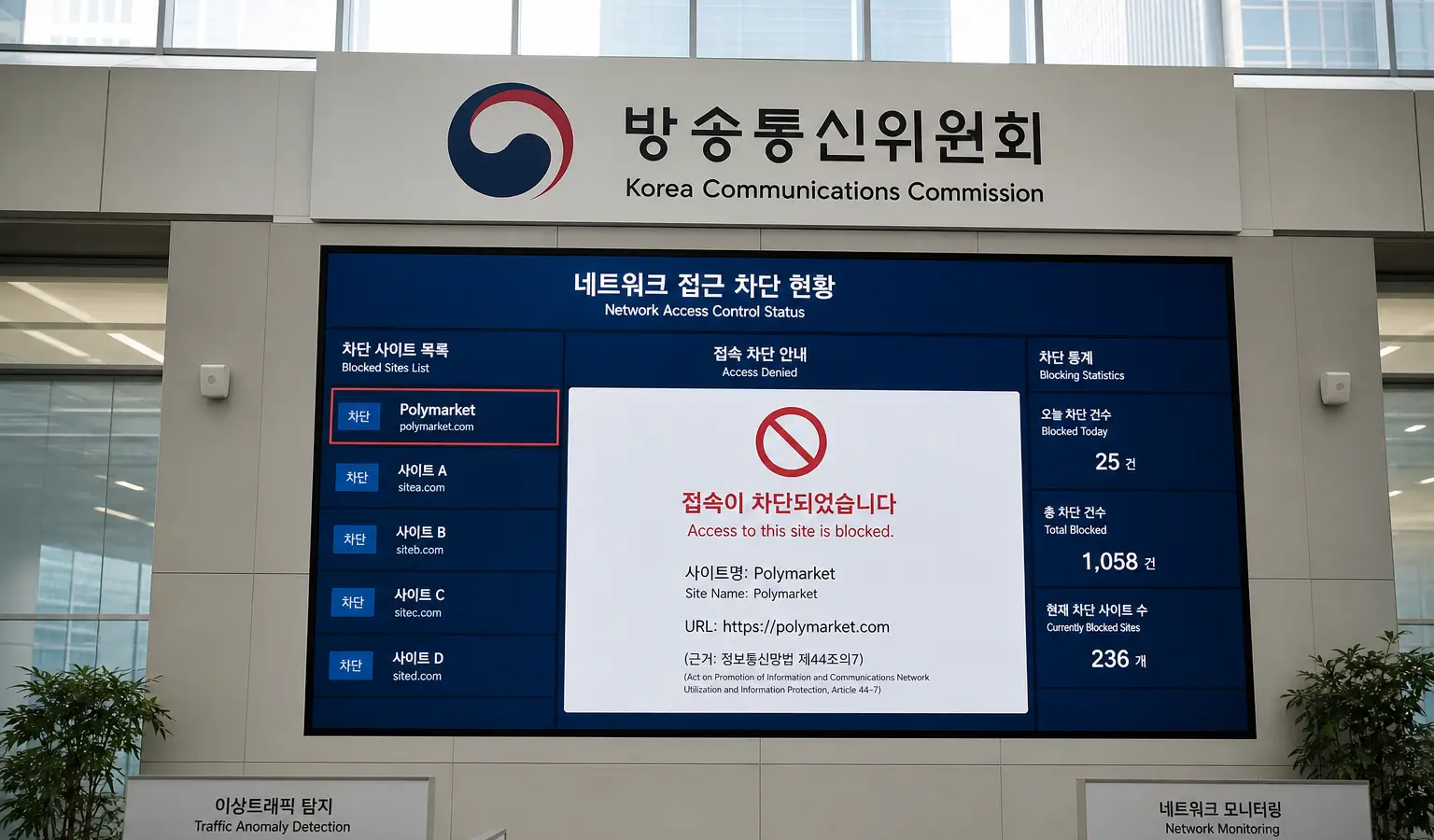
South Korea has blocked domestic access to Polymarket, joining a growing list of more than 30 jurisdictions that restrict the platform. The regulator sees the prediction market as a form of gambling and points to the role of crypto-based settlement and market rules.
Regulator Sees Gambling Structure
The Korea Media and Communications Standards Commission approved the measure after concluding that Polymarket falls under the Criminal Act and similar provisions in the National Sports Promotion Act. According to the commission, the market setup encourages speculative behavior because profits and losses depend on events outside users' control.
Polymarket lets users trade yes-or-no contracts tied to real-world events such as elections, sports, economic data, and the weather. That makes it one of the largest prediction markets, alongside Kalshi. The commission said the operator not only sets the market structure, but also manages trading rules, facilitates crypto deposits and withdrawals, and charges fees for doing so.
Polymarket's Defense Rejected
According to local media, Polymarket said it had removed Korean-language support, does not support payments in won, and uses non-custodial peer-to-peer transactions and smart contracts. The regulator did not accept that argument. The commission also said police and the National Gambling Control Commission asked for a review in July, after which police separately opened an investigation into local users on suspicion of illegal gambling.
The move fits into a broader international crackdown. In the United States, Polymarket previously received a $1.4 million (€1.2 million) fine from the CFTC for running an unregistered derivatives exchange, after which the platform blocked U.S. users. In addition, several countries, including Spain and France, have restricted access to the website.
What This Means for European Crypto Followers
For European crypto followers, this case shows that prediction markets are increasingly being judged not just as a blockchain product, but also as regulated gambling or derivatives activity. That could matter for platforms offering similar contracts, especially now that regulators in multiple countries are asking the same question: does the market fall under crypto infrastructure or gambling law?
According to local media, Polymarket says it has now fully blocked 39 countries, although South Korea is not yet among them. That highlights how quickly access to these platforms can change by jurisdiction, even when the underlying technology runs on smart contracts and crypto settlement.
The debate around Polymarket is not happening in a vacuum. In the United States, the platform is also under scrutiny, including after the banking relationship with JPMorgan was ended in 2025 because of regulatory concerns.