South Korean Crypto Trading Slumps to Two-Year Low
The decline comes as the KOSPI and KOSDAQ weaken and the Financial Services Commission tightens requirements for VASPs and major shareholders.
Key Takeaways
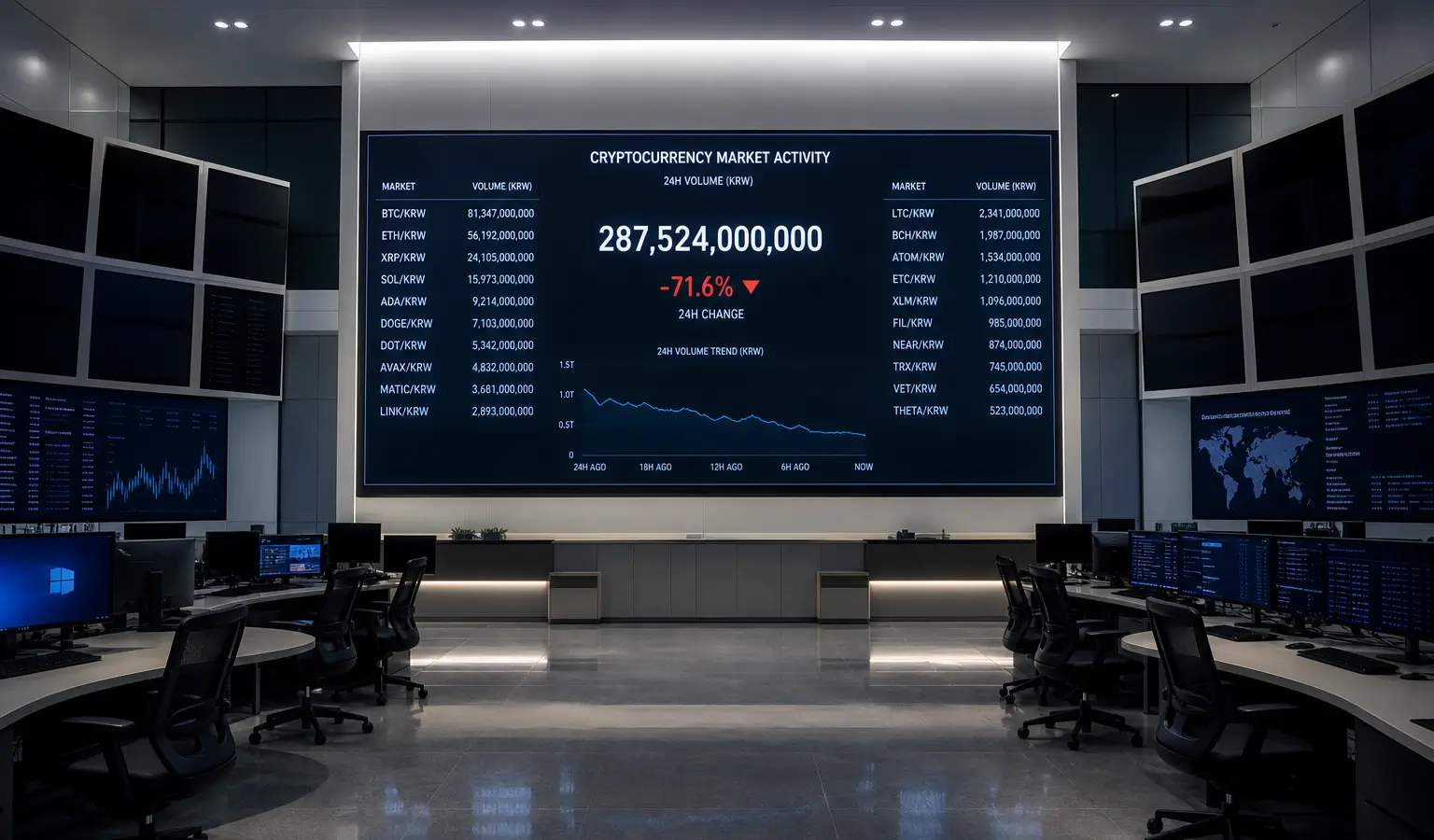
- South Korea's crypto volume fell to its lowest level in two years, with weekly trading volume dropping below 10 trillion won.
- Combined volume on five major fiat crypto exchanges fell 25.75 percent in a week and declined for five straight weeks.
- Stricter rules and a weaker stock market are weighing on risk appetite, especially among retail traders in South Korea.
South Korea's crypto market has dropped to its weakest level in two years. Weekly trading volume slipped below 10 trillion won for the first time since September 2023, as a sharp selloff in local stocks also took a toll on risk appetite.
Volume Falls for Five Weeks Straight
From July 3 to July 10, total volume across the five largest fiat crypto exchanges - Upbit, Bithumb, Coinone, Korbit, and Gopax - reached about 9.97 trillion won, or $6.65 billion (€5.8 billion). That was 25.75 percent lower than the 13.4 trillion won recorded a week earlier and roughly 43.5 percent below early June levels.
Market data shows this was the fifth consecutive weekly decline. The trend suggests trading activity is cooling across the board, especially among South Korean retail traders, who have long been quick to rotate between crypto and other high-risk assets.
Stricter Rules Are Adding Pressure
The slowdown did not happen in a vacuum. In the first quarter of 2026, combined volume had already fallen sharply, and Bithumb alone saw more than a 30 percent drop. Confidence took another hit earlier this year after an operational mistake at Bithumb, which likely made cautious retail investors even more hesitant.
Regulators have also tightened the screws. The Financial Services Commission now requires VASPs to meet strict standards, including real-name bank accounts and information security certificates. Then in March 2026, authorities introduced a 20 percent ownership cap for major shareholders in crypto exchanges such as Upbit and Bithumb. The rule is designed to limit concentration of control, and firms have three years to comply.
Why This Matters
For European crypto readers, the decline is a reminder of how closely South Korea's crypto market moves with its stock market. The KOSDAQ has fallen 31 percent over nine weeks, and the KOSPI has entered technical bear market territory, while AI trading and the heavy weight of Samsung and SK Hynix are adding more volatility. Together, those pressures make South Korea a useful barometer for how quickly retail liquidity can disappear when broader sentiment turns negative.
Analysts do not see the drop as a clean exit from crypto, but more as a change in where activity is going. Some trading may shift to smaller platforms, DEXs, or traditional assets, while thinner liquidity on major exchanges could squeeze spreads and cut into fee revenue. That also fits a wider pattern of large platforms broadening their product lines to keep users active, such as crypto exchanges expanding into stocks and commodities.