Tokenized Cat Bonds Target Insurance Gap After Disasters
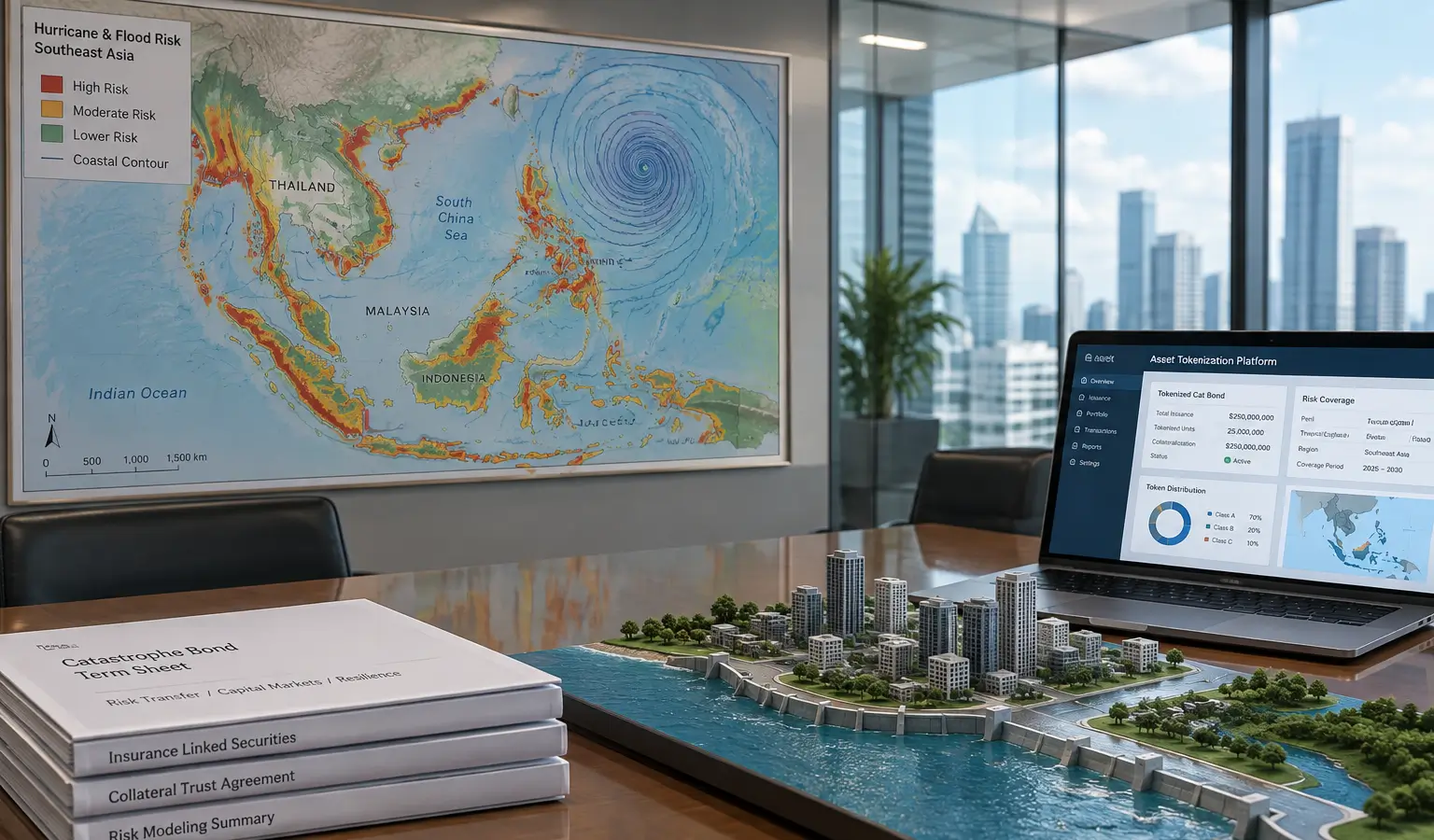
Harneys and dropRWA want to tokenize cat bonds to raise capital for disaster risks such as floods and typhoons in Asia-Pacific. The structure has to comply with securities, insurance, and investor protection rules.
Key Takeaways
- Harneys and dropRWA want to issue tokenized catastrophe bonds early next year for disaster risks that are hard to insure.
- The cat bond market is growing fast, while natural disasters are causing far more damage worldwide than insurers cover.
- Tokenization should make smaller investments possible, but the structure will still be tied to securities, insurance, and investor protection rules.
Harneys and tokenization platform dropRWA want to issue tokenized catastrophe bonds early next year. Each token would represent legal ownership of a cat bond. The companies want to raise capital for disaster risks that are difficult to insure.
The move comes at a time when the cat bond market is already growing strongly. According to Swiss Re, economic losses from natural disasters last year totaled $220 billion (€197 billion), while insurers covered only $107 billion (€95.7 billion) of that. At the same time, $65.6 billion (€58.7 billion) in cat bonds were outstanding in June, and new issuance in the second quarter reached $11.3 billion (€10.1 billion), the highest quarterly figure ever, according to Artemis.
Big Gap in Coverage
A large share of damage remains uninsured, especially in high-risk regions. In Asia-Pacific, 91% of disaster damage was uninsured in 2023, according to the OECD. The organization also pointed out that limited claims data and difficult disaster models make it harder for insurers and reinsurers to price coverage properly, especially in high-risk areas.
Henry Tucker, chief executive of specialist insurance group Hearns, said the tokenized setup does not turn disaster insurance into a normal retail investment. The capital is fully locked in to cover a defined insurance risk. According to him, this is not about betting on someone else’s loss, but about financing a specific risk.
Why Tokenization Matters
The companies are considering a structure that could allow smaller economic interests, even though it would still have to comply with securities, insurance, and investor protection rules. That matters for a market that has traditionally been open mainly to specialist funds and large institutions, with minimum investments often rising to $250,000 (€223,600) or more.
Tucker pointed especially to flood coverage and typhoon protection in Southeast Asia as examples of risks that are hard to place with traditional reinsurers. According to him, a tokenized structure can help raise capital for one clearly defined risk, with preset assumptions and a corresponding return for investors.
Relevance for European Readers
For European crypto and financial readers, this shows how blockchain-like infrastructure is also being used outside the classic crypto market. Here, tokenization is being used for an investment product directly tied to insurance risk, not speculation on a token price. That makes the discussion especially relevant for players looking at new forms of capital formation, regulation, and access to institutional markets.
There is already a practical example of cat bonds in the public sector. The World Bank arranged $200 million in May in hurricane coverage for Jamaica, after an earlier transaction that paid out after Hurricane Melissa in 2025. Jamaica’s finance minister, Fayval Williams, said at the time that cat bonds were an important part of the country’s capital market access for its resilience strategy.