Trump Leaves the Door Open for Bitcoin in Trump Accounts
The tax-advantaged kids' accounts are currently tied to an S&P 500 ETF; Bitcoin would first require new legislation.
Key Takeaways
- Trump suggested that Bitcoin could one day be added to Trump Accounts for kids.
- Current law only allows low-cost U.S. stock index funds, so Bitcoin would likely require new legislation.
- Bitcoin barely moved on Monday and later climbed back above $62,000.
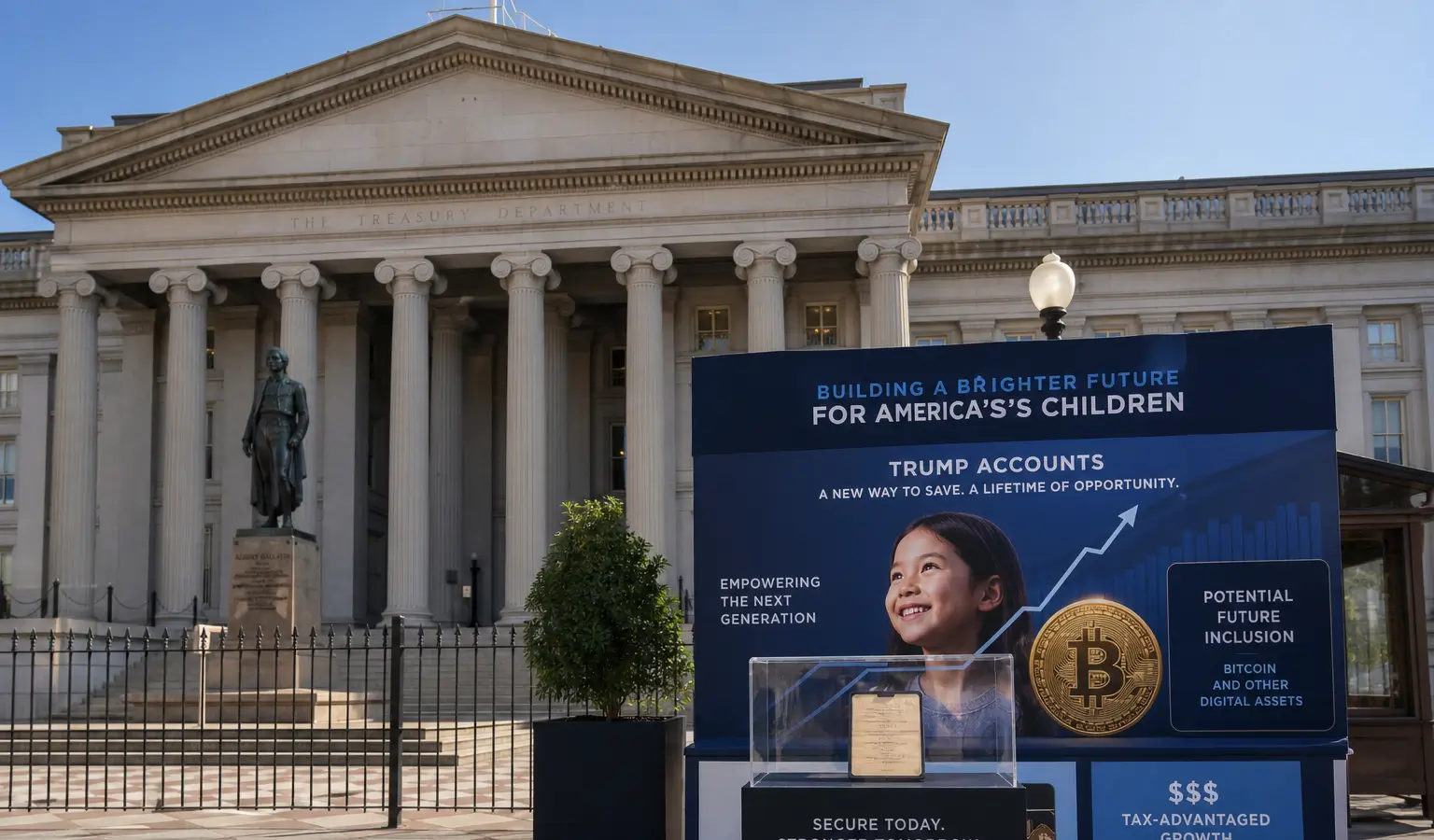
President Donald Trump said Bitcoin could eventually be included in Trump Accounts, the new tax-advantaged savings accounts for children in the U.S. That keeps the possibility of a bigger crypto role alive in a government-backed savings product, even though the current legal framework leaves very little room for it.
Trump Keeps the Option Open
Trump was asked on Monday whether Bitcoin could be part of the program, and he replied that "something could happen." His remarks came at an event tied to the launch of Trump Accounts, only days after the accounts became available nationwide for families.
The accounts went live on July 4 under the One Big Beautiful Bill Act. Children born between 2025 and 2028 receive a one-time Treasury deposit of $1,000 (€876). Parents can also add up to $5,000 (€4,380) a year until the child turns 18.
The Treasury has partnered with Robinhood and BNY on the app and account infrastructure. For now, every contribution is routed into a single default fund, the State Street SPDR Portfolio S&P 500 ETF. The Treasury has also approved just four other index ETFs, and fund switching is not yet available.
The Law Puts the Brakes on Bitcoin
The main constraint is not the rollout rules, but the law itself. Congress specified that only U.S. stock index funds with fees below 0.1 percent can qualify. The Treasury can narrow those rules, but it cannot broaden them on its own.
In practice, that means Bitcoin would probably need new legislation before it could be added to a kids' account. So while Trump's comment matters politically, it is not something that could be implemented right away.
The wider tax backdrop is important too. The IRS classifies digital assets, including Bitcoin, as property for federal income tax purposes. In effect, that puts crypto transactions under capital gains tax rules, much like stocks or real estate. For policymakers, that creates another hurdle, since any move to include Bitcoin in a government program would have to fit within existing tax and reporting requirements.
Why This Matters
For European crypto readers, the bigger takeaway is how quickly Bitcoin is becoming part of the political conversation in the U.S., well beyond spot trading and ETFs. At the same time, the combination of legislation, tax rules, and federal programs shows that institutional adoption is not just about market demand. It also depends on legal limits.
Trump again linked his pro-crypto stance to competition with China. He said he has become "a big crypto guy" because otherwise China would have the edge. He also said he has watched the industry expand and believes capital inflows show Bitcoin still has plenty of upside.
His enthusiasm is not separate from his own financial interests. His latest financial disclosure showed more than $1 billion (€0.9 billion) in income from family crypto activities in 2025. Last week, he also raised questions about Bitcoin's tax treatment while defending that income.
Bitcoin barely reacted to the comments on Monday and later moved back above $62,000 (€54,300) after slipping below that level earlier in the day. Trump has followed through on crypto promises before, but usually not quickly. The Strategic Bitcoin Reserve came only months after his Nashville promise, and opening retirement plans to alternative assets also turned into a lengthy regulatory process.