Yakovenko Slams Robinhood Chain Fees and Congestion Profits
The Solana founder is especially critical of the fee model on the chain running on Arbitrum, where speculative meme coin trading pushed up costs and Arbitrum revenue.
Key Takeaways
- Anatoly Yakovenko criticized Robinhood Chain because, in his view, the platform makes money from network congestion and does not clearly show fees in the app.
- Robinhood Chain went live on July 1, 2026, with average transaction fees around $0.40 and peak daily gas fees of about $3.75 million.
- According to the text, Arbitrum also benefits through a profit-sharing deal, while Solana can process transactions for less than a cent, according to Yakovenko.
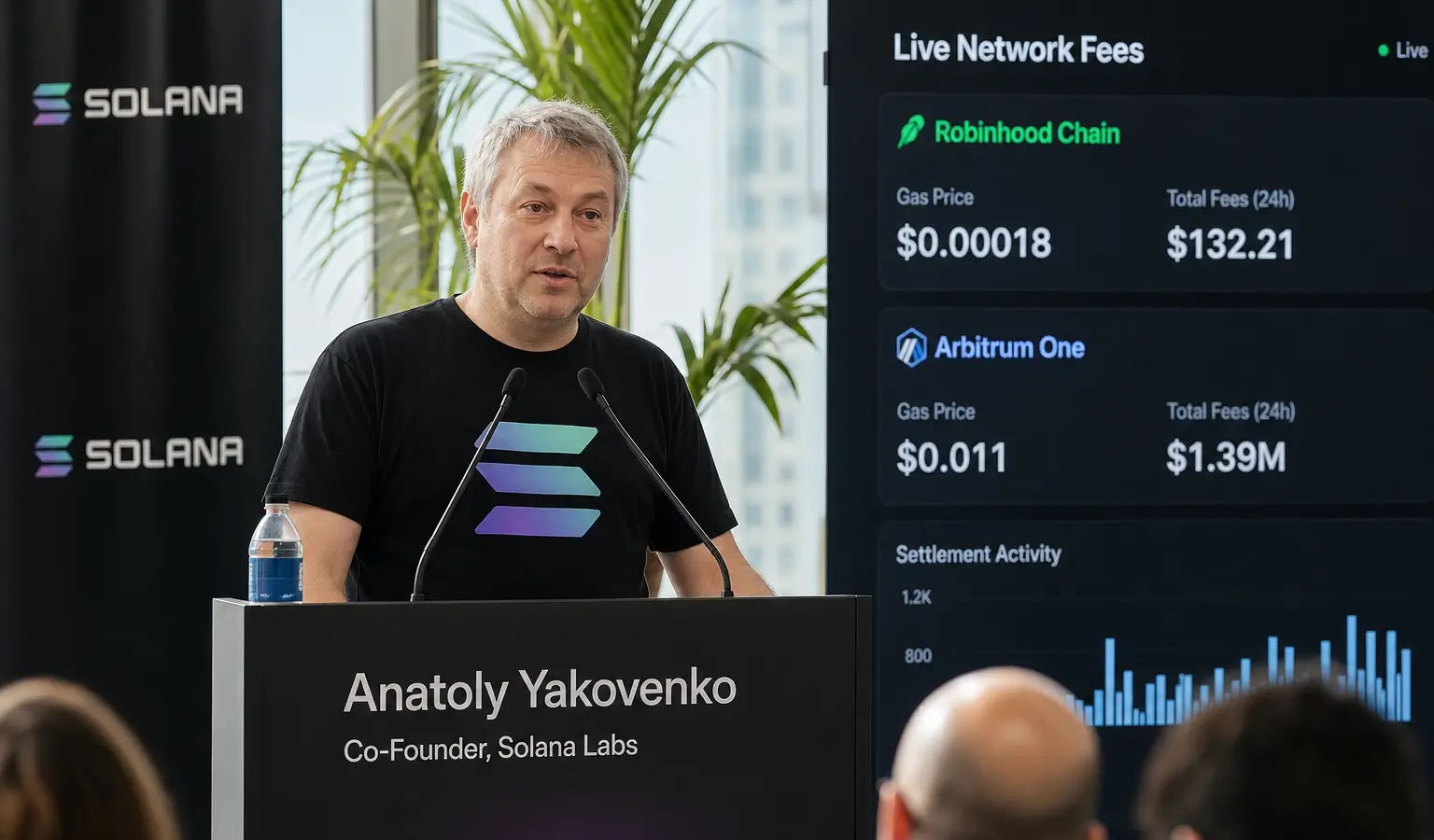
Solana founder Anatoly Yakovenko has come down hard on Robinhood Chain’s fees. In his view, the platform profits from network congestion, while users foot the bill through costs that are not clearly shown in the app. He calls that model basically nonsense, especially since Solana can do the same job for a fraction of a cent, according to him.
Fees Are Rising Fast
Robinhood Chain went live on mainnet on July 1, 2026, and runs on Arbitrum technology, with settlement on Ethereum and Ether as gas. Since then, costs have climbed quickly. Average transaction fees are now around $0.40 (€0.34), while the median fees according to the data are $0.24 (€0.21), putting Robinhood Chain above 26 other chains.
The spike in activity stands out. On September 1, daily gas fees climbed to about $3.75 million (€3.2 million), an increase of roughly 82 times in eleven days. During the same period, the network processed about 10.4 million transactions in a single day. According to the context provided, the higher costs are mainly tied to speculative meme coin trading, with weekly DEX volume at one point topping $1 billion (€0.9 billion).
Arbitrum Benefits Too
Robinhood Chain's fee structure also has consequences for Arbitrum. Under the licensing terms, 10% of net profit goes to Arbitrum, with 8% going to the DAO treasury and 2% to the Developer Guild. In the context provided, about $377,000 (€324,400) went directly into the Arbitrum DAO treasury in a single day.
Yakovenko also pointed out that Solana charges a base fee of 5,000 lamports per signature. With Solana trading around $102 (€88), that still works out to well under a cent per transaction. Solana (SOL) was down 1.64% on the day of the discussion.
Why This Matters
For European crypto readers, this mainly shows how different fee models on chains can play out. Robinhood Chain combines Layer 2 execution with Layer 1 data fees, which means users pay more than on networks where transactions usually stay under a cent. That makes the debate not just technical, but also relevant for anyone watching tokenized trading and the role of fees in the crypto market. Solana's broader push into tokenized markets also comes up in the rapid growth of tokenized equity volume on Solana.
Robinhood Chain is also not the first time an app has switched networks: World left Solana and chose Robinhood Chain earlier for its own tokenized finance app.