Bitcoin Slips After Moonshot AI Breakthrough in Coding
Bitcoin and ether came under pressure after Moonshot AI's Kimi K3 breakthrough, prompting the market to take another look at chips, data centers, and Bitcoin miners.
Key Takeaways
- Bitcoin, ether, and other major cryptocurrencies came under pressure on Friday after Moonshot AI moved to the top of a coding benchmark with Kimi K3.
- Kimi K3 is an open-weight model with 2.8 trillion parameters and a context window of one million tokens, and it ranked first in six of the seven categories.
- Traders worried that cheaper, widely available AI models could weaken Bitcoin miners' role as landlords of data center capacity.
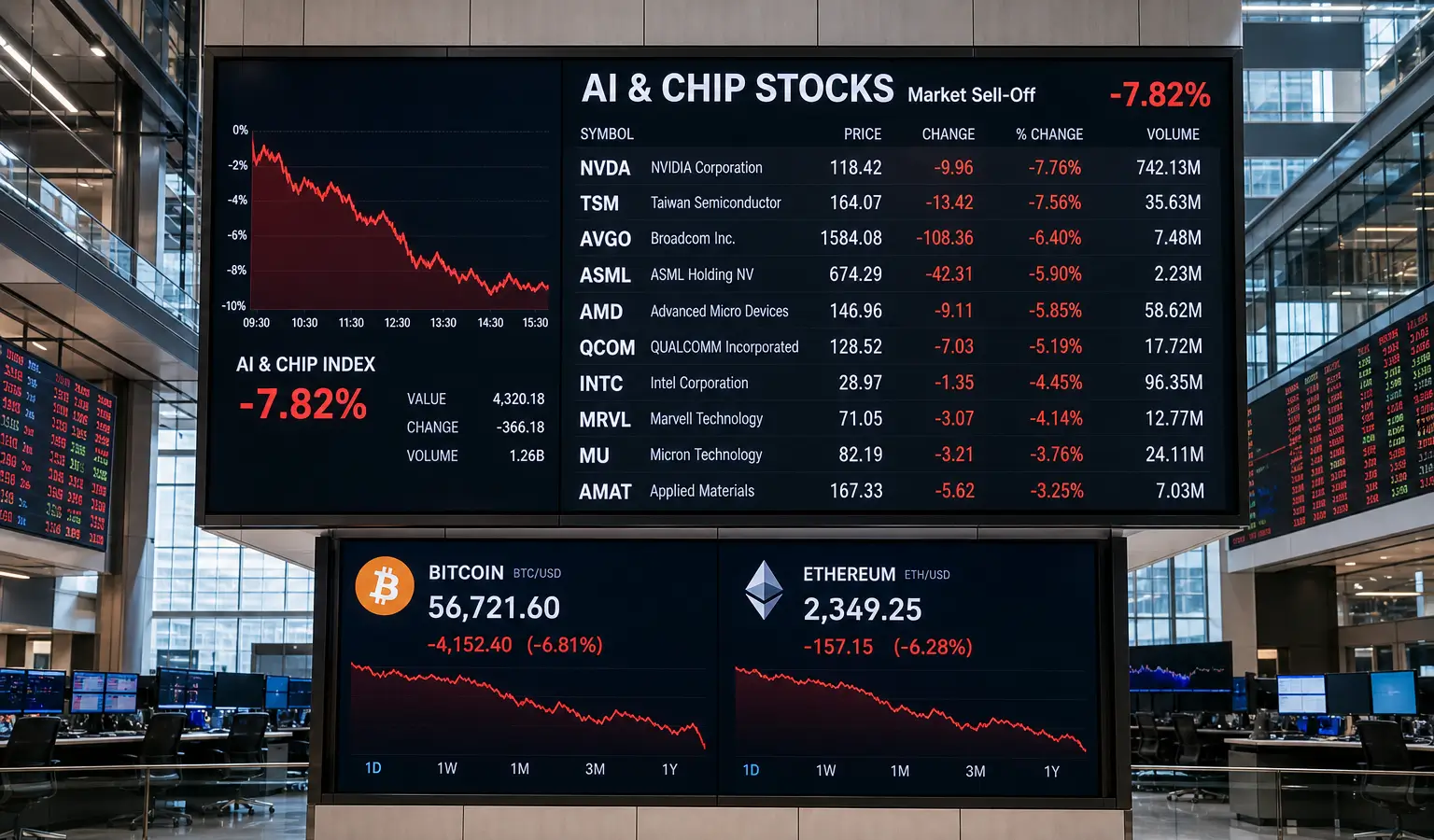
Bitcoin, ether, and the broader crypto market were under pressure on Friday after Moonshot AI in Beijing moved into the lead on a major coding benchmark with Kimi K3. The sell-off came alongside a sharp drop in Asian AI and chip stocks, while traders started talking about a new "Kimi moment" that revived memories of the DeepSeek shock earlier this year.
Kimi K3 Sets the Tone
Moonshot launched Kimi K3 on Thursday. The model has 2.8 trillion parameters and a context window of one million tokens, which is about four times larger than the previous version. Moonshot says it uses a mixture-of-experts setup, with only 16 of the 896 experts active on each task. The company says that helps keep computing costs down and has improved efficiency by about 2.5 times.
On Arena's Frontend Code leaderboard, K3 scored 1,679 points, ahead of Anthropic's Claude Fable 5 at 1,631 and OpenAI's GPT-5.6 at 1,618. That put it first in six of the seven categories. Even so, it is not a model for every use case: in broader tests for general knowledge work, K3 still trails the top Claude and OpenAI setups.
Pressure on Crypto and Chips
The market mostly focused on the licensing side of the story. K3 is open-weight, and the full version is scheduled to be made publicly available on July 27. In practice, that means anyone can download the model and run it on their own hardware without paying licensing fees. For investors, that raises a bigger question in AI: whether frontier computing power will really stay scarce and expensive.
That concern spilled over into crypto on Friday. Bitcoin had already been trading more in step with semiconductors and other AI-related names all week, rather than simply following the usual risk-on or risk-off mood. For European crypto readers, that makes the move more important, since it shows Bitcoin is increasingly tied to the AI capex cycle and not just to classic macro forces.
The market has seen a similar rotation between AI stocks and crypto before. In an analysis of Bitcoin's lagging price action, capital flowing into AI stocks was already highlighted.
What This Means for Miners
There is also a more direct crypto angle underneath the surface. Bitcoin miners have spent the past two years trying to position themselves as landlords of data center capacity for AI companies, betting on long-term demand for training and inference. If open-weight models like Kimi K3 become cheaper and easier to access, that could weaken those miners' leverage and put pressure on the scarcity story.
That does not mean the trend is turning around immediately, but it does mean investors need to rethink how strong the AI narrative really is for some publicly traded Bitcoin companies. For Bitcoin itself, the main takeaway right now is that the coin is moving more and more with developments outside the blockchain, especially when those developments involve chips, data centers, and the wider AI infrastructure.