Bitcoin Holds Steady After Fresh U.S. Strikes on Iran
Bitcoin’s calm stands in sharp contrast to the escalation around the Strait of Hormuz, where oil and LNG shipments are under direct pressure. Monday will show whether the crypto market keeps brushing off the geopolitical tension.
Key Takeaways
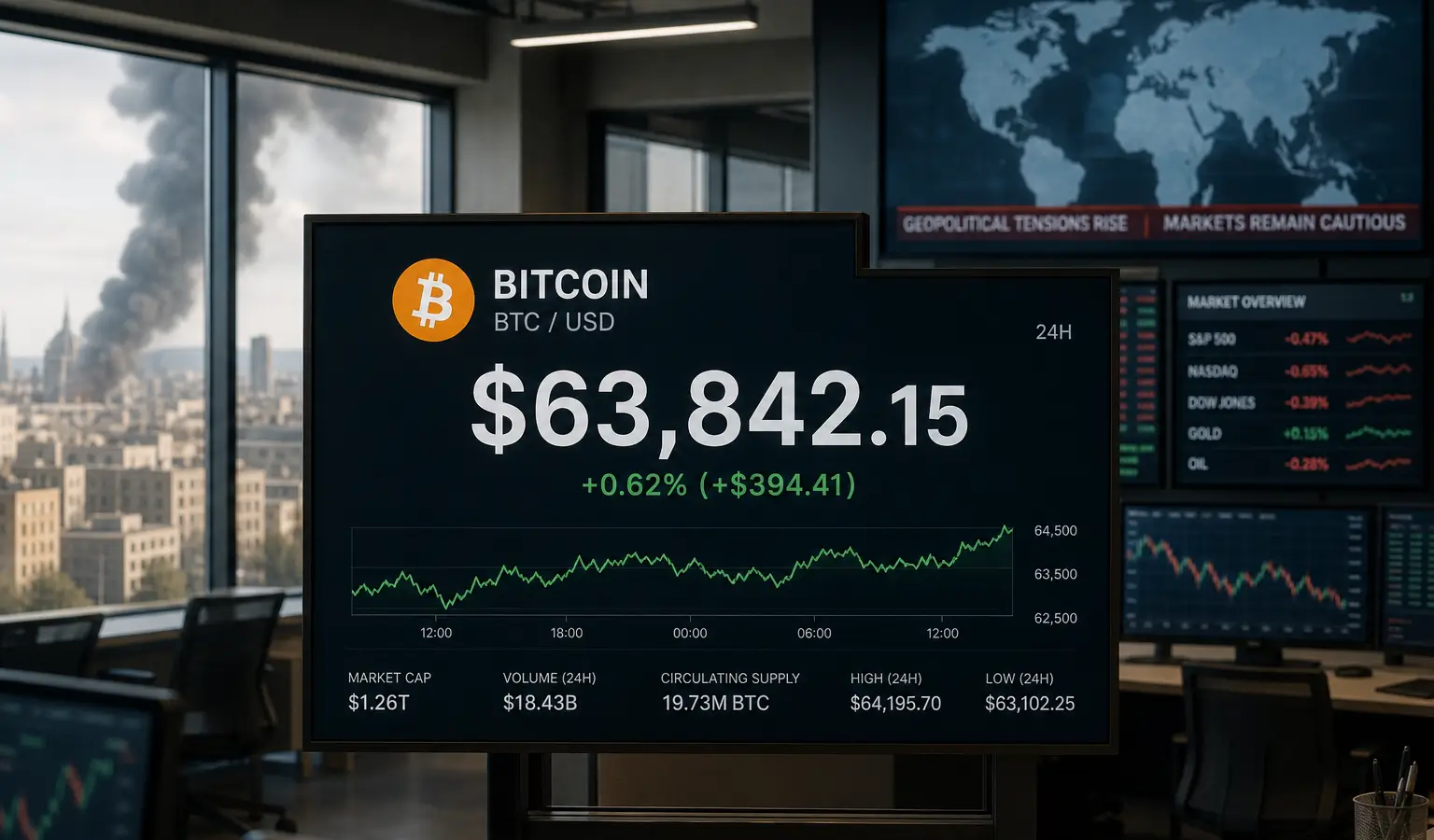
- Bitcoin held near $63,800 on Saturday after fresh U.S. strikes on Iran and another shutdown of the Strait of Hormuz.
- The crypto market barely flinched, with Ether, Solana, XRP, and Dogecoin all posting only modest moves.
- Monday’s market open could matter more, especially if oil trading through Hormuz and Brent’s reaction shape sentiment.
Bitcoin traded around $63,800 (€55,800) on Saturday after the U.S. launched strikes on Iran for the third time this week and Tehran closed the Strait of Hormuz again. The largest crypto asset slipped 0.3% over the past 24 hours and was still up 2% for the week, while the broader crypto market remained unusually steady despite the rising geopolitical risk.
Hormuz Remains the Key
The Strait of Hormuz is one of the world’s most critical energy chokepoints. Roughly 20 million barrels of oil and a major share of liquefied natural gas move through it every day, equal to about 20% of global oil exports and 19% of LNG trade. Any disruption there quickly spills over into oil prices, shipping, and overall market sentiment.
According to vessel-tracking data, some ships were still moving near the strait during Sunday morning hours in Asia, but traffic was clearly lighter than usual. U.S. Central Command said President Trump ordered the strikes after Iranian forces hit a container ship flying the Cypriot flag. Iranian state media reported explosions along the southern coast, including near the energy centers of Bushehr and Asalouyeh and in the port cities of Bandar Abbas and Bandar-e Dayyer.
Crypto Reacts Mildly
Ether showed a similarly muted response and traded near $1,800 (€1,570), also up 2% on the week. Solana was the weakest major coin at $76 (€66), down 5% over the past seven days, while XRP eased to $1.09 (€0.95) and Dogecoin hovered around $0.07 (€0,061). On a day-to-day basis, the biggest coins barely moved, with changes limited to fractions of a percent.
That kind of wait-and-see trading matches what the market has done over the past few months. When Iran first shut the Strait of Hormuz in March, Brent surged above $100 (€87) per barrel and later climbed to nearly $120 (€105), while Bitcoin sold off sharply with each new escalation. The calmer tone now also reflects the weekend setup: oil, stocks, and bonds are closed, leaving Bitcoin as the main major market reacting to the news in real time.
Monday Will Be the Test
For European crypto traders, the real test comes with Monday’s open. Around one-fifth of all oil shipped by sea passes through Hormuz, and the IEA has already released 400 million barrels from emergency reserves during this crisis, the largest move in its history. If Brent opens with a sharp gap higher while Bitcoin stays stable, that will offer a clearer read on how investors are pricing the risk around the strait.