Catastrophe Bonds Go Onchain With a $5,000 Minimum Investment
Harneys and droppRW want to record the legal ownership of catastrophe bonds directly on the blockchain. The first issuance could start in 2027, with Bermuda and regulation as the key test.
Key Takeaways
- Harneys and droppRW are working on a catastrophe bond whose legal ownership will be recorded directly on the blockchain.
- For an initial issuance in early 2027, the minimum investment could drop to $5,000, compared with the usual thresholds of $250,000 or more.
- The project is still waiting for approvals, while the catastrophe bond market has grown strongly in recent years.
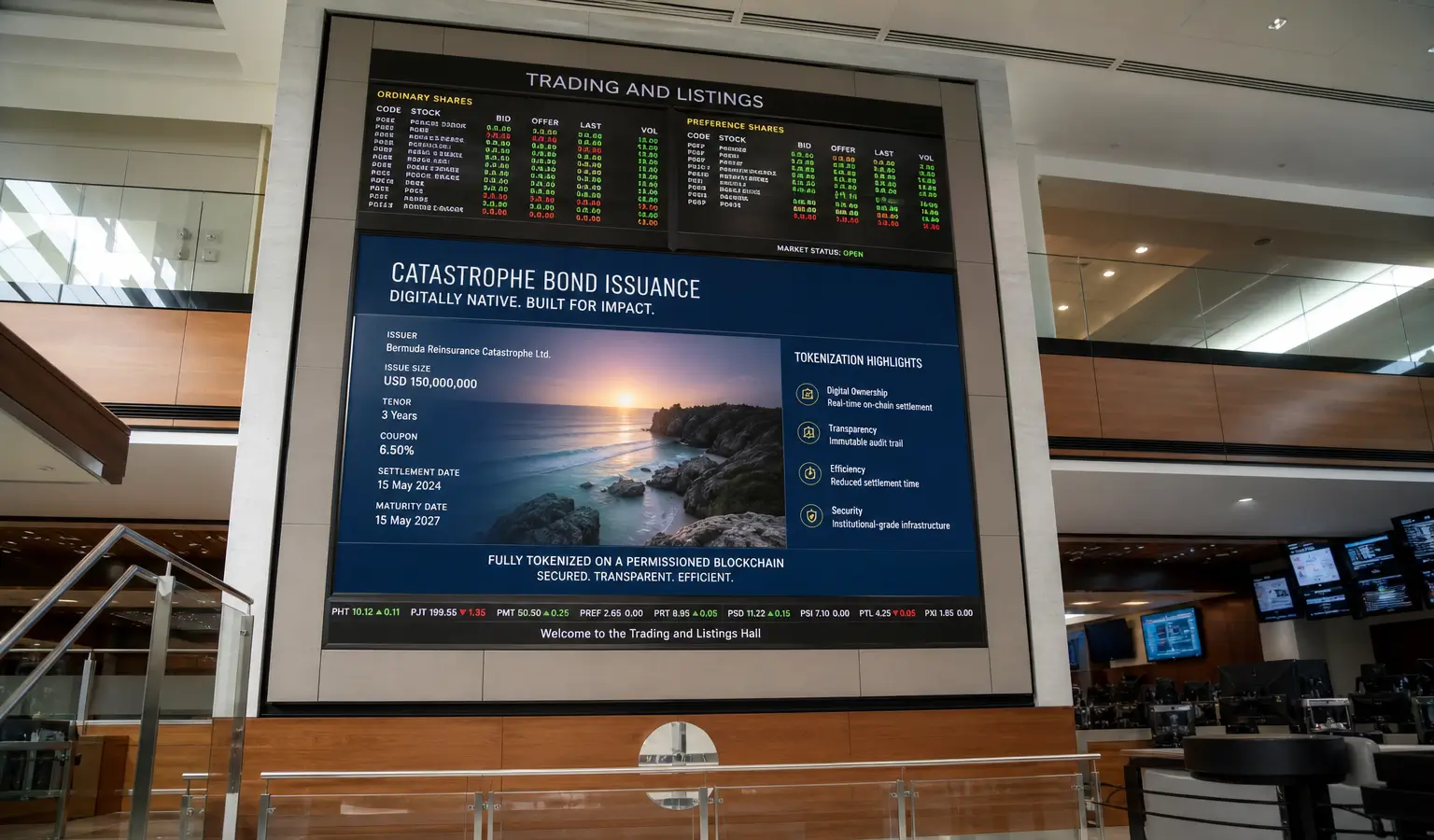
Harneys and droppRW are working on a catastrophe bond whose ownership will be recorded directly on a blockchain. If the plan goes ahead, the first issuance should take place in early 2027 and the minimum investment could fall to $5,000 (€4,320), much lower than the usual threshold of $250,000 (€215,900) or more.
What Makes It Different
Catastrophe bonds are specialized insurance products that pay out after major disasters, such as a hurricane or earthquake. In many tokenization projects, the token only represents an asset that is held offchain elsewhere, but according to the parties involved, that should be different here: the blockchain itself would become the legal ownership register.
Edwin Mata, CEO and co-founder of tokenization company Brickken, said the issue is not whether a catastrophe bond can technically be put on a blockchain. In his view, the key question is whether the blockchain also truly becomes the legal proof of ownership. Only then would transferring the token also mean transferring the legal right.
Mata also stressed that tokenization does not change the underlying catastrophe risks, trigger mechanisms, collateral quality, or valuation. According to him, a live issuance with institutional participation and a legally final settlement would need to prove whether this model works in practice.
Market Is Growing Fast
The timing is notable because the catastrophe bond market has grown quickly in recent years. In the second quarter of 2026, there were already $11.3 billion (€9.8 billion) in new issuance, spread across 48 transactions, according to the provided figures. That followed a record year in 2025, when the market reached $25.6 billion (€22.1 billion) in issuance.
The first half of 2026 also showed that trend, with more than $17 billion (€14.7 billion) in issuance across 64 transactions. The Bermuda Stock Exchange played a major role in that: in 2025, the exchange accounted for 93% of global catastrophe bond issuance, and by the end of the second quarter of 2026, $70.5 billion (€60.9 billion) in catastrophe bonds and insurance-linked securities were listed there.
Why This Matters
For European crypto readers, this is especially interesting because tokenization is increasingly moving beyond the familiar crypto space. If a traditional product like a catastrophe bond can really be issued onchain with legal ownership on the blockchain, it could show how far the market has already come in digitizing investment products. That fits into a broader move in which major financial firms are also bringing stocks and settlement onchain, as long as regulators approve it.
At the same time, the legal and regulatory side still matters most. The project is still waiting for the required approvals, and any platform operator would need a license under Bermuda's Digital Asset Business Act 2018. That makes 2027 mainly a test of whether the legal, settlement, and audit layer of this market can also hold up onchain.