Circle Rises After Earnings Beat and Arc Support
Circle beat profit expectations and kept USDC growing, while Arc is set to launch its public mainnet on September 16 with support from BlackRock, Visa, Mastercard, and other major firms.
Key Takeaways
- Circle rose about 10% in premarket trading after reporting second-quarter earnings that beat expectations.
- Revenue came in at $701 million, just below forecasts, while adjusted profit and EBITDA came in above estimates.
- Arc will launch its public mainnet on September 16 and has backing from major names like BlackRock, Mastercard, Visa, and DTCC.
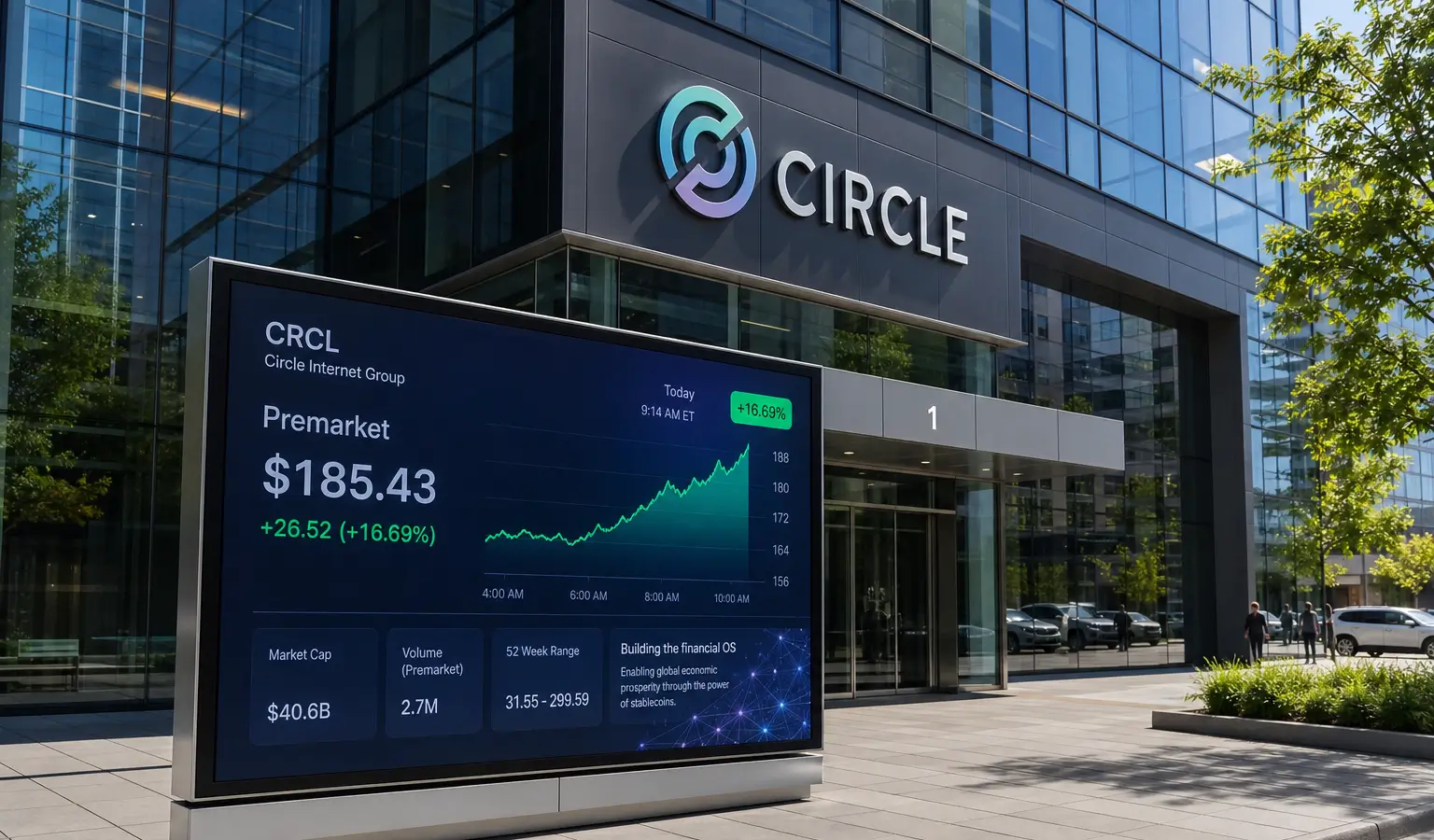
Circle (CRCL) climbed about 10% in Wednesday premarket trading after the stablecoin issuer reported second-quarter results that topped expectations, even though revenue came in a bit light. Investors also got a clearer look at Arc, the company’s new blockchain, which is scheduled to launch its public mainnet on September 16 and already has support from several major financial firms.
Earnings Beat Expectations
Circle posted adjusted earnings of 18 cents per share for the second quarter, beating analysts’ estimate of 16 cents. Revenue and reserve income totaled $701 million (€609 million), up 7% from a year earlier, but slightly below the $712 million (€618 million) Wall Street had expected.
Net income from continuing operations reached $48 million (€41.7 million), ahead of the $43 million (€37.3 million forecast. Adjusted EBITDA increased 8% to $143 million (€124 million). CEO Jeremy Allaire said the results reflect the current interest-rate backdrop and a softer crypto market, but noted that large institutions are still using USDC.
USDC, Circle’s dollar-backed stablecoin, ended June with $73.3 billion (€63.7 billion) in circulation. That was 19% higher than a year earlier, though still below the nearly $80 billion (€69.5 billion) peak reached earlier this year. Onchain transaction volume surged 151% in the quarter to $14.8 trillion (€12.9 trillion).
Wall Street Is Watching Arc
A lot of the focus, however, was on Arc, which now has more than 100 ecosystem and institutional builders working on the network. Its founding validator set includes BlackRock, DTCC, ICE, Mastercard, Visa, Standard Chartered, Galaxy, and MoneyGram. BlackRock plans to bring its BUIDL fund for tokenized U.S. Treasuries onto the network, while DTCC is building infrastructure to tokenize securities it holds in custody.
That fits into a wider trend in which banks and asset managers are turning to blockchain rails for tokenized funds, stablecoin settlement, and collateral management. For institutional users, the appeal is not only faster transfers, but also a setup that better matches existing compliance and settlement workflows. That makes Arc a useful test case for how far traditional finance is willing to go with blockchain infrastructure.
What This Means for European Readers
For European crypto readers, the bigger takeaway is how closely stablecoins and blockchain networks are being woven into traditional financial infrastructure. Circle also recently received approval from the U.S. regulator OCC to launch Circle National Trust, placing the company under federal oversight as a stablecoin issuer with a trust bank charter. It is another sign that regulation and institutional adoption are becoming more tightly connected in crypto.
Competition for that institutional role is also picking up. BlackRock Expands Tokenized Cash With Ethereum Fund shows that major asset managers are already rolling out their own onchain products in the same direction as Circle’s infrastructure.
Circle also said the Circle Payments Network has reached an annualized transaction volume of $14.7 billion (€12.8 billion) over the past 30 days, up 76% from the previous quarter. The number of participating financial institutions now stands at 175, showing that the company’s payments layer is scaling quickly alongside USDC itself.