EU Enforces AI Act: Labels Required for Chatbots and Deepfakes
Chatbots, deepfakes, and AI-generated content now have to be clearly labeled. Crypto companies using AI for support or marketing also fall under the EU rules.
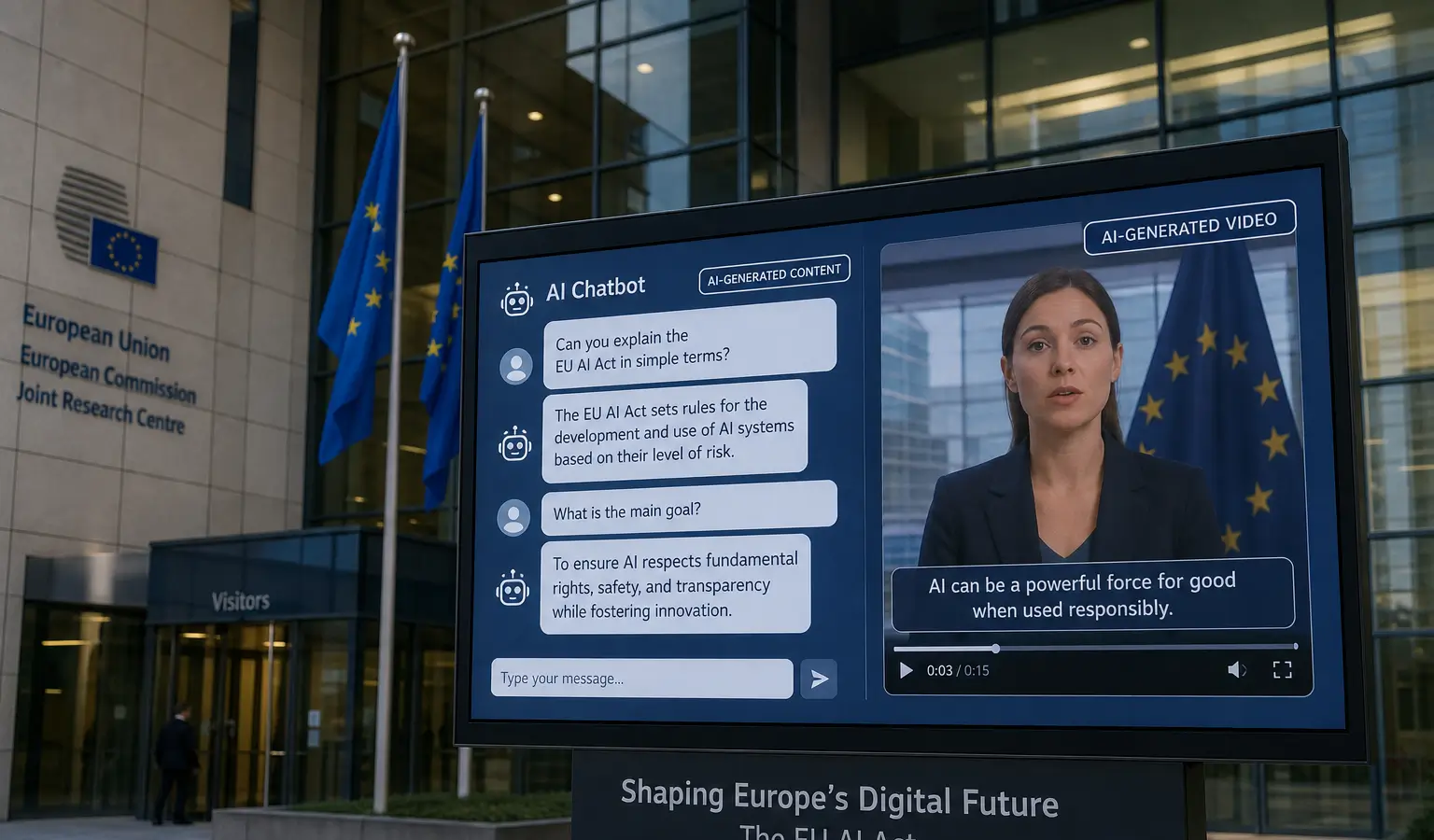
Key Takeaways
- The EU is now enforcing AI Act transparency rules for chatbots, deepfakes, and other manipulated content.
- AI systems that interact with people must make it clear from the first exchange that they are machine-driven.
- Crypto companies using AI for support, marketing, or content creation may be directly covered by the labeling rules.
The European Union has been enforcing the transparency provisions in the AI Act since Sunday. That means chatbots must immediately tell users they are speaking with a machine, while AI-generated deepfakes and other altered content need to be clearly labeled. For crypto companies and token projects that use AI for support, marketing, or content production, the rules could apply directly.
New Rules for AI Systems
The European Commission confirmed that Article 50, the law’s transparency section, took effect on August 2, 2026. AI systems that deal directly with people, including chatbots, voice assistants, and agents, have to disclose that they are machine-based from the very first interaction. The rule applies both to providers and to anyone using the system in the EU, regardless of where the company is headquartered.
The requirements are not limited to conversations. Anyone publishing AI-generated or manipulated images, audio, or video must label that material as artificial. Text intended to inform the public also needs a label, unless a human editor has reviewed it and accepted responsibility for it. In cases involving emotion recognition and biometric categorization, the people affected must also be informed.
Enforcement Gets Real
Until now, the AI Act has largely depended on voluntary compliance, but that phase is over. For the first time, the Commission’s AI Office and national regulators can ask for documents, inspect models directly, order fixes, or pull systems from the EU market. The toughest violations can carry fines of up to €35 million or 7 percent of global annual revenue.
Transparency breaches come with a lower ceiling, but the penalties are still significant at €15 million or 3 percent of global revenue. Generative systems already on the market have until December 2, 2026, to add machine-readable watermarks to synthetic content. Personal, non-professional use is excluded, but once the content is used commercially or professionally, the rules apply.
Why This Matters for Crypto
The new framework could be especially relevant for crypto firms that use AI to talk to customers or promote products. AI trading bots, automated support tools, and marketing videos that include generated images can all fall under the transparency rules. Since the law applies to systems that reach EU users, even a company based outside the bloc could be affected.
The AI Act is also the EU’s first broad AI law to be fully enforced, using a risk-based model that places stricter obligations on systems with greater impact. That makes the European approach more demanding and more uniform than in many other regions, and it matters for crypto companies launching products across several markets at once.