IMF Warns About Risks Around Tokenized Stocks
The IMF sees tokenized U.S. stocks like Tesla and Nvidia mainly as early price signals, but warns that they come with more volatility and less liquidity than traditional exchanges.
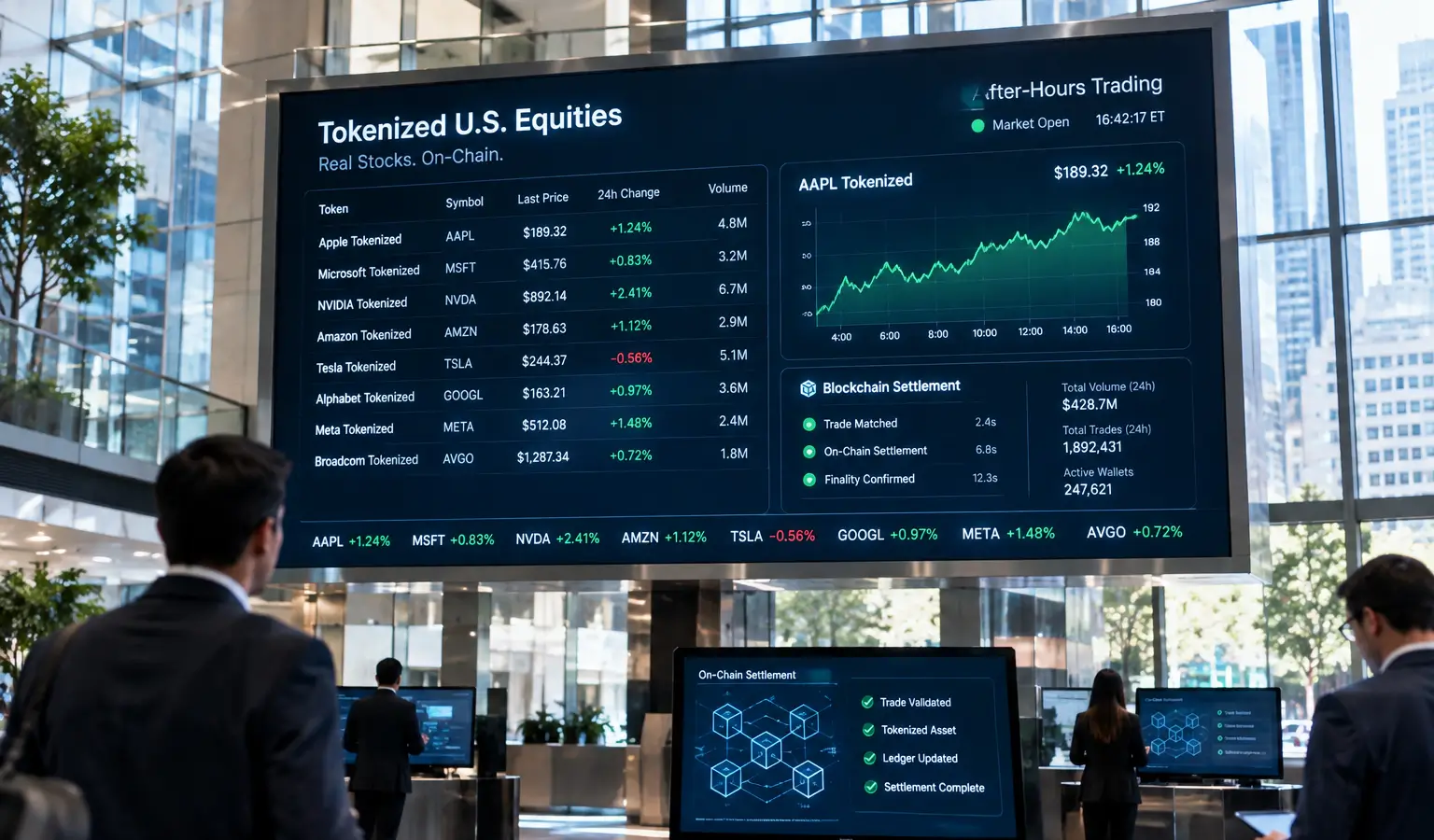
Key Takeaways
- The IMF sees tokenized stocks as attractive because of 24/7 trading and low entry amounts, but points to more volatility and less liquidity.
- More than half of the trading in the tokenized U.S. equities it studied took place outside market hours, and 80% of transactions were smaller than one share.
- The IMF warns that tokenization can lower costs, but legal rules, liquidity safeguards, and settlement arrangements still need to be worked out further first.
Tokenized stocks already offer investors two of crypto’s promises: trading outside market hours and the ability to get in with small amounts. According to the IMF, those benefits also come with clearly more volatility and much less liquidity than regular stocks.
Trading Outside Market Hours
In its latest Global Financial Stability Report, the IMF looked at the five most traded tokenized U.S. equities, including Tesla, Nvidia, and Alphabet, plus a broader benchmark like the Nasdaq 100 Index. More than half of the trading took place outside normal U.S. market hours. About 80% of transactions were smaller than one share, which the IMF says shows that investors mainly value 24/7 access and low entry amounts.
The study also shows that tokenized stocks are not separate from the traditional market. More than 85% of the moves that started overnight in tokenized shares were seen again in regular stocks within five minutes after the U.S. market opened. That makes tokenized trading interesting as an early price signal, but it also highlights how closely the new market is still tied to the old one.
More Volatility Than Regular Stocks
According to the IMF, tokenized stocks were about 1.5 times as volatile as the comparable stocks on traditional venues. At the same time, they were significantly less liquid. The organization sees that as a sign that the market is still small and fragmented, with trading spread across private platforms, public blockchains, custodians, and settlement tools that do not always connect well with each other.
That fragmentation also matters for European crypto followers, because tokenized stocks are showing up more often on crypto exchanges and new trading platforms. The SEC has now approved a temporary, conditional exemption for limited trading in tokenized stocks on so-called Tokenized Securities Venues, while the NYSE, under owner Intercontinental Exchange, is working on a platform for 24/7 trading in tokenized stocks and ETFs. That shows the debate is no longer just about crypto, but also about how far traditional markets want to let blockchain infrastructure in.
The recent SEC move on tokenized stocks on blockchain also fits into that trend: regulators are looking for a framework where real stock rights and onchain trading line up better.
Why This Matters Now
The IMF warns that tokenization can save costs and time, for example by automating dividend payments and collateral transfers. But the fund also points to another risk: if 24-hour trading, automatic margin calls, and fast liquidations come together, a shock could be harder to control. According to the IMF, legal rules, liquidity safeguards, and settlement arrangements therefore need to be worked out further before the market gets much bigger.