IMF Warns Tokenization Could Speed Markets, But Raise Shock Risk
The IMF says tokenized assets and stablecoins could speed up settlement, but warns that fewer buffers may also increase shocks and cyber risk.
Key Takeaways
- Tokenization can make financial markets faster and cheaper because settlement, ownership transfers, and payments can happen in seconds.
- The IMF warns that traditional buffers disappear, which could let shocks, errors, and automated selling spread through the system faster.
- According to the IMF, cross-border tokenized finance creates legal uncertainty around applicable law, settlement finality, and crisis intervention.
Tokenization could make financial markets faster and cheaper, but the International Monetary Fund (IMF) says it may also leave them more exposed to sudden shocks. In a blog post, Tobias Adrian, the IMF’s head of monetary policy and capital markets, said many of the frictions built into traditional finance would disappear, along with some of the safeguards that help slow problems down.
Faster Settlement
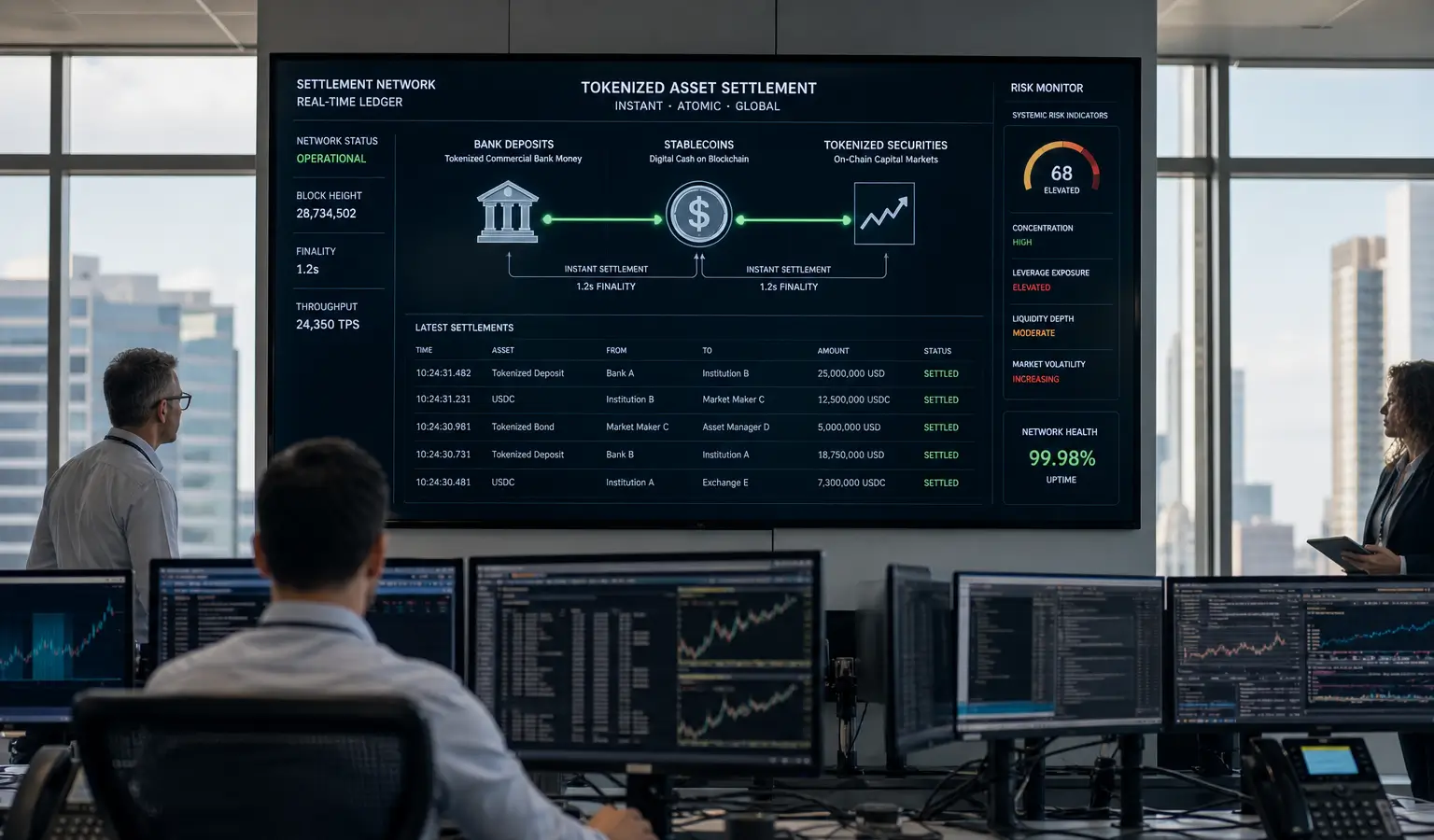
Tokenization moves assets such as stocks, bonds, and bank deposits into a blockchain environment. From there, smart contracts can manage trading, transfer ownership, and settle payments on a single shared ledger. In traditional finance, transactions can still take days because clearing, settlement, and reconciliation happen across multiple parties. With tokenized assets, those same steps can happen in seconds.
Adrian also said tokenization could bring different forms of digital money closer together. Tokenized bank deposits, fiat-backed stablecoins, and tokenized central bank reserves could all serve as settlement assets on the same ledger. In addition, high-quality assets could move more quickly as collateral across several platforms.
Fewer Buffers, More Risk
That efficiency is also where the IMF sees the downside. In traditional markets, delays give banks, regulators, and risk managers time to catch problems before they spread. If those buffers are removed, a market shock, a coding mistake, or a sudden burst of automated selling could ripple through the system faster than institutions can react.
Adrian warned that liquidity demands could emerge in real time, margin calls could be automated, and failures could spread more quickly. He also noted that web3-style infrastructure could push more activity onto fewer, larger platforms, making an outage or governance error potentially systemwide. Cyber risk rises as well when more transactions are concentrated on shared ledgers.
Why This Matters for Europe
For European crypto and financial markets, the regulatory question is especially important. The IMF says tokenized finance often spans several jurisdictions, which makes it harder to pin down which law applies, how settlement finality is recognized in court, and who has the authority to intervene during a crisis. Without that clarity, Adrian said tokenization is likely to remain fragmented and confined to the margins of the financial system.
The same debate is also unfolding in the U.S., where regulators and market participants are still trying to build a workable framework for tokenized securities. The industry is already testing new models for tokenized funds and stocks in a SEC-aligned custodial model, while the bigger question is how far existing rules can realistically stretch.