South Korean Crypto Market Shrinks and Ages Fast
The decline is hitting not just volumes and revenue, but also the makeup of the market: people in their 40s now dominate, and regulators are rolling out stricter AML rules.
Key Takeaways
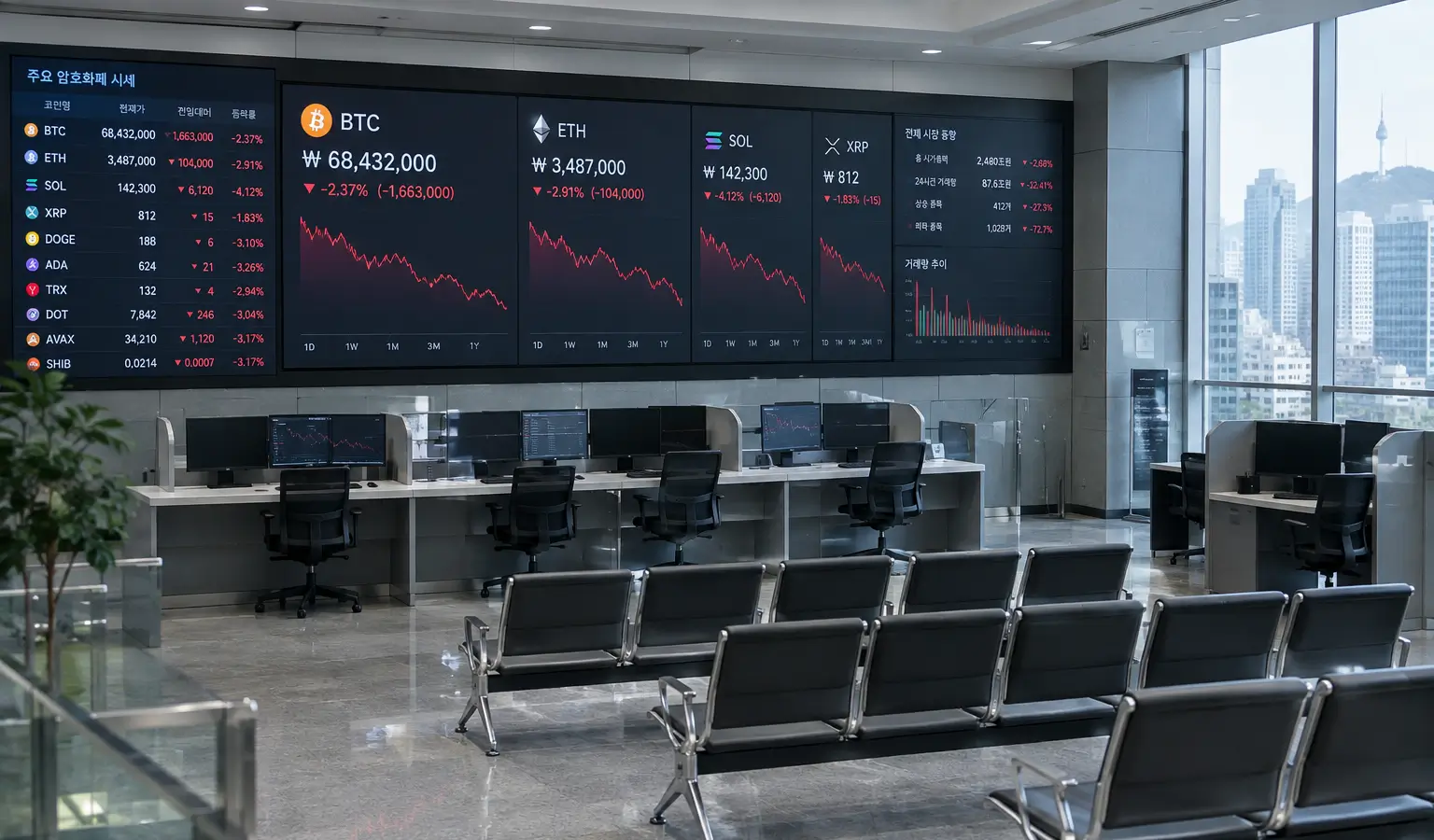
- South Korea's crypto market shrank in the first half of 2026: the value on domestic exchanges fell 33% and daily trading volume dropped 44%.
- The market aged further, with users in their 40s now the biggest group and only a slight increase in the total number of trading accounts.
- Exchanges saw revenue fall 41%, while South Korea also introduced stricter AML rules for crypto transactions above 10 million won.
South Korea's crypto market became smaller, quieter, and older in the first half of 2026. According to a semiannual survey by the Korea Financial Intelligence Unit and the Financial Supervisory Service, the value of crypto on domestic exchanges fell 33%, while daily trading volume dropped 44%.
Market Shrinks Sharply
The market value of crypto on South Korean exchanges came to 58.9 trillion won, 28.3 trillion won less than in the second half of 2025. Won deposits on exchanges also fell 35% to 5.2 trillion won. That suggests there was less money sitting on the platforms and less trading activity too.
Price swings stayed big in the meantime. Crypto assets on the exchanges surveyed showed a maximum drawdown of 69%, lower than the 73% in the second half of 2025, but still higher than the 55.1% seen in the KOSPI and the 31.8% in the KOSDAQ.
Older Users Dominate
The age breakdown of the market shifted further. Users in their 40s now make up the largest group, while accounts holding less than 1 million won rose 4% to 8.63 million. The total number of accounts allowed to trade increased only 0.4% to 11.175 million.
The numbers also show that exchanges earned less from that activity. Revenue on domestic platforms fell 41% and combined operating profit dropped 78% to 81.6 billion won. The survey looked at 26 registered virtual asset service providers.
Stricter Rules and Risks
The data fit into a broader shift in South Korea. Earlier this year, the value of crypto held by South Korean investors had already fallen sharply, while the KOSPI rose strongly. That suggests some capital moved into stocks.
For European readers, the key point is that South Korea is also tightening rules further. In August, stricter AML measures took effect, with automatic alerts for crypto transactions above 10 million won through foreign exchanges or private wallets. Regulators also warned about small tokens listed on only one exchange, saying they can carry extra liquidity risk and extreme volatility. That mix of weaker volumes and tighter enforcement fits the broader market pullback, as also seen in the earlier drop in South Korean trading volumes.